

A power fluctuation lasting only seconds can put an entire semiconductor production batch at risk. Preventing power-related downtime in manufacturing means reducing the likelihood that electrical disturbances interrupt production and limiting their impact when they do. Manufacturing downtime is any period when a scheduled production process stops generating output, whether because of a power problem, equipment failure, or another disruption.
If you’re responsible for keeping production moving, you know a stoppage can affect far more than the machine where it starts. This article explains how power problems trigger unplanned downtime and outlines practical ways to reduce the risk. It also shows what manufacturing downtime examples can teach about spotting vulnerabilities, planning for interruptions, and preparing for a controlled recovery.
Key Takeaways
- Distinguish scheduled maintenance and changeovers from unexpected stoppages to identify where prevention can make the biggest difference.
- Assess downtime beyond lost output: interruptions can also drive repair, overtime, material, and delivery costs.
- Look for the underlying cause in case studies; restarting a line with a temporary fix can leave the same failure ready to recur.
- Learn when a UPS or Harmonic Analysis may help address power-related risks to production.
What Actually Causes Unplanned Downtime?
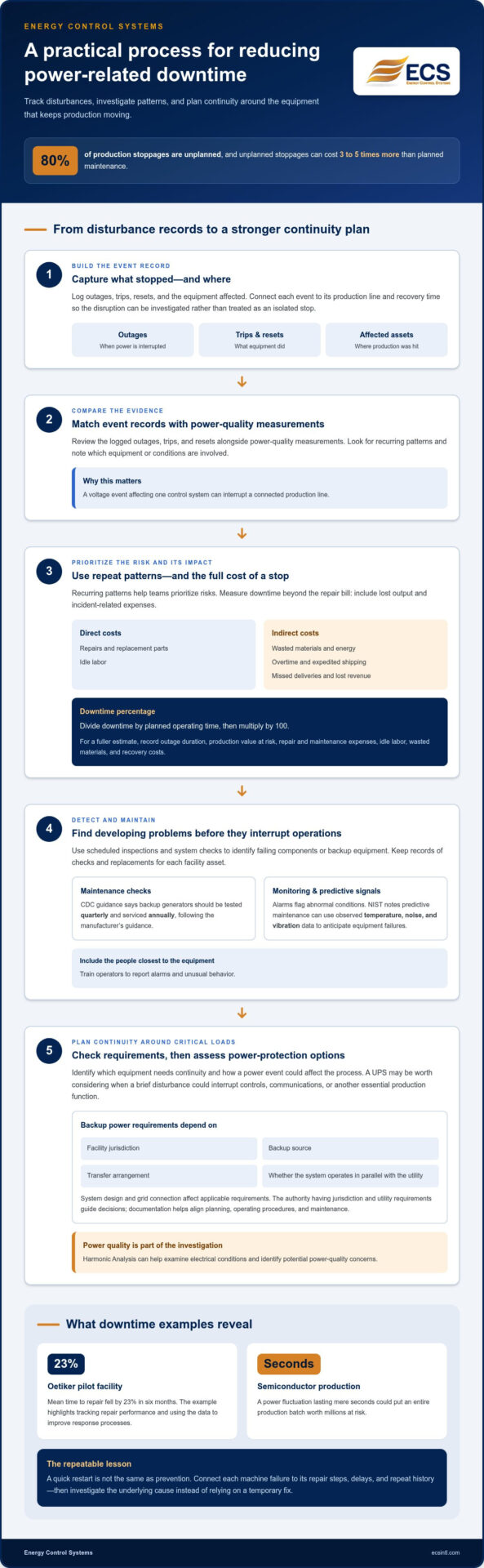
Planned downtime is scheduled for maintenance or changeovers; unplanned downtime starts unexpectedly with failures, shortages, or power disruptions. Unplanned stoppages account for approximately 80% of production stoppages and can cost 3 to 5 times more than planned maintenance.
Electrical Reliability Risk Assessment
Electrical reliability risk assessment looks at power quality, vulnerable equipment, and past disturbances. It matters because a voltage event affecting one control system can interrupt a connected production line. Start by logging outages, trips, resets, and affected equipment, then compare those records with power-quality measurements. Recurring patterns can help you prioritize risks. Preventing power-related downtime in manufacturing begins with understanding where disturbances affect production.
Maintenance and Early Power-Problem Detection
Preventive maintenance uses scheduled inspections and system checks to find developing electrical problems before they interrupt operations. It matters because failing components or backup equipment can cause unexpected stoppages. Record checks and replacement activity for each facility asset. Centers for Disease Control and Prevention (CDC) guidance says backup generators should be tested quarterly and serviced annually, following the manufacturer’s guidance. Monitoring and alarms flag abnormal conditions, while National Institute of Standards and Technology (NIST) notes predictive maintenance can use observed temperature, noise, and vibration data to anticipate equipment failures. Train operators to report alarms and unusual behavior. These practices support preventing power-related downtime in manufacturing.
Backup Power Requirements
Backup power requirements are the electrical, fire, building, and utility rules that apply to a facility’s system. System design and grid connection affect which requirements apply. In the United States, identify them based on the facility’s jurisdiction, backup source, transfer arrangement, and whether the system operates in parallel with the utility. The authority having jurisdiction and utility requirements guide those decisions. Documenting applicable requirements helps align planning, operating procedures, and maintenance.
What Is Downtime in Manufacturing?
Manufacturing downtime is any period when a scheduled production process stops generating output.
Direct and Indirect Costs
Direct costs are immediate expenses caused by failures, such as repairs, replacement parts, and idle labor. Indirect costs can include wasted raw materials and energy, overtime, expedited shipping, and missed deliveries. Separating these costs matters because the repair bill alone can hide the broader cost of downtime. For example, a stopped line may leave work in process unusable while other operations wait for its output.
Lost Revenue and Downstream Effects
Lost revenue reflects production that cannot be completed or sold during an outage, while downstream effects can disrupt schedules and affect customers. A delay at one facility can create supply-chain bottlenecks, postpone deliveries, and put orders at risk. Restarts can also affect quality if inspection and process-control checks are skipped.
Calculating Downtime Costs
Downtime costing combines lost output with incident-related expenses, helping teams choose where preventive action can minimize repeat losses. Calculate downtime percentage by dividing downtime by planned operating time, then multiplying by 100. For a fuller cost estimate, record the outage duration, production value at risk, repair and maintenance expenses, idle labor, wasted materials, and recovery costs such as overtime or expedited shipping. Use monitoring records to connect each event with its affected line and recovery time. Facilities assessing continuity measures can explore power protection options.
Manufacturing downtime case studies
Examples of downtime show why recovering quickly isn’t enough: prevention also depends on identifying root causes and changing the conditions behind repeat stops. Compare each example’s production impact, response, and lesson before applying strategies at your facility. Maintenance schedules, equipment failures, and timely detection can all affect how long operations remain interrupted.
At Oetiker’s pilot facility, mean time to repair fell 23% in six months. That result highlights the value of tracking repair performance and using the data to improve response processes. For your team, connect each machine failure to its repair steps, delays, and repeat history. This helps develop targeted changes instead of relying on temporary fixes that restart production without addressing the underlying issue.
This is an example, not a universal industry rate. The lesson is to translate downtime into the output your own schedules and products put at risk.
Power disruptions demand similar attention. A semiconductor fabrication facility might lose an entire production batch worth millions after a power fluctuation lasting mere seconds. Sensors and predictive maintenance can help reveal developing equipment failures, while outage records can show whether events cluster around particular machines or conditions. Use those patterns to investigate causes and strengthen prevention, rather than treating every unexpected stop as an isolated event. Explore power-protection options as part of your resilience planning.
Energy Control Systems: Uninterruptible Power Supplies (UPS)
Energy Control Systems offers Uninterruptible Power Supplies (UPS) for manufacturers assessing how to protect critical loads from power interruptions. A UPS may be worth considering when even a brief disturbance could interrupt controls, communications, or another essential production function. Start by identifying which equipment needs continuity and how a power event could affect the process.
Power quality problems can also contribute to equipment disruptions. Energy Control Systems’ Harmonic Analysis helps manufacturers examine electrical conditions and identify potential power-quality concerns. These offerings can support facilities assessing power-related risks, alongside maintenance planning, monitoring, and a broader continuity strategy.
To discuss power protection for your manufacturing operation, contact Energy Control Systems.
Build a More Resilient Production Plan
The next step is to turn reliability concerns into a clear power-protection plan. Identify which production assets are most sensitive to electrical disturbances, what happens when they stop, and which power-related risks deserve attention first. This focused approach to preventing power-related downtime in manufacturing can help your team make informed decisions and align priorities across operations and maintenance.
Energy Control Systems offers Uninterruptible Power Supplies (UPS), Harmonic Analysis, and advanced transient surge suppression solutions. These options can inform your assessment of facility power needs and resilience goals. Start the conversation with your operational priorities, rather than assumptions about what every plant requires.
Contact Energy Control Systems to discuss power protection for your manufacturing facility. A thoughtful plan can help your team move forward with greater clarity and confidence.
Frequently Asked Questions
How Does Downtime Affect Production Quality?
Downtime can disrupt stable process conditions, so products made after a restart may need closer inspection. For example, operators on a temperature-sensitive line may need to confirm settings before releasing restarted work. Identify material already in process, mark its production window, and review it against quality records. This helps teams isolate potentially affected batches instead of treating all output as equally at risk.
How Do You Measure Downtime Before You Can Reduce It?
Record each stop consistently, including its start, restart, affected machine, production line, and coded cause. Separate time spent waiting for diagnosis, parts, approval, and restart checks, since each stage can reveal a different improvement opportunity. For example, repeated delays while teams locate a fault may point to a need for clearer escalation ownership. Use the same definitions across shifts so performance comparisons remain meaningful.
What are the most common causes of power-related downtime in manufacturing plants?
Common causes include utility outages and electrical disturbances such as voltage sags, surges, transients, and harmonic distortion. Internal switching or changes in connected loads can also affect sensitive controls, drives, and automation equipment. A brief disturbance without a complete outage can still reset a controller and stop a process. Comparing event records with equipment behavior can help narrow down the source.
What backup power options are best for manufacturing facilities: generators, UPS systems, or battery storage?
How should manufacturers size backup power systems for critical equipment and production lines?
Start by listing the critical loads, their operating demand, and any startup surges from motors or other equipment. Then determine how long each load must remain supported and whether loads need to start simultaneously. Include the connected controls and support systems required for safe, orderly operation. These details help align system capacity with actual production priorities rather than the facility’s total connected load.

Article by
Jeff Edwards
Founder of ECS International Inc. Edwards travels and speaks extensively in Latin America, Asia and Africa on the subject of power quality; transients and mitigating their impact on profitability. After graduating from Texas Tech University in Lubbock Texas, Edwards spent 9 years in the Telecommunications sector prior to founding Energy Control Systems in 1987 as a Texas based corporation selling surge suppression and UPS systems. The company has evolved into a global power quality products and energy efficiency concern with operations spanning South America, Asia, Europe and Africa.
Disclaimer
Some of the above information may be the opinion of the author.