

What if the UPS at your remote site isn’t addressing the power problem most likely to disrupt your servers? At lightly staffed edge locations, outages, voltage fluctuations, and surges can threaten uptime while equipment issues go unnoticed. Choosing power protection for edge computing servers starts with understanding the conditions at each site, not assuming one device can cover every risk.
Surge protection and a UPS serve different roles, and the right approach depends on the site’s electrical conditions and how much downtime your operation can tolerate. This guide explains the power risks edge servers may face and how to match protection to site conditions and uptime needs. You’ll also learn what to assess and monitor before specifying equipment, so decisions are based on evidence rather than guesswork.
Key Takeaways
- Identify whether a site faces surges, sustained voltage variation, outages, or harmonic distortion before choosing protection.
- Plan power protection for edge computing servers in layers, matching surge protection, UPS support, and power-quality investigation to their distinct roles.
- Start with critical loads, site power conditions, and uptime needs, then validate equipment selection for the specific application.
- Account for remote access, maintenance capacity, environmental conditions, and downtime consequences when planning protection across distributed sites.
Power protection for edge computing servers: identify the risks first
Edge computing servers process or store data close to where it’s created, rather than relying solely on a centralized data center. Whether procured through IT hardware and networking specialists like GenX Systems LLC or standard enterprise channels, they may be installed in a factory, retail location, telecom facility, or other remote site. Utility conditions, nearby electrical loads, and the level of on-site support can vary from one location to another. A protection plan that fits one site may not address another’s risks.
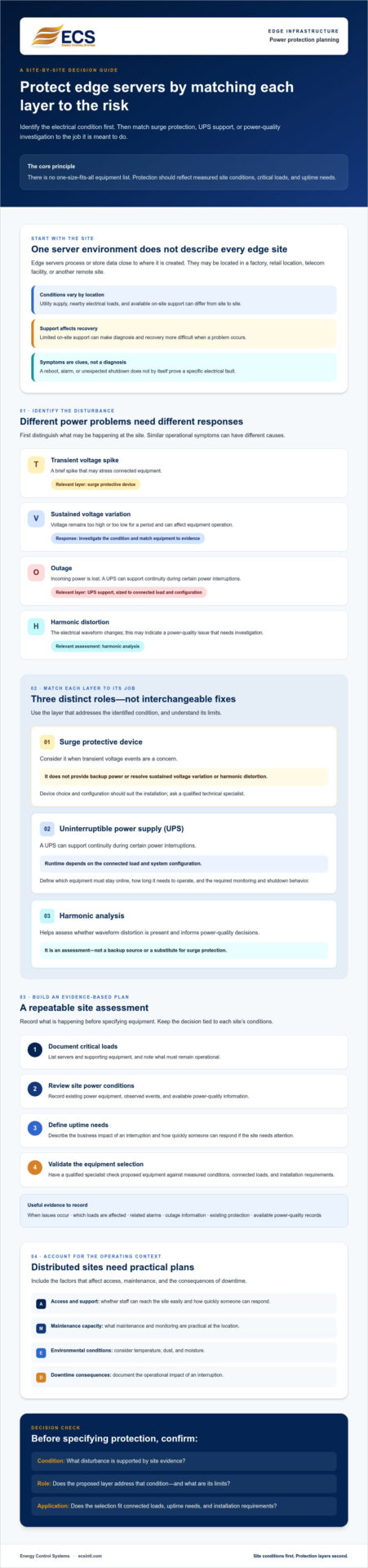
Power protection is a coordinated response to identified electrical risks, matched to the equipment, site conditions, and uptime needs. First, distinguish the type of disturbance. A transient is a brief voltage spike, which a surge protector is designed to address. Sustained voltage variation means voltage remains too high or too low for a period. An outage is a loss of supply. Harmonic distortion changes the electrical waveform and may indicate a power-quality issue that needs investigation.
Which power disturbances can interrupt an edge site?
The cause and operational effect differ. A transient may stress connected equipment; sustained voltage variation can affect its operation; an outage removes incoming power; and distortion may point to a power-quality issue worth investigating. Exposure depends on local conditions, including the utility supply and nearby equipment. Limited on-site support can also make diagnosis and recovery more difficult.
Don’t treat a reboot, alarm, or unexpected shutdown as proof of a specific electrical fault. Similar symptoms can have different causes. Record when issues occur, which loads are affected, and any related alarms or outage information. Then investigate site power conditions before choosing equipment. Harmonic analysis, for example, can help assess whether distortion is present. This evidence provides a firmer basis for planning power protection for edge computing servers.
Choose edge-server power protection by matching each layer to its job
Each protection layer answers a different question. Match the equipment to the disturbance you’ve identified rather than expecting one device to solve unrelated power problems.
- Surge protective devices: Consider these when transient voltage events are a concern. They don’t provide backup power or resolve sustained voltage variation or harmonic distortion. Ask a qualified technical specialist which device and configuration suit the installation.
- UPS systems: A UPS can support continuity during certain power interruptions, but runtime depends on the connected load and system configuration. List the equipment that must stay online, define how long it needs to operate, and decide what monitoring and shutdown behavior is required. An industrial UPS uptime guide can help frame these decisions.
- Harmonic analysis: This helps investigate whether waveform distortion is present and informs power-quality decisions. It’s an assessment, not a backup source or a substitute for surge protection.
Before selecting equipment, ask how it addresses the measured condition, what its limitations are, and what maintenance or monitoring it requires. For surge-device fundamentals, see this surge protective device guide.
Protection layers should follow measured site conditions and the application’s uptime requirements, not a one-size-fits-all equipment list. That’s the practical principle behind power protection for edge computing servers. To explore relevant options, review ECS power-quality offerings, including UPS systems, surge protection products, and harmonic analysis. Confirm product suitability and specifications for the specific installation before selecting equipment.
Plan and maintain power protection for distributed edge sites
A repeatable assessment keeps equipment choices tied to each site’s actual conditions. Use this sequence:
- Document critical loads: List servers and supporting equipment, noting what must remain operational. In retail environments, for instance, this might include edge controllers communicating with connected store displays from ESLtags, Corp. alongside core transactional databases.
- Review site power conditions: Record existing power equipment, observed events, and any available power-quality information.
- Define uptime needs: Describe the business impact of an interruption and how quickly someone can respond if a site needs attention.
- Validate equipment selection: Have a qualified specialist check proposed equipment against measured conditions, connected loads, and installation requirements.
What should an edge-site power assessment document?
Capture the server and supporting loads, existing protection, relevant alarms or outage records, and the consequences of downtime. Add the operating context: whether staff can access the site easily, what maintenance is practical, and whether temperature, dust, moisture, or other environmental conditions affect equipment placement. For remote sites, clarify how status information will be reviewed and who will respond to an alert.
Symptoms and basic records may not reveal the electrical cause. Use qualified technical analysis to confirm harmonic measurements, and verify product suitability and specifications before selection. ECS offers professional harmonic analysis alongside UPS and SineTamer surge protection products. These are options to evaluate, not automatic fits for every edge installation.
The SineTamer RM Series server-room guide provides related rack-mounted power-quality context, but it isn’t a blanket recommendation for edge sites. A site-specific plan for power protection for edge computing servers should reflect measured conditions, maintenance realities, and the cost of interruption. As part of your assessment, review ECS harmonic analysis and power protection options.
Build a more resilient plan for every edge site
Reliable edge operations start with clarity: identify the electrical risks at each location, match protection layers to their distinct jobs, and validate choices against measured conditions and uptime needs. A UPS can support continuity during certain interruptions, while surge protection and harmonic analysis address different needs. Don’t assume a single device covers every disturbance.
A site-by-site approach makes power protection for edge computing servers more practical, especially where access and maintenance vary. Energy Control Systems offers SineTamer surge protection, UPS systems, and harmonic analysis. Confirm product suitability and specifications for the intended installation.
Discuss your edge-site power-quality needs with Energy Control Systems and take the next step with a clearer plan. A thoughtful assessment can help you make protection decisions with greater confidence.
Frequently Asked Questions
Does an edge computing server need a UPS?
An edge server needs a UPS if your uptime plan calls for continued operation or an orderly shutdown during certain power interruptions. Decide which server and supporting loads need backup, how long they must remain available, and how the system will be monitored. A UPS doesn’t replace surge protection or assessment of power-quality problems. Evaluate those needs separately for your site.
Can a surge protector protect edge servers from power outages?
No. A surge protector is intended to address transient voltage events, not maintain power when the supply fails. A UPS can support continuity during certain interruptions, depending on the connected load and system configuration. Some sites may need both, but the choice should follow the identified risks. Confirm equipment requirements and protection coordination with a qualified technical specialist before selecting devices.
How do I know whether power quality is affecting an edge server?
Unexpected reboots, alarms, or equipment interruptions can be clues, but they don’t identify the electrical cause by themselves. Record when symptoms occur, which connected loads are affected, and any available power events or alarms. Compare those records with site measurements. If harmonic distortion or voltage variation is suspected, qualified harmonic analysis can help establish what’s happening before you specify protection.
What power protection is best for remote edge computing sites?

Article by
Jeff Edwards
Founder of ECS International Inc. Edwards travels and speaks extensively in Latin America, Asia and Africa on the subject of power quality; transients and mitigating their impact on profitability. After graduating from Texas Tech University in Lubbock Texas, Edwards spent 9 years in the Telecommunications sector prior to founding Energy Control Systems in 1987 as a Texas based corporation selling surge suppression and UPS systems. The company has evolved into a global power quality products and energy efficiency concern with operations spanning South America, Asia, Europe and Africa.
Disclaimer
Some of the above information may be the opinion of the author.