

Did you know that up to 80% of the power surges threatening your facility are actually generated from inside your own walls? It’s a staggering reality that makes the choice between point of use vs service entrance surge protection more than just a technical detail; it’s a matter of survival for your equipment. You’ve likely felt the deep frustration of unexplained PLC communication errors or the sudden, expensive failure of a VFD that should’ve lasted a decade. It’s exhausting to chase “ghost” errors while production sits idle. You deserve a stable power environment where your hardware is truly safe.
This article explores why a single layer of defense is no longer enough for modern industrial automation. You’ll discover how a two-tiered, cascaded strategy acts as both a perimeter fence and a personal bodyguard for your sensitive electronics. We’ll show you exactly how to eliminate the high-frequency transients that bypass standard protectors, giving you the peace of mind to focus on your operations instead of your power quality.
Key Takeaways
- Stop the “silent killers” generated within your own facility. Learn how internal equipment cycles cause 80% of the transients that degrade your sensitive control boards.
- Understand the critical roles of point of use vs service entrance surge protection. Discover why a perimeter shield alone leaves your PLCs and VFDs vulnerable to internal electrical noise.
- Deploy a cascaded strategy for total facility stability. We explain how to harden your service entrance while using specialized suppressors like the SineTamer RM Series for your digital infrastructure.
- Gain the peace of mind that comes with professional diagnostic tools. See how harmonic analysis identifies the hidden power quality issues that standard protection often misses.
Defining the Roles: Service Entrance vs. Point-of-Use Protection
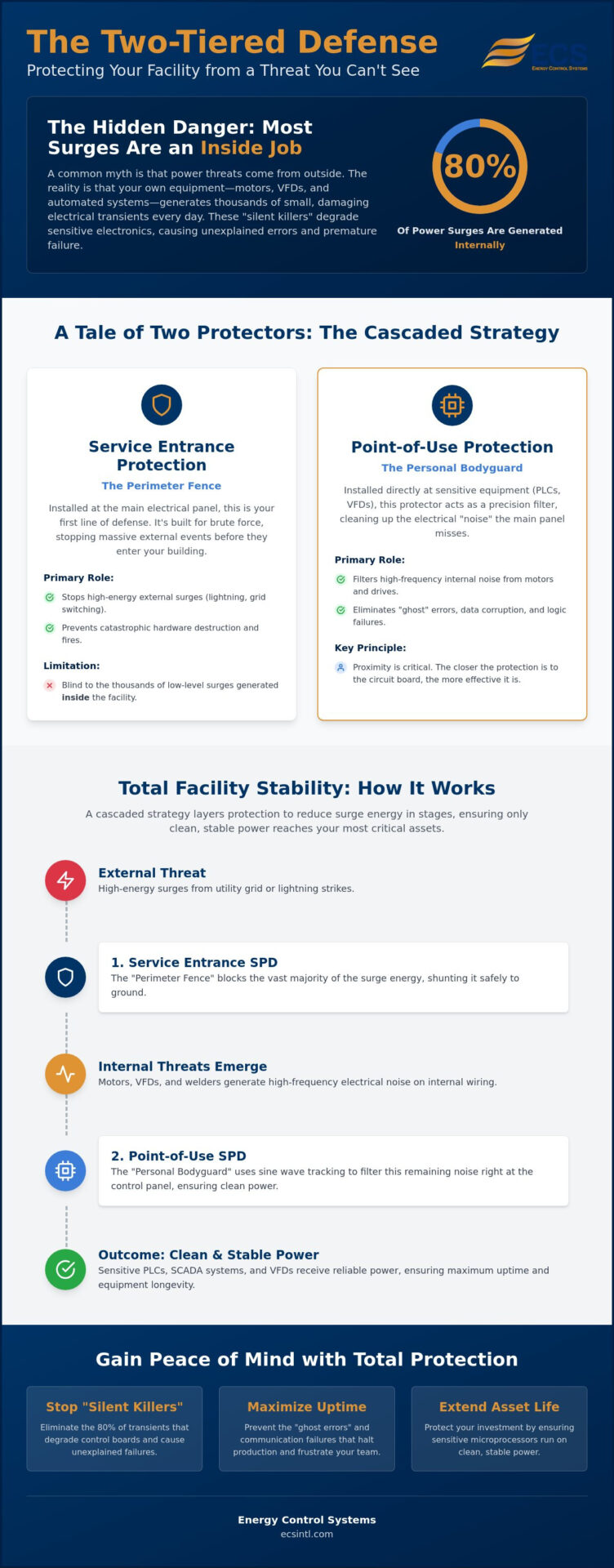
Understanding the difference between point of use vs service entrance surge protection is the first step toward reclaiming your facility’s productivity. You can’t simply install a single protector at the main panel and expect total immunity. Cascaded protection is a multi-layered defense strategy that reduces surge energy in stages, ensuring that by the time power reaches your sensitive assets, it’s clean and stable. This two-tiered approach is the industry standard for mission-critical infrastructure because it addresses threats that a single device simply cannot handle alone.
A high-quality Surge Protection Device (SPD) at your service entrance is vital, but it’s only half the story. To achieve true uptime, you need a strategy that protects both the heavy iron and the delicate silicon. Without both layers, you’re leaving the heart of your automation exposed to internal chaos.
The Service Entrance: Stopping the High-Energy Hammer
Think of this as your facility’s perimeter shield. These Type 1 or Type 2 devices are built for brute force, often working in tandem with the heavy-duty infrastructure provided by an OEM like Africa Switchgear & Transformers. Their primary role involves shunting massive external voltage spikes, like those from lightning strikes or utility grid switching, directly to ground before they ever enter your internal bus. It’s essential for preventing catastrophic fires and major hardware destruction. However, this shield has a significant limitation. It’s blind to the thousands of transients generated by your own machinery inside the building every single day. It stops the hammer, but it misses the needle-like transients that degrade your electronics over time.
Point-of-Use: The Precision Surgeon for Sensitive Electronics
This is where the specialized bodyguard takes over. Point-of-use protection is installed directly at the PLC, VFD, or server rack to handle what the main panel missed. These devices act like a precision surgeon, cleaning up low-level, high-frequency noise that causes “soft” failures and data corruption. Proximity is everything. The closer the protection is to the circuit board, the more effective the clamping becomes. By filtering power at the last possible moment, you eliminate the “ghost” errors that cause unplanned downtime and keep your most expensive control boards running for years longer.
The Industrial Reality: Why 80% of Threats Bypass Your Service Entrance
The common belief that a main panel protector handles every threat is a dangerous myth. Verified industry data confirms that 60% to 80% of power surges actually originate from within your own facility. Every time a large motor starts or a solenoid cycles, it generates a mini-surge. These are the “silent killers” of industrial automation. Because these transients start inside your building, they travel directly to your sensitive electronics without ever passing through the service entrance. The physics of electrical pathing means your perimeter shield is essentially blind to these internal threats.
This reality highlights why the choice between point of use vs service entrance surge protection isn’t an “either/or” decision. If you only protect the entrance, you’re leaving the door wide open for internal transients to degrade your equipment. We see the heavy emotional toll this takes on maintenance teams. Dealing with recurring “ghost errors” and unexplained communication failures is exhausting. It erodes your team’s confidence and kills productivity. To stop these internal threats at the source, you need machinery-level protection like the SineTamer LA Series.
When “Standard” Protection Isn’t Enough
Most standard surge devices only react when voltage hits a massive, predetermined threshold. This is far too slow for modern microprocessors. These basic units allow “let-through voltage” to pass, which slowly degrades the delicate junctions inside your hardware. Instead of simple clamping, you need high-frequency sine wave tracking. This level of layering, or cascading of surge protection ensures that even the smallest, fastest transients are neutralized before they reach your assets.
Protecting the Brains of Your Operation
Your SCADA and PLC systems are the brains of your operation. In an unprotected environment, these systems face constant digital noise that leads to data corruption and hardware failure. For total stability, many leaders combine point-of-use suppressors with an Uninterruptible Power Supply. If you’re tired of guessing why your boards are failing, a professional harmonic analysis can reveal the hidden transients currently killing your uptime.
Implementing a Cascaded Strategy for Total Facility Stability
Building a resilient facility requires more than a single piece of hardware. It demands a deliberate, three-step approach to eliminate the chaos of power quality issues once and for all. First, you must harden the service entrance with robust Type 1 or 2 devices. These units handle the brute force of the utility grid, acting as your primary line of defense. Second, you need to deploy point-of-use suppressors like the SineTamer RM Series for your digital infrastructure. This balanced strategy of point of use vs service entrance surge protection ensures that no transient, whether external or internal, can reach your sensitive assets.
The final step involves looking deeper into your electrical environment. Conducting a Harmonic Analysis allows you to identify hidden power quality gaps that standard protection misses. When evaluating point of use vs service entrance surge protection, remember that the goal is a seamless transition of defense. This process moves you beyond mere compliance. It restores your personal agency. You’ll finally have the certainty that your facility is truly protected, allowing you to focus on growth instead of damage control.
Choosing the Right Point-of-Use Hardware
Not every environment is the same. Your industrial cabinets might require DIN-rail mounted protection, while your data centers need the specialized SineTamer RM Series for server and rack protection. Unlike basic surge strips that rely on simple voltage clamping, these professional-grade tools use Frequency Sensitive Tracking. This technology filters out the high-frequency noise that standard suppressors simply ignore. It provides a level of surgical precision that keeps your microprocessors safe and your data intact.
The Professional Advantage: Beyond the Hardware
Buying a part is easy. Solving a complex operational problem is where true value lies. A technical site analysis serves as the bridge between a transaction and a permanent solution. When you implement a properly protected site, your status within the organization changes. You’re no longer the person reacting to failures. You’re the leader who secured the facility’s future. This stability provides the ultimate brand promise: mental tranquility in an industry that rarely offers it. It’s about more than just hardware; it’s about your right to a stress-free work environment.
For industrial leaders who showcase their advanced systems at trade events, you can visit Coker Exhibition Systems Ltd (CokerExpo) for premium exhibition flooring and display stands that match the quality of your facility’s infrastructure.
Securing Your Facility’s Future and Your Peace of Mind
You don’t have to live with the constant anxiety of unplanned downtime. The choice between point of use vs service entrance surge protection isn’t about picking a winner; it’s about building a unified front. By combining a hardened perimeter with specialized bodyguards at your most sensitive assets, you eliminate the “ghost” errors that drain your productivity. You deserve a stable power environment where your expensive VFDs and PLCs are finally safe from silent internal transients.
With over 30 years of industrial power quality leadership, we understand the high stakes of your operations. Our SineTamer frequency-sensitive tracking technology provides the surgical precision needed to protect modern digital infrastructure. We offer global technical support and professional site analysis to help you move from a state of chaos to a state of total stability. It’s time to stop the cycle of hardware failure and reclaim your professional success.
Stop the downtime and restore your peace of mind; contact ECS for a site analysis today.
True facility resilience is within your reach. Take the lead in your organization by implementing a strategy that protects your equipment and your team’s hard work. We are here to stand as your steady partner in power quality.
Frequently Asked Questions
Do I need point-of-use protection if I have a whole-house surge protector?
Yes, you absolutely need both layers. While a service entrance protector acts as your perimeter fence against lightning and grid switching, it can’t see the thousands of transients generated by your own motors and solenoids inside the facility. Relying on a single layer is a high-stakes gamble with your automation. A cascaded strategy using point of use vs service entrance surge protection is the only way to ensure total stability for your sensitive control boards.
What is the difference between Type 1, Type 2, and Type 3 surge protectors?
These designations tell you exactly where the device belongs in your electrical system. Type 1 devices are installed on the line side of your main breaker to handle massive external energy. Type 2 units sit on the load side of the main panel to manage residual surges. Type 3 protectors are your point-of-use devices, installed directly at the equipment to filter out high-frequency noise and internal transients that the first two layers miss.
Can internally generated surges really damage my equipment?
Internal surges are the most frequent cause of industrial downtime. Every time a motor cycles or a heavy load shifts, it sends a spike through your internal wiring. These “silent killers” rarely cause an immediate explosion. Instead, they create cumulative degradation that leads to unexplained PLC communication errors and the premature death of expensive VFDs. Protecting against them is essential for restoring your facility’s long-term health.
How close does a point-of-use protector need to be to the device?
Proximity is critical for effective clamping. You should install your point-of-use protector as close to the sensitive load as possible, ideally within the same cabinet or at the server rack. Long lead wires can actually increase the voltage that reaches your equipment during a surge. By keeping the connection short and direct, you ensure the device can neutralize the energy before it touches your delicate microprocessors.
Does a UPS replace the need for point-of-use surge protection?
A UPS is not a substitute for a dedicated surge protective device. While a UPS provides battery backup and basic filtering, many industrial units aren’t designed to stop high-frequency transients. These “ghost” errors can pass right through a standard UPS and strike your electronics. For true mission-critical uptime, you need specialized frequency-sensitive tracking to complement your backup power system and provide a complete shield.
How often should industrial surge protection devices be replaced?
Industrial protectors generally have a lifespan of five to ten years, but a single massive event can change that timeline instantly. You should monitor the status indicators on your units during every maintenance round. If the warning lights indicate a failure, the device has fulfilled its duty as a bodyguard and requires immediate replacement. Staying proactive with these replacements is the only way to maintain a stable, stress-free power environment.

Article by
Jeff Edwards
Founder of ECS International Inc. Edwards travels and speaks extensively in Latin America, Asia and Africa on the subject of power quality; transients and mitigating their impact on profitability. After graduating from Texas Tech University in Lubbock Texas, Edwards spent 9 years in the Telecommunications sector prior to founding Energy Control Systems in 1987 as a Texas based corporation selling surge suppression and UPS systems. The company has evolved into a global power quality products and energy efficiency concern with operations spanning South America, Asia, Europe and Africa.
Disclaimer
Some of the above information may be the opinion of the author.