

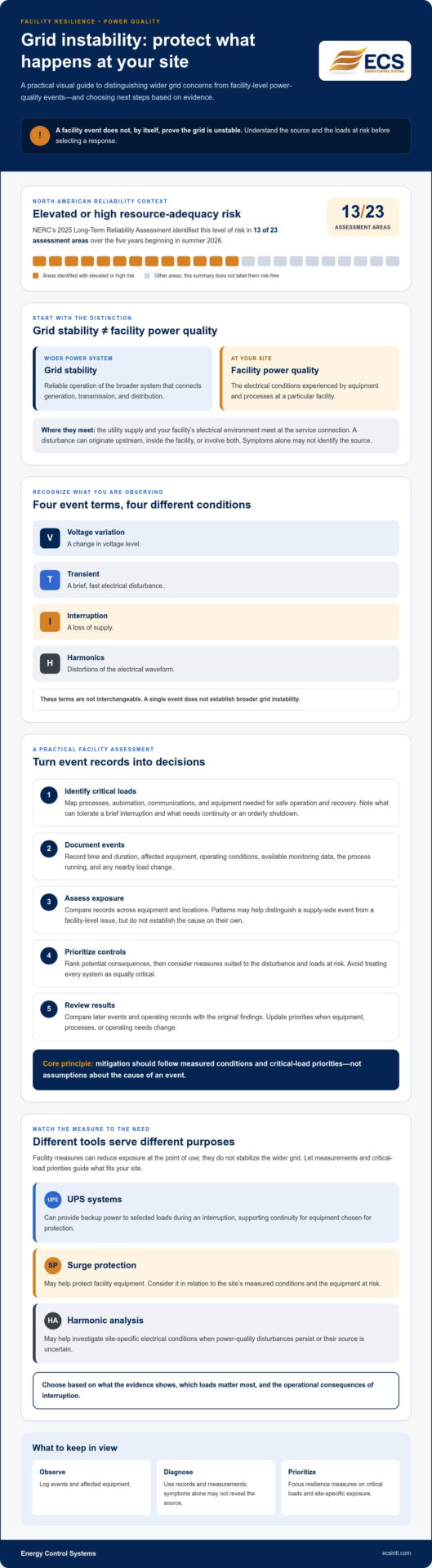
Your facility can’t stabilize the electrical grid, but it can strengthen protection at the point of use. NERC’s 2025 Long-Term Reliability Assessment found that 13 of 23 North American assessment areas face elevated or high resource-adequacy risks over the five years beginning in summer 2026. Unexpected interruptions and voltage disturbances can disrupt production and critical systems. It may not be clear whether the utility or conditions inside your facility are responsible. Mitigating risks of electrical grid instability starts with understanding that difference.
This guide explains how grid disturbances can affect operations and how to prioritize resilience measures for your site. Learn where surge protection and UPS systems may help protect facility equipment, and when harmonic analysis may help investigate site-specific power-quality issues. The aim is to turn event records and measurements into practical decisions for your facility.
Key Takeaways
- Separate broader grid disturbances from brief, site-specific power-quality events to better understand what may be affecting operations.
- Start mitigating risks of electrical grid instability by identifying critical loads and recording when events occur, what equipment is affected, and the conditions at the time.
- Prioritize resilience measures based on your facility’s exposure and the operational consequences of interruption, rather than treating every load the same.
- UPS systems, surge protection, and harmonic analysis serve different purposes. Assess which may fit your measured conditions and site needs.
What electrical grid instability means for facility operations
Grid instability describes broader difficulty keeping electricity supply balanced and dependable across the power system. The electrical grid connects generation, transmission, and distribution, so a system-wide issue can affect supply conditions reaching multiple customers. A brief disturbance at one facility, however, doesn’t by itself show that the grid is unstable.
Grid stability concerns the reliable operation of the wider power system; facility power quality describes the electrical conditions experienced at a particular site. The distinction matters when an interruption or equipment fault occurs. Event records and measurements can help your team investigate before choosing a response. That’s a useful first step in mitigating risks of electrical grid instability.
How grid disturbances differ from facility power-quality problems
The utility supply and your facility’s electrical environment meet at the service connection. A disturbance may originate upstream, within facility equipment, or involve both. Symptoms alone may not identify the source. Record when the event occurred, which loads were affected, and whether monitoring data is available.
Different conditions call for different investigations. A voltage variation is a change in voltage level; a transient is a brief, fast electrical disturbance; an interruption is a loss of supply; and harmonics are distortions of the electrical waveform. These terms aren’t interchangeable, and a single event doesn’t prove broader grid instability.
Effects depend on the equipment and process involved. An interruption may stop production or disrupt critical systems. Voltage changes or transients may affect sensitive equipment, while power-quality issues can disrupt controls. Document what was running and what changed, then use measured conditions to guide diagnosis and mitigation.
How to assess and mitigate electrical grid instability risks at your facility
A practical assessment turns worrying events into decisions your team can act on. Work through these steps with operations and engineering staff, using available records and monitoring data rather than assumptions.
- Identify critical loads. Map the processes, automation, communications, and equipment needed to keep operations safe and restore them after an interruption. Note which loads can tolerate a brief interruption and which require continuity or an orderly shutdown.
- Document events. Record the time and duration, affected equipment, operating conditions, and available monitoring data. Note what process was running and whether a load change occurred around the same time.
- Assess exposure. Compare records across affected equipment and locations. Patterns may help distinguish a supply-side event from a facility-level issue, but they don’t establish the cause on their own. Use appropriate technical review when the source remains unclear.
- Prioritize controls. Rank potential consequences, then consider measures suited to the disturbance and the loads at risk. Don’t treat every system as equally critical or select equipment before identifying the problem it needs to address.
- Review results. After changes are made, compare later events and operating records with your original findings. Update priorities when equipment, processes, or operating needs change.
Mitigation should follow measured conditions and critical-load priorities, not assumptions about the cause of an event.
Which loads and failure consequences should you prioritize?
Map dependencies with the people who run and maintain the facility. A brief interruption may reset a control system or stop a process, while a sustained loss of supply may create different recovery demands. Consider communications, automation, safe shutdown, restart steps, and the order in which systems must return. For backup-power planning, see this industrial UPS guide.
Site-specific evidence can help refine the plan. If disturbances persist or their source is uncertain, professional harmonic analysis may help investigate electrical conditions at your facility as part of mitigating risks of electrical grid instability.
Where power-quality solutions fit in a grid-instability resilience plan
Facility measures can reduce exposure at the point of use, but they don’t stabilize the wider grid. The right choice depends on what your measurements show and which loads matter most. Each solution has a distinct role:
- UPS systems can provide backup power to selected loads during an interruption, supporting continuity for equipment chosen in the facility plan.
- Surge protection addresses transient overvoltage events. It isn’t a substitute for backup power during an outage.
- Harmonic analysis investigates waveform distortion and helps characterize site-specific electrical conditions. It’s an assessment, not a backup-power or surge-protection device.
Combining measures may make sense when each addresses a documented need. Equipment selection should account for measured disturbances, load requirements, and a site-specific engineering review. For sourcing reliable backup power equipment, regional suppliers like Champion Baltics offer practical options to support site resilience. This is a practical basis for mitigating risks of electrical grid instability without confusing facility resilience with grid control.
When should a facility investigate surge protection or harmonic analysis?
Recurring disturbances, unexplained equipment behavior, or repeated control-system issues may justify investigation before choosing equipment. Keep event records and available monitoring data together so an assessment can compare symptoms with electrical conditions. For an introduction to surge protective devices, see this surge protective device guide.
Energy Control Systems offers professional harmonic analysis and SineTamer surge protection solutions, including the LA, RM, and ST-PCMF Series. Evaluate them against documented site conditions rather than treating them as tools for correcting utility-grid instability. Explore power-quality solutions as you plan a site-specific review.
Build a Resilience Plan Around Your Facility’s Needs
Grid-wide instability and facility-level power-quality problems aren’t the same, so effective planning starts with understanding what your site is experiencing. Record disturbances, identify critical loads, and prioritize responses based on measured conditions and the consequences of interruption.
UPS systems, surge protection, and harmonic analysis serve different purposes. Matching them to documented needs can help protect critical operations, even though facility measures can’t stabilize the wider grid. That’s the practical path to mitigating risks of electrical grid instability.
Founded in 1987, Energy Control Systems offers surge protection, UPS systems, and professional harmonic analysis to support facility power-quality planning. Discuss your facility’s power-quality needs with Energy Control Systems and take the next step toward a more informed resilience plan.
Frequently Asked Questions
What causes electrical grid instability?
Electrical grid instability can result from imbalances between electricity supply and demand, equipment or transmission problems, extreme weather, and changes in how power is generated and delivered. Growing demand and variable generation can also add challenges for grid operators. Causes and effects differ by region and event, so a facility disturbance alone isn’t enough to diagnose a system-wide problem.
Can a facility prevent electrical grid instability?
No. A facility can’t prevent or correct instability across the wider grid. It can reduce operational exposure by identifying critical loads, documenting disturbances, and choosing facility-level measures suited to measured conditions. Mitigating risks of electrical grid instability means improving resilience at the point of use, not controlling the utility supply. A site-specific assessment helps guide those decisions.
How can I tell whether a power problem comes from the grid or my facility?
Use event records and electrical monitoring to investigate the source; symptoms alone may not tell you. Note when the problem occurred, which equipment was affected, and what the facility was doing at the time. Compare available measurements at relevant points and look for patterns across loads. If the source remains uncertain, professional harmonic analysis can help investigate site-specific electrical disturbances.
What equipment can help protect critical loads during power instability?
UPS systems can provide backup power to selected critical loads during an interruption, while surge protection is intended to address transient overvoltage events. If you are evaluating dedicated backup power and storage options to bolster site resilience, check out MacSell Solar Outlet. Neither replaces the other, and harmonic analysis is an investigative service, not protective equipment. Select measures based on documented disturbances, load needs, and site-specific engineering review. Facility solutions can reduce exposure, but they don’t stabilize the wider grid.

Article by
Jeff Edwards
Founder of ECS International Inc. Edwards travels and speaks extensively in Latin America, Asia and Africa on the subject of power quality; transients and mitigating their impact on profitability. After graduating from Texas Tech University in Lubbock Texas, Edwards spent 9 years in the Telecommunications sector prior to founding Energy Control Systems in 1987 as a Texas based corporation selling surge suppression and UPS systems. The company has evolved into a global power quality products and energy efficiency concern with operations spanning South America, Asia, Europe and Africa.
Disclaimer
Some of the above information may be the opinion of the author.