

Replacement isn’t automatically the costlier choice. The cost of replacing surge-damaged equipment is best weighed against the repair estimate: for several consumer devices, replacing becomes more practical as repairs approach 40%-60% of the cost of a comparable new item.
When surge-damaged equipment disrupts work or daily routines, it’s natural to want a clear figure before deciding what to do. The cost of replacing surge-damaged equipment depends on what failed, the replacement required, and the equipment’s value. Compare a technician’s repair estimate with the cost of a comparable replacement, including installation if needed. This guide explains how to assess those options and why the type of damage and the equipment’s condition matter.
Key Takeaways
- Repair claims show that costs vary by device and the work needed, so use a written diagnosis to understand what is driving the estimate.
- Compare the repair estimate with the cost of a comparable replacement, while weighing the equipment’s condition and the extent of the damage.
- Surges can harm internal circuits and other components, sometimes causing immediate failure and sometimes gradual deterioration.
- For power continuity and power-quality concerns, Uninterruptible Power Supplies (UPS) and Harmonic Analysis can help inform a broader equipment-protection plan.
Repair claims data and cost observations
Repair estimates vary widely by device: audio, smart-home, and gaming equipment involve different parts and labor. Use these examples to frame your decision, not to predict an individual bill.
Comparing Protector and Replacement Costs
A whole-house surge protector is an upfront investment in protection, while replacing damaged equipment is a recovery expense after a surge. The comparison depends on installation needs and the devices at risk, so there’s no single cost ratio. Weigh the protection against the potential cost of replacing multiple devices.
Factors Affecting Replacement Costs
Equipment type, age, part availability, and labor all shape the repair-versus-replacement decision. A repair estimate approaching 40%-60% of replacement value may favor replacing audio equipment or a console. For specialized broadcast, audio, or creative workflow hardware, referencing equipment suppliers such as United Broadcast & Media Solutions (UBMS) can help establish accurate retail values. Compare the estimate with a like-for-like replacement, and consider whether labor or installation adds to the repair bill.
Warranty and Utility Reimbursement
Home-warranty reimbursement depends on contract coverage, while utility reimbursement depends on the circumstances and applicable policies. Homeowners insurance coverage varies with the surge’s cause, policy terms, and exclusions. A covered loss may be subject to a deductible, and location alone doesn’t establish coverage. To document a claim, photograph damaged items, save receipts, and record affected equipment in a household inventory. Include technician findings and repair estimates. These records help describe the loss, but policy limits and exclusions determine what insurance may pay.
When repair costs make replacement practical
Replacement may make practical sense when repairing the equipment no longer fits its value and condition. Compare a technician’s diagnosis with the likely cost of restoring reliable operation.
Comparing Repair and Replacement Costs
Compare the repair estimate with the cost of a comparable replacement, including installation if needed. The cost of replacing surge-damaged equipment is easier to assess when both options provide the same functions.
Steps Before Replacing Equipment
Ask a technician to identify failed components and assess whether repair or replacement is appropriate. The Centers for Disease Control and Prevention (CDC) says a repair technician should check the equipment to determine whether repair or replacement is needed. Compare the written estimate with a like-for-like replacement, including labor and installation. Warm outlets, sparks, or a burning-plastic smell after a surge call for turning off power at the breaker.
Repairing or Reusing Damaged Equipment
A device that powers on after a surge may still have problems that affect reliable operation. Have a technician assess the equipment before deciding whether to reuse it. Consider the repair estimate, the device’s condition, and whether the repair restores the functions you need. For future continuity planning, Uninterruptible Power Supplies (UPS) may be relevant. That broader plan can help put the cost of replacing surge-damaged equipment in context.
When deciding whether to restore equipment or replace it, the Centers for Disease Control and Prevention (CDC) says a repair technician should check it to determine whether repair or replacement is needed.
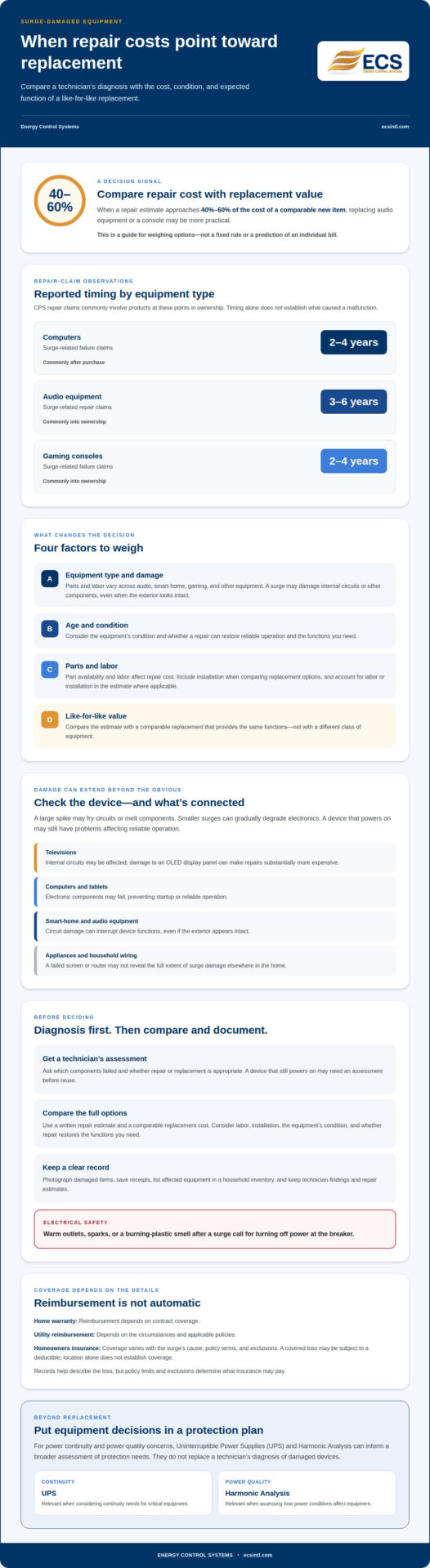
Common surge-damaged components
A surge can damage more than the device that stops working. A large spike may fry circuits or melt components, while smaller surges can gradually degrade electronics.
In TVs, computers, audio equipment, and smart-home devices, the circuitry affected depends on the unit. Damage may prevent startup, disrupt normal operation, or cause complete failure. A surge can also affect appliances and household wiring, so one failed screen or router may not reveal the full extent of the damage.
- Televisions: Surge damage can affect internal circuits, and an affected OLED display panel can make repairs substantially more expensive.
- Computers and tablets: Electronic components may fail, leaving a device unable to start or work reliably.
- Smart-home devices and audio equipment: Circuit damage can interrupt the functions these devices provide, even if the exterior looks intact.
- Household wiring: A covered loss that damages wiring may fall under dwelling coverage, depending on policy terms and circumstances.
Does homeowners insurance cover replacing surge-damaged equipment? Coverage depends on the surge’s cause, policy details, and exclusions. If a covered event, such as lightning, caused the damage, personal property coverage could help pay for repairs or replacement.
Because symptoms can differ across connected devices, document each affected item and its behavior. For a broader view of power-quality risks, explore power-quality assessment as part of a practical equipment-protection plan.
Repair history can add context when evaluating a failed device. CPS repair claims for surge-related computer failures commonly involve products 2-4 years after purchase, while CPS repair claims for surge-damaged audio equipment commonly involve products 3-6 years into ownership.
For consoles, CPS claims for surge-related gaming console failures commonly emerge 2-4 years into ownership. These timeframes do not by themselves establish what caused a malfunction; a large power surge can immediately damage an appliance by frying circuits or melting components.
Energy Control Systems
Energy Control Systems helps you assess power-quality and continuity needs after equipment damage, so replacement decisions can inform a broader protection plan. Uninterruptible Power Supplies (UPS) and Harmonic Analysis are relevant when assessing how power conditions affect critical equipment. These offerings can inform discussions about protection needs, but they don’t replace a technician’s diagnosis of damaged devices.
If a surge has raised concerns about recurring disruption or equipment exposure, consider how power quality and continuity fit into your operating needs. Contact Energy Control Systems to discuss your situation and possible next steps.
Build a More Resilient Power Plan
Understanding the cost of replacing surge-damaged equipment can help turn a difficult repair decision into an opportunity to reconsider your power needs. Look beyond the failed device: identify what’s essential to daily operations and consider how power quality and continuity fit into your plans. A clear priority list can guide future protection decisions without treating every device the same way.
Energy Control Systems offers advanced transient voltage surge suppression solutions, including comprehensive panel-level and hardwired protection options. These solutions can be part of a broader discussion about power concerns, alongside Uninterruptible Power Supplies (UPS) and Harmonic Analysis.
Contact Energy Control Systems to discuss your power needs and possible next steps. A thoughtful plan can help you move forward with greater clarity.
Frequently Asked Questions
What does it cost to replace surge-damaged appliances and electronics?
Treat these as examples, then compare the damaged device’s functions and setup needs with those of an appropriate replacement.
What is the average cost to repair versus replace surge-damaged equipment?
There isn’t one meaningful average across all equipment, because repair and replacement costs depend on the device and the failure. Compare an itemized repair estimate with the cost of a comparable replacement, including installation if needed.
How do replacement costs and insurance rules vary by U.S. location?
Repair estimates vary by device and damage, while insurance coverage depends on the surge’s cause, policy terms, and exclusions. Location alone does not establish coverage.

Article by
Jeff Edwards
Founder of ECS International Inc. Edwards travels and speaks extensively in Latin America, Asia and Africa on the subject of power quality; transients and mitigating their impact on profitability. After graduating from Texas Tech University in Lubbock Texas, Edwards spent 9 years in the Telecommunications sector prior to founding Energy Control Systems in 1987 as a Texas based corporation selling surge suppression and UPS systems. The company has evolved into a global power quality products and energy efficiency concern with operations spanning South America, Asia, Europe and Africa.
Disclaimer
Some of the above information may be the opinion of the author.