

If it didn’t storm last night, why did your CNC machine controller just fry? You’ve seen the “ghost” errors on your SCADA system and felt that sinking feeling when a production line stops for no apparent reason. These events are actually specific types of industrial power disturbances that occur daily, even under clear skies. You deserve a facility that runs with predictable stability; not one where you’re constantly bracing for the next unexplained failure.
The truth is that lightning isn’t your primary enemy. While we often focus on the weather, the vast majority of surges are “inside jobs” generated by your own daily operations. Discover the invisible internal and grid-level threats that cause 80% of industrial power surges and how to protect your sensitive electronics. We’ll identify the specific internal sources of these transients and show you how to stop the cycle of hardware replacement. It’s time to restore your personal agency and achieve the peace of mind that comes with true, reliable uptime.
Key Takeaways
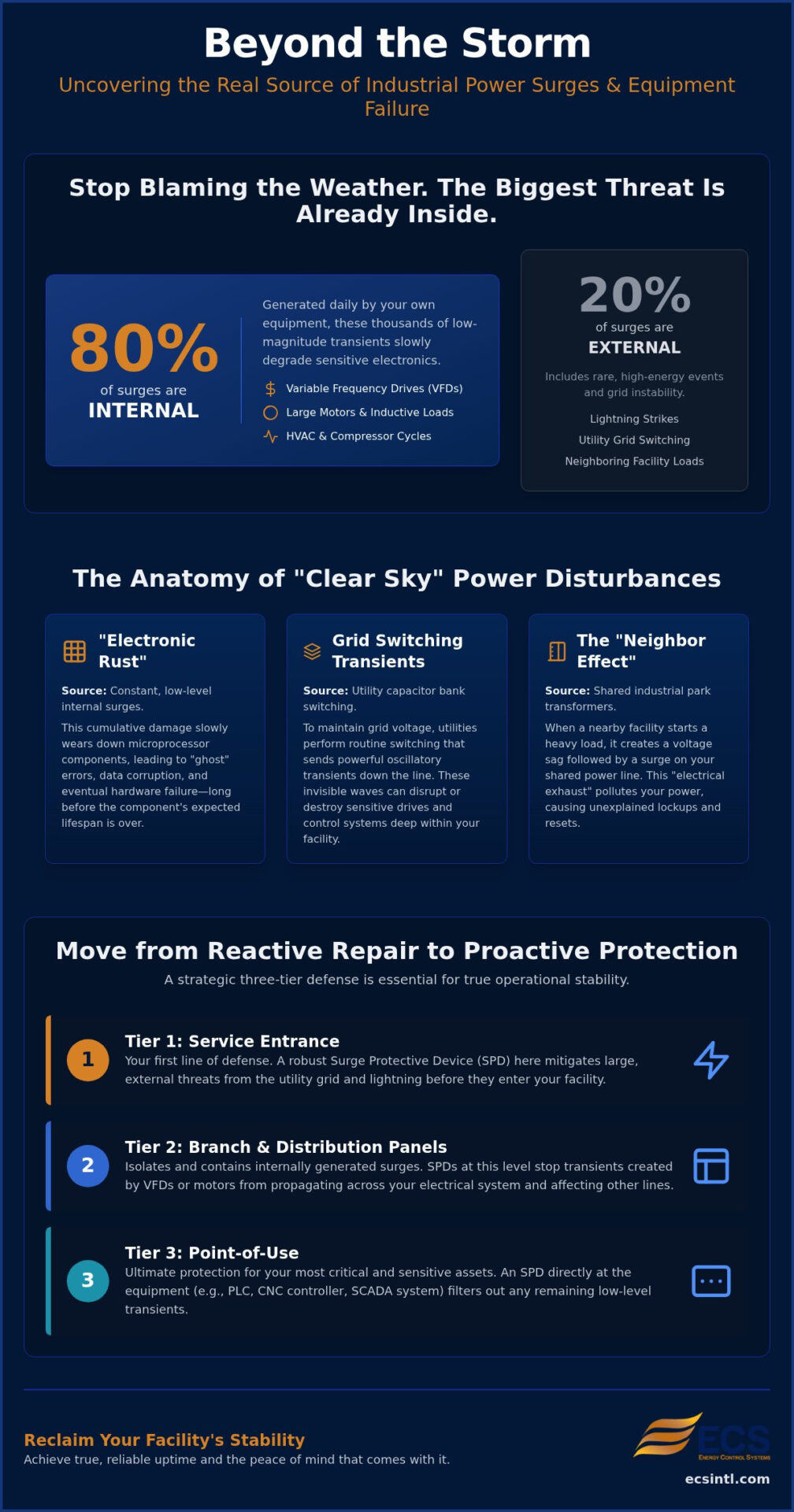
- Stop blaming the weather and start looking inward; 80% of electronic failures are caused by low-magnitude internal transients that slowly degrade your hardware over time.
- Identify the specific types of industrial power disturbances—from utility grid switching to neighboring facility load spikes—that threaten your uptime even on perfectly clear days.
- Move from “reactive repair” to proactive protection by implementing a strategic three-tier defense at your service entrance, branch panels, and point-of-use.
- Reclaim your facility’s stability and your own peace of mind by silencing the “ghost” errors that plague sensitive SCADA systems and production lines.
Internal Transients: Why 80% of Power Surges Originate Inside Your Facility
Lightning is the rare, terrifying intruder. But your own facility is home to a domestic saboteur. While we often blame the weather for equipment failure, research shows that 80% of surges are “inside jobs” generated by your daily operations. These internal transients are low-magnitude, high-frequency spikes. They don’t usually cause a visible explosion. Instead, they happen thousands of times a day, every time a motor starts or a compressor kicks in. This constant bombardment is one of the most destructive types of industrial power disturbances because it remains invisible until the damage is done.
These internal saboteurs include Variable Frequency Drives (VFDs), large motors, and HVAC compressors. The danger lies in the switching cycle. When heavy equipment turns off, the electrical demand doesn’t just vanish. It creates a back-EMF surge that hits your sensitive PLCs and control systems. It’s a relentless cycle that robs you of your facility’s stability and your own peace of mind.
Inductive Loads and the Back-EMF Effect
When a motor stops, the magnetic field within its coils collapses instantly. This energy has to go somewhere, so it snaps back into your electrical lines. We define this “inductive kick” as a primary cause of controller resets and unexplained system lockups. High-precision hardware, such as servo electric motors, is particularly sensitive to these micro-surges. Without protection, these transients disrupt the delicate timing required for automated production lines.
The Cumulative Damage of Electronic Rust
Most electronic failures aren’t instantaneous. They are the result of a slow, agonizing process we call “electronic rust.” Every small transient wears down the microscopic silicon layers on your microprocessors. Over time, this degradation leads to logic errors and software glitches that aren’t actually caused by your software at all. You waste hours chasing “ghosts” in the code when the real culprit is poor power quality. Recognizing these types of industrial power disturbances allows you to stop the cumulative damage and finally restore operational control to your facility.
Grid Instability and Utility Switching: External Surges Without a Cloud in the Sky
You don’t need a thunderstorm to lose a production line. While internal transients are the most frequent offenders, the external grid presents a constant, invisible threat to your facility’s health. You aren’t just managing your own equipment; you’re at the mercy of every move the utility company makes. Grid re-routing and routine maintenance can send massive spikes through your service entrance without warning. These types of industrial power disturbances are often the hardest to track because they originate miles away from your front door.
The strain on our infrastructure is growing. With Texas electricity demand seeing a 30% increase since 2020, the grid is under more pressure than ever. This leads to more frequent utility switching and voltage adjustments that can compromise your sensitive electronics. It’s a heavy burden to carry, but understanding these external pressures is the first step toward protecting your team’s hard work.
Utility Capacitor Bank Switching
Power companies switch capacitor banks daily to maintain voltage levels and correct power factors. This isn’t a failure of the system; it’s a standard operation. However, the act of switching creates a distinctive oscillatory transient. This pulse can travel deep into your facility, wreaking havoc on sensitive drives and control systems. Protecting your infrastructure requires a robust surge protective device at the service entrance to act as a first line of defense against these grid-level events.
The Neighbor Effect in Industrial Parks
If you share a transformer with other companies in an industrial zone, you’re essentially breathing their electrical exhaust. When a neighboring plant starts a heavy-load motor, it pulls voltage away from your building. When that load stabilizes, the voltage snaps back with a surge. This cross-facility power pollution is a primary reason why harmonic analysis is so vital. It allows you to diagnose external noise and prove that your “ghost” errors aren’t coming from your own floor. Understanding these external types of industrial power disturbances allows you to reclaim your operational agency.
The danger also peaks during power recovery. When the utility restores power after a local blackout, the resulting inrush current can be far more damaging than the outage itself. Aging transformers and faulty utility grounding can even create “floating neutrals,” sending unstable voltage directly into your microprocessors. It’s a chaotic landscape, but you don’t have to navigate it alone. Performing a professional technical site analysis can help you identify these external threats before they lead to another costly replacement cycle.
Restoring Operational Stability: A Strategic Approach to Power Quality
You’ve spent too many nights chasing ghosts in the machine. It’s time to move from reactive repair to proactive protection. Reclaim your facility’s agency. Stop the cycle of hardware replacement and find your peace of mind. True stability doesn’t come from fixing things after they break. It comes from a strategic, layered defense that shields your equipment from the relentless bombardment of micro-surges.
A real solution requires a 3-tier protection strategy. You need a shield at the service entrance, at the branch panels, and at the point-of-use. Most facility managers rely on basic surge strips at the machine level, but these fail to stop the high-frequency transients that kill PLCs and CNC controllers. Standard strips are built for catastrophic events; they ignore the daily “electronic rust” that destroys industrial logic. When the grid fluctuates, an uninterruptible power supply bridges the gap, providing clean energy during moments of grid instability. This multi-layered approach is the only way to manage the diverse types of industrial power disturbances that threaten your uptime.
The SineTamer Advantage for Industrial Environments
The SineTamer LA Series is engineered for the harsh reality of the factory floor. It filters the frequency-attenuated transients that generic devices miss. By protecting your SCADA systems, you do more than save hardware. You reduce the emotional toll of midnight emergency calls and the frustration of unexplained downtime. You deserve a work environment where technology is a source of strength, not a source of constant anxiety.
Next Steps: Site Survey and Harmonic Analysis
You can’t fight what you can’t see. A professional power quality audit and harmonic analysis allow you to see the invisible threats on an oscilloscope. These diagnostic tools identify the specific types of industrial power disturbances unique to your facility. This isn’t just a technical exercise; it’s a path toward professional success and recognition within your organization. You don’t have to be a victim of an aging power grid or your own heavy machinery. Take control, restore your operational stability, and finally achieve the mental tranquility you’ve earned.
Take Control of Your Operational Stability
You’ve discovered that lightning is often just a distraction from the real culprits. The daily internal transients and grid-level fluctuations are what truly threaten your uptime. Managing these various types of industrial power disturbances requires more than a reactive mindset. It demands a partner who understands the high stakes of your production schedule and the emotional toll of every failure.
We’ve spent over 30 years protecting global infrastructure from the silent killers in the wires. Our SineTamer LA Series utilizes specialized frequency-attenuation technology to stop the cumulative damage that basic protectors ignore. Through our professional Harmonic Analysis services, we help you see the invisible threats and eliminate them for good. This isn’t just about hardware; it’s about your right to a stress-free work environment.
Reclaim your uptime; Request a SineTamer Site Analysis today
You deserve a facility that works as hard as you do. Take back your personal agency and start every shift with the confidence that your systems are safe and steady. We’re here to help you achieve the professional success and mental tranquility you’ve earned.
Frequently Asked Questions
Can a power surge happen without lightning?
Yes, power surges happen every day without a single cloud in the sky. In fact, lightning accounts for only a tiny fraction of the electrical issues industrial facilities face. Most surges are actually internal transients caused by your own equipment or routine utility grid switching. These invisible events happen silently, meaning you might not even realize your hardware is under attack until a critical system fails.
What are the most common causes of power surges in a factory?
The most frequent causes are internal inductive loads such as large motors, Variable Frequency Drives (VFDs), and HVAC compressors. Every time this equipment cycles off, it sends a back-EMF surge into your electrical lines. Other common types of industrial power disturbances include utility capacitor bank switching and load changes from neighboring facilities. These daily occurrences create a relentless cycle of electrical stress on your sensitive microprocessors.
How do I know if my equipment is being damaged by low-level surges?
Look for “ghost” errors in your SCADA system, unexplained controller resets, or the frequent need to replace expensive electronic boards. This is the result of “electronic rust,” where low-level surges slowly degrade silicon layers over time. If your team is frustrated by software glitches that don’t have a clear cause, it is likely that cumulative transient damage is stealing your facility’s operational stability.
Is a UPS the same as a surge protector for industrial machines?
No, they serve different but complementary roles in your facility. A UPS is designed to provide backup power during an outage and bridge temporary voltage sags. However, most standard UPS units cannot filter the high-frequency transients that cause long-term damage. You need a dedicated surge protective device, such as the SineTamer LA Series, to stop the specific types of industrial power disturbances that bypass basic battery backups.

Article by
Jeff Edwards
Founder of ECS International Inc. Edwards travels and speaks extensively in Latin America, Asia and Africa on the subject of power quality; transients and mitigating their impact on profitability. After graduating from Texas Tech University in Lubbock Texas, Edwards spent 9 years in the Telecommunications sector prior to founding Energy Control Systems in 1987 as a Texas based corporation selling surge suppression and UPS systems. The company has evolved into a global power quality products and energy efficiency concern with operations spanning South America, Asia, Europe and Africa.
Disclaimer
Some of the above information may be the opinion of the author.