

Last Tuesday, your main production line ground to a halt for the third time this month, yet the diagnostic logs showed nothing but “ghost” errors. It’s a soul-crushing experience to stand in a silent factory, knowing every minute of downtime erodes your team’s hard-earned progress. You shouldn’t have to feel like a passenger in your own facility. We understand the deep frustration of troubleshooting harmonic distortion when the source feels invisible. You deserve a workspace defined by stability, not unpredictability.
This guide provides a definitive path to clarity, moving you from reactive repairs to proactive protection. You’ll learn how to pinpoint the electrical noise threatening your infrastructure and how to apply the latest IEEE 519-2022 standards. We’ll explore how professional Harmonic Analysis and the SineTamer LA Series can finally silence the interference, restoring both your equipment’s lifespan and your own peace of mind.
Key Takeaways
- Understand how non-linear loads create “ghost” errors that standard maintenance misses, threatening both your equipment and your peace of mind.
- Master a systematic 6-step methodology for troubleshooting harmonic distortion to move from reactive repairs to engineering a permanent cure for your facility.
- Identify the role of professional Harmonic Analysis in establishing a clear baseline for your production line’s long-term stability.
- Learn how the SineTamer LA Series acts as a stabilizing force, protecting your expensive VFDs and automation systems from the invisible noise that shortens their lifespan.
The Silent Equipment Killer: Why Harmonic Distortion Demands Your Attention
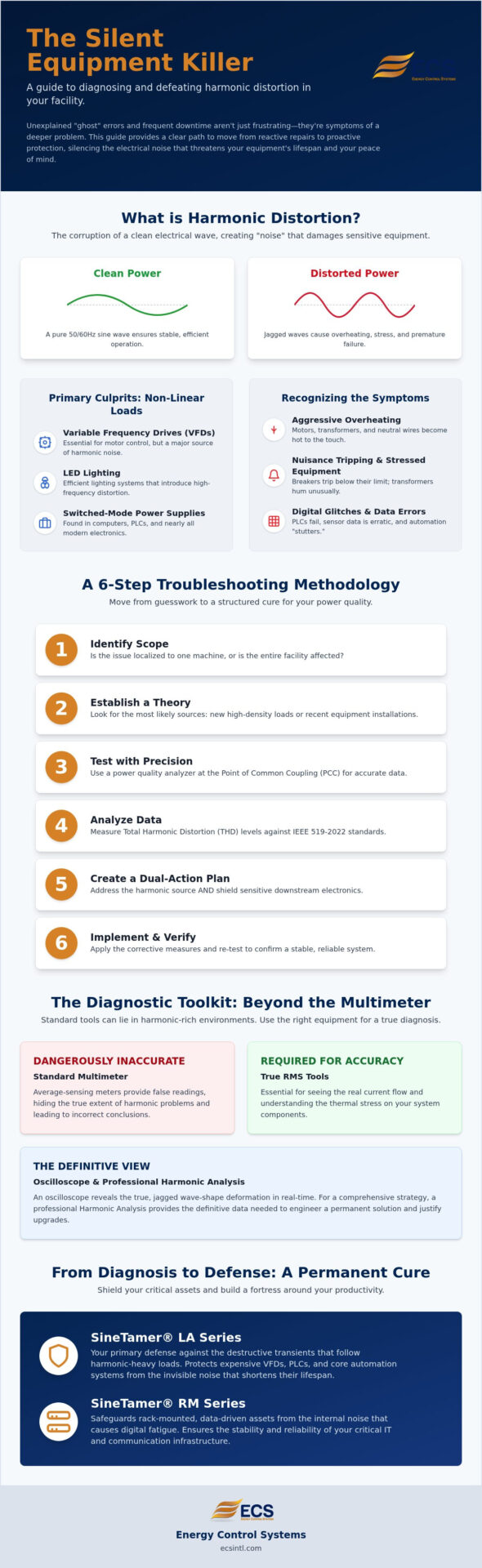
You’ve likely spent hours chasing a fault that simply doesn’t exist on paper. It’s exhausting. Harmonic distortion is the corruption of your fundamental 60Hz or 50Hz sine wave, triggered by non-linear loads that pull current in abrupt, jagged pulses. This creates a “ghost in the machine” that standard maintenance tools usually miss. It leaves you feeling helpless while your facility’s rhythm falters.
Modern efficiency often demands a hidden sacrifice. Common industrial sources like Variable Frequency Drives (VFDs), LED lighting, and switched-mode power supplies are essential for your operations, yet they are the primary culprits. If you ignore them, these harmonics lead to aggressive overheating and shortened motor life. They even cause the catastrophic failure of surge protective devices. Your expensive assets end up defenseless.
Recognizing the Symptoms of Poor Power Quality
You can’t see the distorted wave, but you can certainly feel the consequences. Physical warnings are often the first sign of trouble. Listen for transformers that hum with an unusual, stressed vibration. Watch for circuit breakers that trip despite being nowhere near their load limit. If your neutral conductors are hot to the touch, you have a problem. Digital symptoms are equally telling. Look for PLC communication glitches that vanish after a reboot, erratic sensor data that causes automation “stuttering,” or frequent UPS battery cycling during normal operation.
Effective troubleshooting harmonic distortion begins with identifying these subtle cries for help from your infrastructure. Total harmonic distortion (THD) represents the cumulative measurement of these unwanted frequencies, serving as a direct indicator of your system’s thermal stress and wasted energy.
A 6-Step Methodology for Troubleshooting Harmonic Distortion
Restoring stability requires more than just guesswork. You need a structured approach to reclaim control over your power quality. The first step in troubleshooting harmonic distortion is identifying the scope. Is the damage localized to a single VFD, or is the entire facility suffering? Once you know the reach, establish a theory. Look for the usual suspects: high-density electronic loads or that new bank of drives installed last quarter.
Testing your theory demands precision. Connect a power quality analyzer at the Point of Common Coupling (PCC) to measure THD levels against established standards. This data is essential for troubleshooting harmonic issues without wasting time on false leads. Finally, create a dual-action plan. You must address the harmonic source while simultaneously shielding sensitive downstream electronics. This systematic path leads to implementing the cure and verifying results, building a fortress around your productivity.
The Diagnostic Toolkit: Moving Beyond the Multimeter
Your standard multimeter might be lying to you. In harmonic-rich environments, average-sensing meters often provide dangerously inaccurate readings. You need True RMS tools to see the reality of your current flow. For a true visual of the chaos, an oscilloscope reveals the jagged wave-shape deformation that threatens your equipment. If the complexity feels overwhelming, a professional Harmonic Analysis provides the definitive data needed to justify upgrades to your management. You can restore your personal agency by partnering with experts for a site analysis to ensure your infrastructure remains battle-tested and reliable.
From Diagnosis to Defense: Implementing Permanent Power Stability
You’ve done the hard work of identifying the interference. Now, it’s time to move beyond temporary fixes and engineer a permanent cure. This transition restores your personal agency. You’re no longer reacting to “ghost” errors; you’re commanding your facility’s power quality. By troubleshooting harmonic distortion with a systematic mindset, you’ve earned the right to a stable production line. You don’t have to settle for “good enough” when your equipment’s lifespan is on the line.
The SineTamer LA Series serves as your primary defense. It shields sensitive electronics from the destructive transients that inevitably follow harmonic-heavy loads. For your data-driven assets, the SineTamer RM Series safeguards rack-mounted technology from the internal noise that causes digital fatigue. This isn’t just a hardware upgrade. It’s a lifestyle improvement. It means fewer 2 AM emergency calls and more time for the strategic planning that gets you noticed by management. You become the steady hand that ensures the plant stays running.
Engineering a Shield with ECS Solutions
We create a layered defense by integrating expert site analysis with advanced suppression. For your most critical automation, the SineTamer ST-PCMF Series provides dedicated protection for PLCs and controllers. A site-wide power quality audit is the final step. It verifies your system’s functionality and prevents future disturbances from taking root. You deserve the tranquility of knowing your infrastructure is truly battle-tested. Troubleshooting harmonic distortion is only half the battle; the other half is building a fortress that keeps the noise out for good.
Reclaim Your Stability and Secure Your Facility’s Future
You’ve spent too long fighting a battle against invisible interference. By mastering the systematic path of troubleshooting harmonic distortion, you’ve moved from frustration to a position of true engineering strength. You now understand that while non-linear loads are necessary, their side effects don’t have to dictate your facility’s uptime or your team’s success. You deserve the peace of mind that comes with a perfectly stable production line.
With over 35 years of power quality expertise and our proprietary Frequency Attenuation Network technology, ECS acts as your seasoned protector. We provide global support for industrial infrastructure to ensure your equipment thrives under any conditions. Stop the ghost errors and start engineering a more predictable, stress-free work environment today.
Request a Professional Harmonic Analysis and Reclaim Your Uptime. You have the power to protect your infrastructure. Let’s build that shield together.
Frequently Asked Questions
What are the most common signs of harmonic distortion in a factory?
Common signs include transformers that hum or vibrate excessively, circuit breakers that trip without a clear overload, and neutral conductors that run unusually hot. You might also notice PLC communication errors or erratic sensor data. These symptoms are clear indicators that you need to begin troubleshooting harmonic distortion to prevent permanent damage to your expensive VFDs and motors.
Can harmonic distortion cause my surge protectors to fail?
Yes, harmonics create constant thermal stress that can cause standard surge protectors to fail prematurely. High levels of harmonic current lead to excessive heat. This degrades the internal components of a surge protective device until it can no longer defend your equipment. It’s why we recommend the SineTamer LA Series, which is designed to handle the high-transient environments often found alongside harmonics.
How does harmonic analysis differ from a standard electrical inspection?
A standard inspection focuses on safety and code compliance, while Harmonic Analysis is a deep dive into power quality and wave-shape integrity. Inspections look for loose wires or overloaded circuits. Harmonic Analysis uses specialized analyzers to measure THD and identify the specific frequencies causing interference. It provides the technical data you need to engineer a permanent solution and restore facility stability.
What is the difference between total harmonic distortion (THD) and voltage transients?
THD refers to the ongoing corruption of the sine wave caused by non-linear loads, while voltage transients are sudden, high-energy spikes. Think of THD as “dirty” power that creates constant wear on your motors. Transients are more like a sudden switching event or a surge. Both threaten your uptime, but they require different strategies for protection and long-term infrastructure health.

Article by
Jeff Edwards
Founder of ECS International Inc. Edwards travels and speaks extensively in Latin America, Asia and Africa on the subject of power quality; transients and mitigating their impact on profitability. After graduating from Texas Tech University in Lubbock Texas, Edwards spent 9 years in the Telecommunications sector prior to founding Energy Control Systems in 1987 as a Texas based corporation selling surge suppression and UPS systems. The company has evolved into a global power quality products and energy efficiency concern with operations spanning South America, Asia, Europe and Africa.
Disclaimer
Some of the above information may be the opinion of the author.