

What if a “ghost” alarm is a symptom, not a false alarm? When a warning keeps returning without an obvious fault, it’s understandable to question the sensor, wiring, or control-system logic. But resetting the system or replacing parts before tracing the signal can prolong downtime. Troubleshooting ghost alarms in control systems starts with evidence, not assumptions.
This guide walks you through a safe, systematic investigation that keeps protections in place. Learn what to record, how to trace an alarm to its input, and how to distinguish a device or configuration issue from a possible power disturbance. If the alarm history points toward power quality, measured findings and harmonic analysis can help assess whether it’s worth investigating. The aim is a clearer diagnosis and fewer guesswork fixes.
Key Takeaways
- An alarm that conflicts with observed conditions isn’t proof of a faulty signal. An intermittent fault may disappear before inspection.
- For troubleshooting ghost alarms in control systems, preserve the alarm record and trace the affected input before testing possible causes.
- Review sensor state, wiring, connections, grounding, configuration, and communications systematically rather than replacing parts on a hunch.
- Correlated electrical events can justify further investigation, but they’re clues, not proof. Harmonic analysis can help assess power conditions.
What a ghost alarm in a control system can, and cannot, tell you
A ghost alarm is a warning that appears inconsistent with the conditions operators can observe. The term describes the mismatch, not its cause. An unexplained alarm is not proof of sensor failure; it’s a signal to check the system record against what was happening at the time.
The alarm may reflect a brief condition that has already passed. A loose connection, changing process state, or other intermittent issue can be difficult to detect afterward, so an apparently false alarm still deserves investigation. Understanding alarm management also helps put recurring warnings in context: alarms should draw attention to conditions that may require an operator response, not simply add noise.
How to distinguish an unexplained alarm from an intermittent fault
Start with the timeline. Compare the alarm timestamp with operator observations, equipment state, and available event logs. Record whether it cleared on its own, repeated, or appeared alongside a process change. Check whether the same relationship appears across multiple events. A consistent pattern is useful evidence, but it does not establish the cause.
Before acknowledging or resetting the alarm, preserve its details according to your site’s procedures. Capture the alarm text and time, affected equipment or tag, and what operators observed. Include relevant controller or communication events when available. This gives the next diagnostic step a clear starting point and helps prevent guesswork during troubleshooting ghost alarms in control systems.
- Check whether the indicated condition was visible or recorded elsewhere.
- Compare repeated alarms for timing, affected inputs, and operating-state patterns.
- Preserve logs and observations before resetting or changing settings.
Don’t bypass alarms, interlocks, or protective functions to make a recurring warning disappear. If a test or intervention is needed, follow established site safety procedures. The aim is to determine whether the signal reflects a brief real condition, a faulty indication, or an unresolved issue while keeping people and equipment protected.
How to troubleshoot ghost alarms in control systems step by step
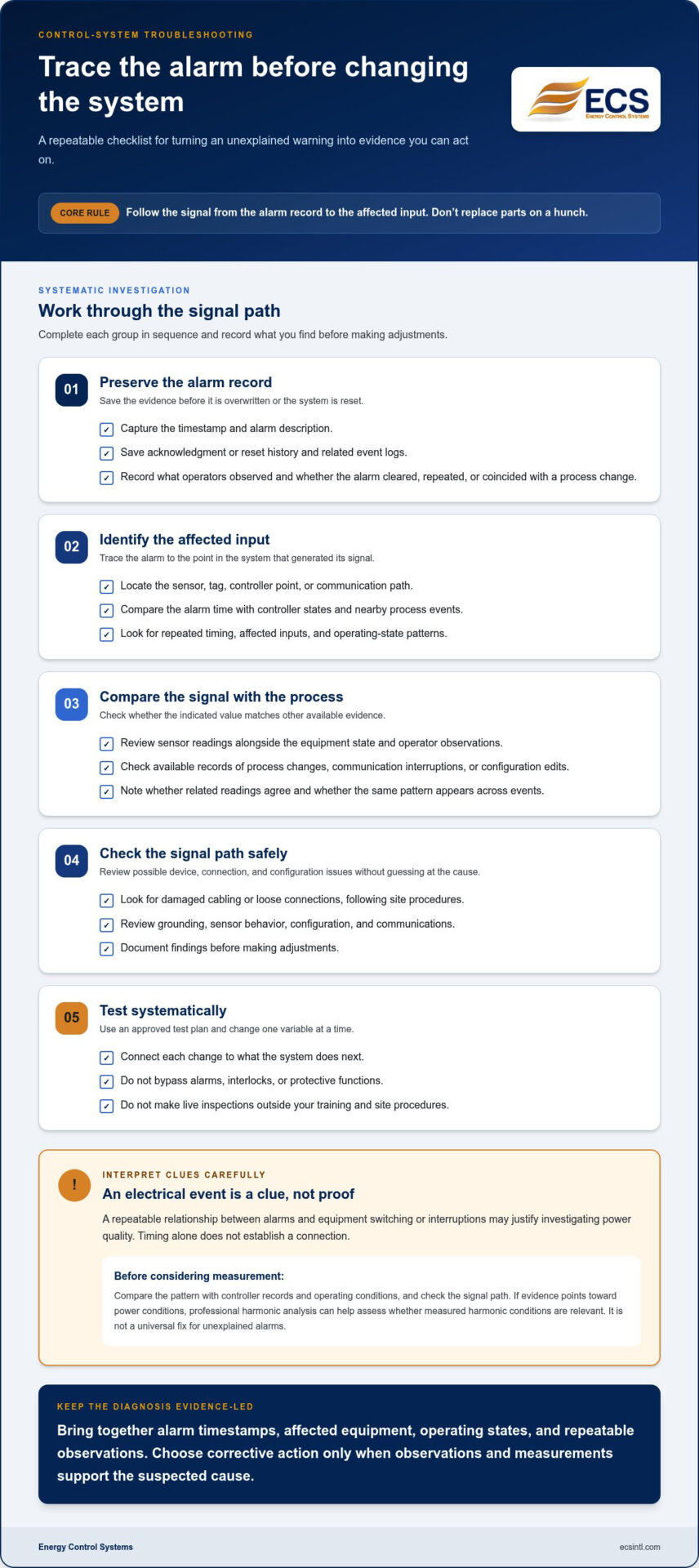
A repeatable process turns an unexplained warning into evidence you can act on. When troubleshooting ghost alarms in control systems, work from the alarm record toward the affected input. Check each part of the signal path in sequence rather than assuming the alarm identifies the faulty component.
- Preserve the alarm record. Save the timestamp, alarm description, acknowledgment or reset history, and related event logs before information is overwritten.
- Identify the affected input. Trace the alarm to its sensor, tag, controller point, or communication path. Compare its timestamp with controller states and nearby process events.
- Compare the signal with the process. Review the sensor reading and equipment state alongside available records of process changes, communication interruptions, or configuration edits. Note whether the indicated value agrees with other observations.
- Check the signal path safely. Following site procedures, look for damaged cabling or loose connections, and review grounding, sensor behavior, configuration, and communications. Document findings before making adjustments.
- Test systematically. Use an approved test plan and change one variable at a time. Don’t bypass protections or make live inspections outside your training and site procedures.
Changing one variable at a time makes each result easier to interpret, so you can connect a change to what the system does next.
What to check in alarm logs, sensors, wiring, and configuration
Compare repeated timestamps and alarm descriptions with controller states and nearby events. Check whether the same input changes state, whether related readings agree, and whether there are communication interruptions or configuration changes around the same time. Inspect for visible cable damage or loose connections only as allowed by site procedures, and record what you find before adjusting anything. A pattern that overlaps with an electrical event is a clue, not proof of a power-quality problem. If that path is plausible, review this guide to industrial surge protection devices. For a measured look at power conditions, professional harmonic analysis can help assess whether they may be relevant.
When power-quality analysis may help resolve recurring control-system alarms
Power quality is worth investigating when alarm records show a repeatable relationship with electrical events, such as alarms appearing around equipment switching or interruptions. Timing alone does not prove a connection. Compare the pattern with controller records and operating conditions, and check the signal path before deciding what to measure.
Harmonic analysis provides a measurement-led way to examine power conditions when the evidence points in that direction. It can help establish whether measured harmonic conditions are relevant to the issue, but it is not a universal fix for unexplained alarms. For an overview of this approach, see harmonic analysis for power stability.
From troubleshooting evidence to a targeted next step
Bring together alarm timestamps, affected equipment, operating states, and repeatable observations. This record helps focus professional harmonic analysis on the equipment and conditions associated with the alarms, rather than treating every unexplained warning as a power problem. Note gaps in the evidence too. They can help clarify what further measurement is needed.
Choose a corrective action only after observations and measurements support the suspected cause. If findings indicate a relevant surge-protection need, SineTamer surge protection may be appropriate to consider. If they point to a need for power continuity, consider whether a UPS is suitable. Neither should be treated as an automatic remedy for an alarm without supporting evidence.
For a recurring concern with evidence that suggests a power-quality issue, Energy Control Systems provides professional harmonic analysis to assess power conditions.
Turn recurring alarms into a clearer next step
A recurring alarm deserves investigation, even when it doesn’t match what you can see. Preserve its record, trace the affected input, and compare its timing with equipment state and process events. A pattern can guide your checks, but it isn’t proof of a cause. Keep protections in place, and let observations and measurements guide any corrective action.
That evidence-led approach is the heart of troubleshooting ghost alarms in control systems. When the record points toward a possible power-quality issue, professional harmonic analysis can help assess conditions before you decide what action makes sense. Energy Control Systems provides harmonic analysis, SineTamer surge protection devices, and UPS systems for power-quality needs.
If your documented observations suggest a power-quality concern, discuss it with Energy Control Systems. Use the alarm history and operating observations to guide a focused conversation about the next diagnostic step.
Frequently Asked Questions
What causes ghost alarms in control systems?
Ghost alarms can have several possible causes, and the alarm alone doesn’t identify which one is responsible. An intermittent sensor or connection issue, a configuration problem, communication interruptions, or electrical disturbances may warrant investigation. Compare the alarm with equipment conditions and event records. A warning that clears before inspection may still reflect a real, temporary fault.
How do you troubleshoot a false alarm on a PLC?
For troubleshooting ghost alarms in control systems, first preserve the PLC alarm record, including its timestamp and description. Identify the affected input, then compare its state with related controller records and process events. Review sensor readings, wiring, connections, grounding, configuration, and communications systematically. Change one variable at a time, document results, and don’t bypass alarms or protective functions during diagnosis.
Can electrical noise cause false alarms in control systems?
Electrical noise may be one possible factor to investigate, but an unexplained alarm doesn’t prove that noise is involved. Look for a repeatable relationship between alarm timestamps and electrical events, then assess whether measurements support that suspicion. Treat timing as a clue, not a diagnosis. Signal, wiring, sensor, configuration, or communication issues may also explain the alarm.
When should I request power-quality analysis for recurring control-system alarms?
Consider professional power-quality analysis when alarm logs and repeatable observations point toward a possible relationship with electrical events, and routine signal-path checks haven’t explained the pattern. Share documented timestamps, affected equipment, and operating conditions to help focus the investigation. Energy Control Systems provides professional harmonic analysis to assess power conditions; measured findings can guide decisions without assuming power quality is the cause.

Article by
Jeff Edwards
Founder of ECS International Inc. Edwards travels and speaks extensively in Latin America, Asia and Africa on the subject of power quality; transients and mitigating their impact on profitability. After graduating from Texas Tech University in Lubbock Texas, Edwards spent 9 years in the Telecommunications sector prior to founding Energy Control Systems in 1987 as a Texas based corporation selling surge suppression and UPS systems. The company has evolved into a global power quality products and energy efficiency concern with operations spanning South America, Asia, Europe and Africa.
Disclaimer
Some of the above information may be the opinion of the author.