

What if the “unexplained” failure that halted your production line at 2:00 AM wasn’t a mechanical fluke, but a predictable symptom of electrical chaos you can finally control? It’s exhausting to be the person everyone looks at when the motors stop. You’ve felt the weight of those expensive electronic failures and the frustration of staring at harmonic distortion reports that offer more questions than answers. You deserve more than just a running plant; you deserve the mental tranquility that comes with knowing your infrastructure is secure.
We understand that operational stability is your primary goal. This comprehensive 2026 power quality audit checklist is designed to move you from a state of reactive anxiety to total professional agency. By mastering these technical and operational steps, you’ll identify the hidden killers of your equipment before they cause a shutdown. We’ll walk you through the latest IEC TS 62749:2026 requirements and the critical NFPA 70 arc flash labeling updates that define modern standards. This guide provides a clear roadmap to diagnose disturbances, restore stability, and earn the recognition you deserve for improving your plant’s long-term reliability.
Key Takeaways
- Reclaim your peace of mind by identifying the real financial and emotional toll of downtime before conducting a visual facility walkthrough.
- Utilize a professional power quality audit checklist to measure Total Harmonic Distortion and monitor voltage sags over a critical 7-day window.
- Transform complex data into a compelling business case by correlating specific electrical disturbances with your most frequent equipment failures.
- Secure long-term operational relief by selecting protection strategies that address high-frequency noise and transients, not just large voltage spikes.
The Foundation of Stability: Your Power Quality Audit Pre-Checklist
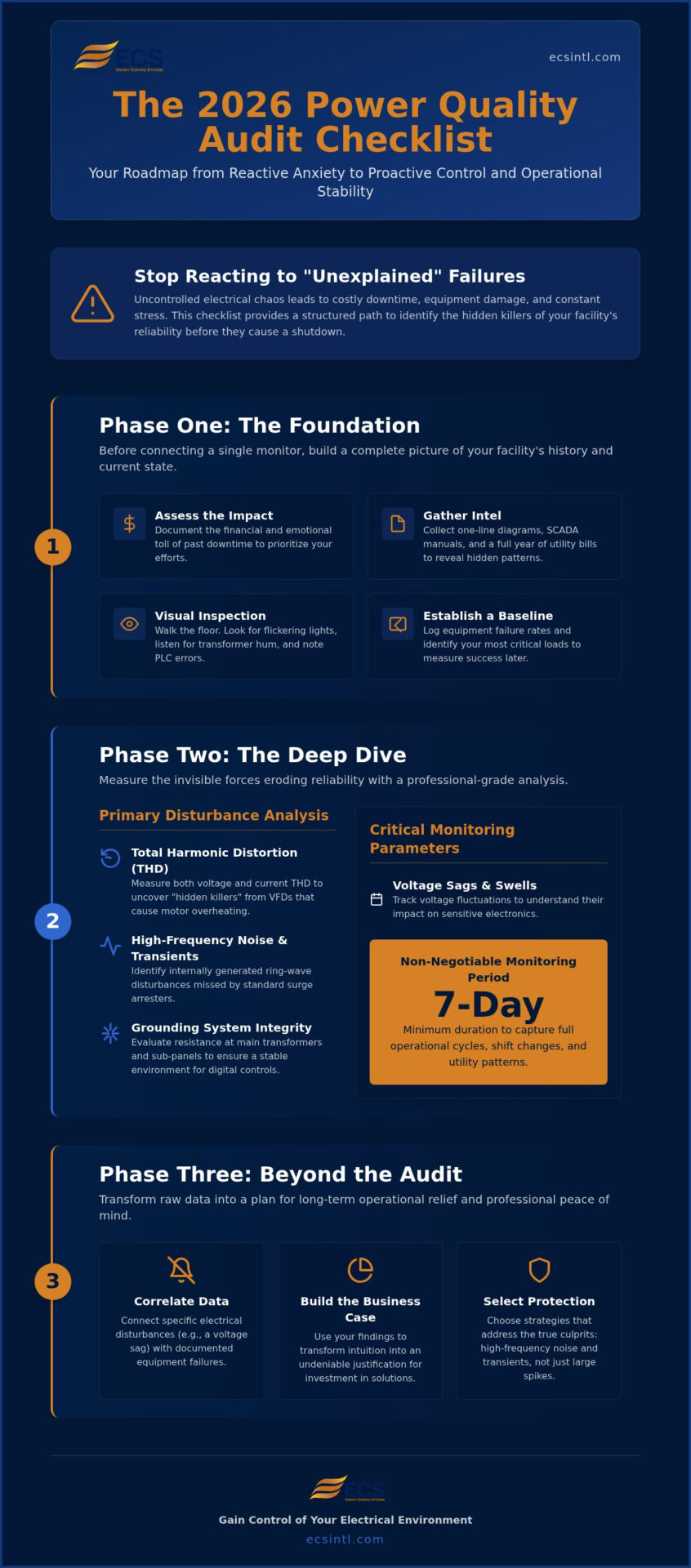
Before you hook up a single monitor, you must understand the landscape of your facility. A successful power quality audit checklist doesn’t start with hardware; it starts with history. You’ve felt the sting of a production halt that cost thousands per hour. Documenting these moments helps you prioritize your efforts where they matter most. It’s helpful to first understand what power quality is in a technical sense, but your immediate focus is on the human and financial toll. Gather your one-line diagrams and SCADA manuals now. These documents are your map through the chaos. Reviewing a full year of utility bills will reveal hidden patterns, such as peak demand charges or power factor penalties, that suggest your system is struggling under the surface.
The Visual Inspection: Spotting the Warning Signs
Walk your floor with a critical eye. Look for “ghosting” or flickering lights. These aren’t just minor annoyances. They’re often visible evidence of voltage sags that threaten sensitive electronics. Listen to your transformers. Excessive humming or heat signatures on enclosures are cries for help from stressed components. You might also notice frequent PLC communication errors or unexplained resets. Don’t dismiss these as simple software glitches. They are usually the first signs that your electrical environment is unstable and needs intervention.
When replacing damaged components or upgrading your facility’s digital infrastructure, choosing reliable computer hardware from a specialist provider like Computech-Solutions ensures that your new equipment meets the necessary standards for industrial resilience.
Data Gathering and Baseline Establishment
You need a baseline to prove your success later. Log your current equipment failure rates and compare them to known power events. This data transforms your intuition into an undeniable business case for restoration. Identify your most critical loads, the ones that simply cannot fail without catastrophic results. These are the primary candidates for an uninterruptible power supply. Establishing this foundation ensures your power quality audit checklist leads to a restorative solution rather than just a pile of confusing data.
The Deep Dive: Critical Parameters for Every Power Quality Checklist
Now that you’ve secured your baseline, it’s time to look at the invisible forces eroding your facility’s reliability. A professional power quality audit checklist must go beyond basic voltage readings. You need to measure Total Harmonic Distortion (THD) for both voltage and current to uncover the “hidden killers” of your industrial motors. High-frequency noise often masquerades as mechanical wear, but it’s actually an electrical disturbance stealing your uptime. Don’t forget to evaluate the grounding system resistance at your main transformer and sub-panels. Poor grounding doesn’t just invite safety risks; it creates a chaotic environment for your most sensitive digital controls, such as those found in high-end imaging labs where you can learn more about the investment required for precision electron microscopy equipment.
Harmonics and Frequency Stability
Non-linear loads like variable frequency drives (VFDs) are essential for efficiency, but they often inject harmonics that cause motor overheating and premature insulation failure. By performing a professional harmonic analysis, you can pinpoint these disturbances before they lead to a catastrophic shutdown. You should also verify frequency stability. Even slight deviations can disrupt the timing of your SCADA systems, leading to those frustrating synchronization errors that keep you up at night. For a structured approach to these measurements, the Energy Savings Toolbox manual provides excellent templates for identifying these opportunities.
Transients and Sags: The Silent Killers
Most standard surge arresters are designed for massive, external lightning strikes. They completely miss the high-frequency transients and “ring-wave” disturbances generated internally every time a large motor starts or a capacitor bank switches. Tracking voltage sags and swells over a minimum 7-day monitoring period is non-negotiable. This duration allows you to see how your facility reacts to different shifts and utility cycles. If you find that sags originate internally, it’s time to consider how professional harmonic analysis and protection can restore your facility’s equilibrium and your own professional peace of mind.
Beyond the Audit: Transforming Data into Operational Relief
Data alone won’t save your facility. It’s just a record of past frustrations. To achieve true operational relief, you must translate the numbers from your power quality audit checklist into a strategic defense plan. Correlating your findings with specific equipment failures allows you to build an undeniable case for investment. You’ve already identified the “hidden killers” in your system; now it’s time to stop them. Selecting the right surge protective device is critical. You need hardware that handles high-frequency noise and ring-waves, not just the rare lightning strike. Implementing a layered strategy begins at the service entrance with the SineTamer LA Series to create a primary shield for your entire infrastructure.
Mitigating Transient Damage with SineTamer
Protecting your most sensitive assets requires precision. For rack-mount electronics and control cabinets, applying SineTamer RM Series protection provides a dedicated line of defense where it’s needed most. SineTamer differs from standard arresters because it actively tracks the frequency of the AC sine wave to filter out damaging transients that other devices ignore. This level of protection restores your personal agency and ensures your SCADA systems remain stable, even in a chaotic electrical environment.
Finalizing Your Power Quality Strategy
Your work isn’t done once the monitors are removed. Present your results to stakeholders with a focus on both financial ROI and the mental tranquility of a stable plant. If you need to refine your initial findings or explain common visual cues to management, consulting an industrial walk-through audit guidebook can help clarify common electrical issues for non-technical decision makers. Finally, schedule a professional site analysis to confirm the optimal placement of your SPDs. This ensures your power quality audit checklist leads to a permanent monitoring schedule and long-term stability for your organization.
Claim Your Professional Peace of Mind
You don’t have to live with the constant threat of unexplained downtime. By utilizing a structured power quality audit checklist, you’ve taken the first step toward reclaiming control over your facility’s electrical health. You now understand how to spot the visual warning signs and why measuring high-frequency transients is critical for protecting your sensitive SCADA systems. This isn’t just about hardware; it’s about your right to a stress-free work environment where your expertise is recognized and your production lines remain steady.
Since 1987, we’ve stood as a protective partner for global industrial leaders facing these exact challenges. Our proprietary SineTamer technology and expert harmonic analysis services are designed to provide the stability you need to succeed. Don’t let electrical chaos dictate your schedule any longer. Download our comprehensive Power Quality Audit Guide and request a professional site analysis today. We’re here to help you restore your facility’s equilibrium and ensure your long-term professional success. You have the tools to secure your plant’s future, and we’re ready to help you implement them.
Frequently Asked Questions
What is the most common cause of power quality issues in industrial plants?
Internal equipment and operations cause the vast majority of all power quality disturbances within a facility. While it’s easy to blame the utility provider, your own variable frequency drives and heavy machinery starts often create the harmonics and voltage sags that disrupt sensitive digital controls. Identifying these internal sources is a primary goal of any thorough power quality audit checklist. It helps you stop the cycle of self-inflicted downtime and restores your operational stability.
How often should a facility perform a power quality audit?
You should perform a comprehensive audit at least once every year or whenever you install major new equipment. Industrial environments are dynamic; a single new production line can shift the electrical balance of your entire facility. Regular checkups ensure your protection strategies remain effective against evolving threats. This proactive schedule restores your agency and prevents small anomalies from turning into catastrophic failures that halt your operations and cause unnecessary stress for your team.
Can a power quality audit help reduce my monthly electric bill?
Yes, an audit identifies specific inefficiencies like low power factor and peak demand spikes that lead to expensive utility penalties. By analyzing your voltage and current waveforms, you can pinpoint where energy is being wasted as heat or harmonic distortion. Correcting these issues doesn’t just protect your hardware; it provides measurable financial relief by lowering your monthly operational costs. It’s a strategic way to improve your system efficiency and your bottom line.
What is the difference between a surge and a transient in a power audit?
A surge is typically a large, temporary increase in voltage often caused by external events like lightning or utility switching. Transients are much faster, high-frequency spikes or ring-waves that occur thousands of times a day from internal motor operations. While both cause damage, transients are the silent killers that slowly erode electronic components. Distinguishing between them on your power quality audit checklist is essential for selecting the correct suppression technology and achieving mental tranquility.

Article by
Jeff Edwards
Founder of ECS International Inc. Edwards travels and speaks extensively in Latin America, Asia and Africa on the subject of power quality; transients and mitigating their impact on profitability. After graduating from Texas Tech University in Lubbock Texas, Edwards spent 9 years in the Telecommunications sector prior to founding Energy Control Systems in 1987 as a Texas based corporation selling surge suppression and UPS systems. The company has evolved into a global power quality products and energy efficiency concern with operations spanning South America, Asia, Europe and Africa.
Disclaimer
Some of the above information may be the opinion of the author.