

Your million-dollar UPS is likely failing you every single day without you even knowing it. While it guards against total blackouts, it’s often blind to the high-frequency transients that slowly degrade your hardware. You’ve felt that sinking feeling when a server rack throws a “ghost” error at 3:00 AM, forcing you into another stressful emergency call. You’ve seen sensitive power supply units fail years before their time, leaving you to justify mounting replacement costs to leadership. It’s draining to live in a state of constant technical anxiety. A modern data center power protection strategy must evolve past the battery backup to address these hidden killers.
You deserve a “set and forget” environment where your infrastructure just works. We’re going to show you how to eliminate 99% of power-related downtime by focusing on frequency-based attenuation rather than simple voltage clamping. We’ll examine how incorporating the SineTamer ST Series allows you to move beyond the minimum requirements of the NEC 2026 updates. This guide provides the roadmap to restore your personal agency and achieve the mental tranquility that comes with a truly stabilized facility.
Key Takeaways
- Stop relying on a “UPS-only” mindset and learn to build a comprehensive data center power protection strategy that addresses high-frequency transients.
- Discover how a cascading defense model provides a multi-layered shield from the service entrance down to the sensitive point-of-use equipment.
- Uncover the “ghosts in the machine” with harmonic analysis to prevent overheating and unexplained neutral-to-ground voltage spikes.
- Verify your facility’s resilience by auditing grounding paths and ensuring all devices meet the latest IEEE C62.41 and C62.45 compliance standards.
- Transition from technical chaos to operational calm by applying the ECS framework to protect your hardware and your peace of mind.
The Hidden Vulnerabilities: Why a UPS is Not a Complete Data Center Power Protection Strategy
You likely invested heavily in a high-end Uninterruptible Power Supply (UPS) to safeguard your facility. It provides a sense of safety; you believe your data is secure because the batteries are charged. That safety is often an illusion. A truly resilient data center power protection strategy isn’t just about keeping the lights on during a blackout. It’s a holistic approach to maintaining both voltage and frequency stability every microsecond. Most standard UPS systems are designed to bridge the gap between utility power and a generator. They simply aren’t built to filter out the high-frequency noise that eats your hardware from the inside out.
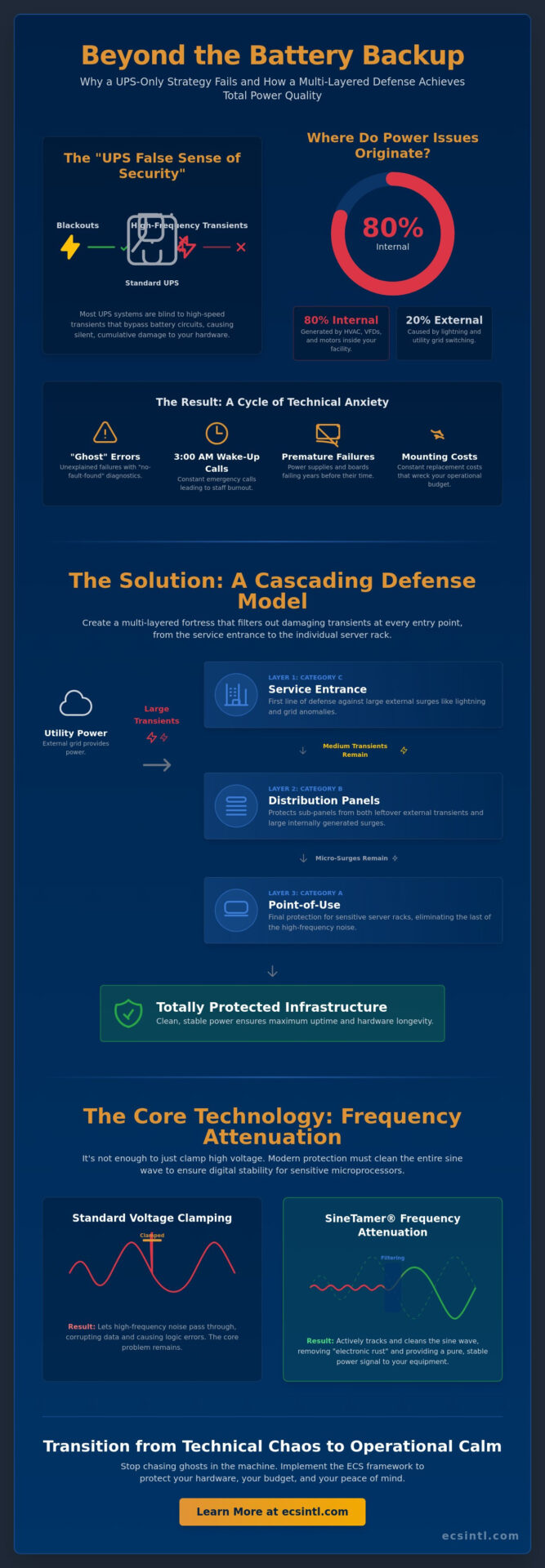
There’s a dangerous “UPS False Sense of Security” in the industry. While these units are excellent at handling total power loss, they’re often transparent to high-speed transients. These surges move too fast for standard battery bypass circuits to catch. This leads to the 80/20 rule of power quality: 80% of damaging transients are generated inside your own facility. Only 20% come from external events like lightning. This means your biggest threats are sitting right next to your server racks, generated by the very equipment you rely on to keep the building running.
The emotional toll on your IT staff is real. When transients bypass your UPS, they cause “no-fault-found” equipment failures. Your team spends hours, or even days, chasing “ghost” errors that leave no physical trace. It’s exhausting. It’s demoralizing. They feel like they’re losing their professional agency because they can’t find a logical reason for the downtime. We believe you deserve better than a life of 3:00 AM emergency calls and unexplained hardware swaps. True protection starts by looking at what’s happening inside your four walls.
Internal Transients: The Silent Killers of 2026
Your HVAC systems and Variable Frequency Drives (VFDs) are essential for cooling, but they’re also constant sources of micro-surges. Every time a motor cycles or a drive adjusts, it sends a ripple through your electrical system. These aren’t the catastrophic surges that blow fuses; they’re degradative. Think of it like sand in a precision engine. Over time, this “electronic rust” confuses microprocessor logic. Your hardware doesn’t die instantly; it just stops being reliable. This cumulative effect is what leads to those premature power supply failures that wreck your budget and your peace of mind.
The Role of Frequency Attenuation in Digital Stability
Modern high-speed processors operate at incredibly tight tolerances. Simple voltage clamping isn’t enough for them anymore. Standard protectors wait for a massive voltage spike before they react, but by then, the high-frequency noise has already corrupted your data. You need sine wave tracking. This technology monitors the actual shape of the power wave and removes the noise before it reaches the logic gate. By implementing the SineTamer LA Series, you restore signal integrity. You give your processors a clean, stable environment. You finally gain the “set and forget” environment that allows you to focus on growth rather than fire drills.
The Cascading Defense Model: Implementing a Multi-Layered SPD Strategy
Relying on a single point of protection is a gamble you don’t have to take. True resilience comes from a cascading defense that meets the threat at every possible entry point. This tiered approach is the backbone of a modern data center power protection strategy. By placing specific safeguards at the service entrance (Category C), distribution panels (Category B), and point-of-use (Category A), you create a gauntlet that transients simply cannot survive. This isn’t just about hardware redundancy; it’s about building a fortress that preserves your uptime and your professional reputation.
The physical installation of these devices is just as critical as their specifications. We always recommend “side-mounting” for data center SPDs. This method allows for the shortest possible lead lengths, which is vital because every inch of wire adds impedance. High impedance slows down the response time of the protector, letting damaging energy slip through to your sensitive racks. A low-impedance pathway ensures that the surge is diverted to ground instantly. When your system is installed with this level of precision, you gain the relief of knowing your infrastructure is truly stabilized.
Tier 1: Service Entrance and Transfer Switch Protection
Your first line of defense starts where the utility meets your building. Type 1 SPDs at the service entrance are designed to handle the massive energy of external switching events and lightning. This layer is also your primary shield during generator testing. When your Automatic Transfer Switch (ATS) cycles, it can create significant voltage instability that threatens your downstream components. Category C devices must maintain a let-through voltage that remains significantly lower than the basic impulse level of the facility’s main switchgear to prevent insulation breakdown.
Tier 2: PDU and Critical Branch Circuit Safeguards
Once you’ve secured the perimeter, you must address the noise generated within your own walls. Integrating surge protective devices at the distribution panel level isolates your server rows from the “dirty” power created by cooling pumps and HVAC cycling. These internal loads often introduce current harmonics in data centers, which can distort the sine wave and lead to mysterious equipment reboots. By protecting the PDU and branch circuits, you ensure that the power reaching your high-density racks is clean and quiet. If you aren’t sure where your greatest vulnerabilities lie, a professional Harmonic Analysis can provide the clarity you need to move forward with confidence.
Harmonic Analysis: Identifying the “Ghost in the Machine”
You’ve built a multi-layered defense, but your equipment still acts up. Sometimes, the threat isn’t a sudden surge; it’s a persistent, rhythmic distortion of the power wave itself. This is harmonic distortion. It’s the invisible friction in your electrical system that causes neutral-to-ground voltage to climb. When non-linear loads pull current in pulses, they create high-frequency “ghosts” that haunt your infrastructure. A comprehensive data center power protection strategy is incomplete without addressing this fundamental waveform health.
These harmonics do more than just make lines look messy on a scope. They physically punish your hardware. They cause transformers to hum and overheat even when they aren’t at full load. They stress server power supplies, forcing them to work harder to filter out the noise. Think of a professional Harmonic Analysis as an MRI for your electrical system. It moves you from a state of anxious guessing to a state of diagnostic certainty. You stop chasing shadows and start making data-backed decisions. This clarity restores your professional agency and gives you the confidence to stand before leadership with a proven plan for stability.
Symptoms of Poor Power Quality in Data Centers
How do you know if harmonics are the culprit? Look for the physical signs of stress. Overheating cables in your conduit or premature battery failure in your UPS units are classic red flags. You might also notice unexplained PLC communication errors that disrupt your automation. These aren’t just technical glitches; they’re symptoms of a system under constant strain. When you have the data from a professional analysis, you can finally justify infrastructure investments to your CFO. You move the conversation from “I think we need this” to “Here is the verified risk we are mitigating.”
The ECS Approach to Site-Specific Analysis
Generic solutions don’t work for complex data centers. Every facility has a unique electrical fingerprint. We move beyond “one-size-fits-all” hardware to provide custom-engineered power quality. Professional monitoring is essential because a “one-time” snapshot can miss the transients that occur during peak loads or specific operational cycles. By implementing harmonic conditioning as part of your overall strategy, you significantly reduce the total cost of ownership for your entire facility. You protect your hardware, extend its lifespan, and finally achieve the mental tranquility you’ve been working toward.
Critical Checkpoints for Data Center Power Resilience
Your data center power protection strategy requires more than just high-end hardware; it demands rigorous verification. You can’t manage what you don’t measure. The first step in securing your facility is ensuring every protective device meets IEEE C62.41 and C62.45 standards. These aren’t just technical benchmarks. They’re your assurance that your equipment can survive the specific surge environments and repetitive transients common in high-density facilities. If your devices aren’t tested to these standards, you’re essentially flying blind.
Grounding is the unsung hero of power quality. You must conduct a thorough audit of your grounding and bonding systems to guarantee a low-impedance path to earth. Without this, even the best surge protector is handcuffed. Energy needs a place to go. If the path to ground is restricted, that damaging energy will reflect back into your sensitive microprocessor logic. This leads to the very “ghost” errors and premature failures you’re trying to avoid. A clean, low-resistance ground restores your personal agency by giving you a predictable, stable foundation.
Consistency is the final piece of the resilience puzzle. Establish a strict maintenance schedule to inspect SPD status indicators. A protector that has sacrificed itself to save your servers is no longer protecting anything. It’s a silent vulnerability. Regular checks ensure you never lose that “set and forget” peace of mind. You owe it to yourself and your team to move beyond reactive maintenance and toward a culture of proactive stability. Secure your entire infrastructure now with the SineTamer ST Series for total facility protection.
Rack-Level Protection for 2026 Server Densities
Modern blade servers and high-density clusters pack incredible processing power into tiny spaces. They’re also incredibly sensitive to the smallest voltage fluctuations. This is why the SineTamer RM Series is a critical checkpoint for any modern facility. By placing protection directly at the rack, you safeguard the “brain” of your data center from the noise generated by neighboring equipment. It reduces the immense stress of rack-level troubleshooting. You gain the relief of knowing your most expensive assets are shielded by a dedicated, local defense.
Cooling and Fire Suppression: The Forgotten Infrastructure
It’s easy to focus solely on the servers, but your cooling and fire suppression systems are just as vital. A single surge in a chiller or a cooling pump can trigger a thermal event that takes down the entire server farm in minutes. You must also protect your fire alarm control panels and access control systems. These components often rely on outdoor units that are prime targets for lightning transients. Protecting this “forgotten” infrastructure is essential for total operational tranquility. It ensures that a peripheral failure doesn’t escalate into a facility-wide catastrophe.
Reclaiming Uptime: The ECS Framework for Total Power Quality
Your uptime is your professional reputation. We protect both. At Energy Control Systems, our philosophy is simple: effective protection is about the human behind the hardware. We know the weight you carry when the facility is at risk. We understand the frustration of chasing errors that shouldn’t exist. A truly successful data center power protection strategy doesn’t just save servers; it restores your personal agency and grants you the mental tranquility you’ve earned. You should be able to trust your infrastructure, not fight it.
We’ve spent decades helping operators transition from a state of constant “firefighting” to one of proactive management. When you address the root causes of power instability, the 3:00 AM emergency calls disappear. The “ghost” errors vanish. You gain the freedom to focus on high-level strategy and infrastructure growth rather than hardware survival. This is the relief that comes from a stabilized environment. We’re here to be your steady hand in a complex and often chaotic technological landscape.
Why Industry Leaders Trust SineTamer
For over 35 years, Energy Control Systems has been a global leader in power quality. While others focus on basic surge suppression, we’ve perfected the Frequency Attenuation Network. This unique technology sets the SineTamer series apart by cleaning the entire sine wave, not just clamping the highest peaks. Our legacy is built on proven results in the world’s most demanding environments. Industry veterans rely on us because our systems have a documented history of reducing downtime by 99% in facilities plagued by chronic power issues. We don’t just sell hardware; we provide a legacy of stability.
Your Next Steps Toward Total Stability
Achieving a “set and forget” environment starts with a clear understanding of your specific needs. Every facility has a unique electrical fingerprint, which is why we recommend a professional site audit as your first step. We combine this with a comprehensive Harmonic Analysis to uncover the hidden distortions that threaten your uptime. From there, we help you select the precise mix of LA, RM, and ST series devices to build your cascading defense. You have the right to a stress-free work environment. Empower your team and secure your uptime with ECS.
Secure Your Legacy of Absolute Operational Tranquility
You now have the roadmap to move beyond the limitations of standard battery backups. By embracing frequency attenuation and a multi-layered defense, you protect the microprocessors that are the heart of your operation. A modern data center power protection strategy is no longer a luxury; it’s a fundamental requirement for professional agency in a high-stakes industry. You have the tools to eliminate the hidden transients that steal your time and your peace of mind.
We’re here to help you implement these changes with confidence. With over 35 years of global industrial expertise and our patented SineTamer Frequency Attenuation Network technology, we provide the stability you need to succeed. Our comprehensive Harmonic Analysis services ensure that your diagnostic decisions are backed by hard data rather than guesswork. It’s time to stop reacting to failures and start commanding your infrastructure.
Restore your peace of mind; Schedule your Data Center Power Quality Audit today.
You’ve done the hard work of identifying the risks. Now, let’s build the fortress your facility deserves. Your path to a stabilized, “set and forget” environment starts today.
Frequently Asked Questions
Does my UPS provide enough surge protection for a data center?
No, a standard UPS is designed for power continuity; it isn’t a dedicated surge suppressor. Most units let high-frequency transients pass directly to your servers while the system is on utility power. This gap in your data center power protection strategy leaves sensitive logic gates vulnerable to internal noise. You need a dedicated SPD to handle the high-speed events that batteries simply can’t see.
What is the difference between a surge and a transient in data center power?
Surges are high-energy events like lightning that typically last for milliseconds. Transients are sub-microsecond bursts of high-frequency energy often caused by internal equipment like HVAC systems or VFDs. While surges are catastrophic and visible, transients are degradative. They act like sand in a precision engine; they slowly wear down the microprocessors you rely on for 24/7 uptime.
How often should I conduct a harmonic analysis of my facility?
You should schedule a professional harmonic analysis at least once per year or whenever you add significant new loads to your floor. Think of it as a wellness check for your electrical system’s health. It uncovers the hidden distortions that lead to overheating cables and neutral-to-ground voltage issues. This proactive step keeps your facility stabilized and ensures your team isn’t chasing “ghost” errors.
Can low-level transients really damage server hardware over time?
Yes, low-level transients cause cumulative damage often called “electronic rust.” Every micro-surge slightly degrades the microscopic insulation pathways within your server’s processors. You won’t see a puff of smoke today, but you’ll face an unexplained failure six months from now. Protecting against these silent killers is the only way to ensure long-term hardware reliability and restore your professional agency.
What is the best placement for an SPD in a data center environment?
Effective placement requires a cascading approach. You must protect the service entrance to stop utility-side events and the distribution panels to isolate internal noise from cooling systems. Finally, rack-level protection for your high-density clusters ensures that the most sensitive “brains” of your operation remain shielded. This multi-layered defense is the only way to achieve a truly “set and forget” power environment.
How do I know if my current surge protection strategy is failing?
Look for the “ghosts” in your racks. If your team is constantly troubleshooting “no-fault-found” reboots or replacing power supplies years before their expected end-of-life, your current strategy is failing. These are the physical symptoms of electrical stress. Ignoring these signs leads to the high-stakes pressure of 3:00 AM emergency calls and mounting frustration for your IT staff.
What is sine wave tracking and why is it critical for digital technology?
Sine wave tracking is a technology that monitors the actual shape of the electrical wave rather than waiting for a fixed voltage spike. It’s critical because modern digital processors are sensitive to noise that occurs well below standard clamping levels. By following the sine wave, you can filter out high-frequency interference before it corrupts your data. This ensures your high-speed logic stays stable and reliable.
Does a data center power protection strategy help with energy efficiency?
A robust data center power protection strategy definitely improves your facility’s efficiency. By using harmonic analysis to identify and mitigate waveform distortion, you reduce the wasted energy that dissipates as heat in your transformers and cables. This lowers your cooling demands and helps you meet the stricter PUE requirements of 2026, such as the German Energy Efficiency Act’s 1.2 PUE mandate.

Article by
Jeff Edwards
Founder of ECS International Inc. Edwards travels and speaks extensively in Latin America, Asia and Africa on the subject of power quality; transients and mitigating their impact on profitability. After graduating from Texas Tech University in Lubbock Texas, Edwards spent 9 years in the Telecommunications sector prior to founding Energy Control Systems in 1987 as a Texas based corporation selling surge suppression and UPS systems. The company has evolved into a global power quality products and energy efficiency concern with operations spanning South America, Asia, Europe and Africa.
Disclaimer
Some of the above information may be the opinion of the author.