

What if the UPS protecting your critical equipment isn’t the whole answer to a damaging surge? Surge protection for industrial UPS systems depends on more than one device. Built-in UPS protection may not address every disturbance across a facility, because UPS systems and surge protective devices play distinct, complementary roles.
You’ll learn how they work together, what site conditions to assess, and how to plan a more resilient power-protection strategy. Start by mapping the electrical environment: where disturbances occur, which power paths they can affect, and which loads need protection. This guide covers the considerations that shape a coordinated plan, how power-quality analysis can clarify recurring problems, and how surge suppression options such as the SineTamer LA Series fit into the discussion.
Key Takeaways
- A UPS supports continuity during power interruptions, while surge protection addresses transient overvoltage. Treat them as complementary layers, not substitutes.
- Assess surge protection for industrial ups by mapping critical loads and tracing power paths, including UPS input, output, bypass, and downstream equipment.
- Review disturbance history to help define protection needs and identify where more site-level insight may be useful.
- An equipment review, power-path assessment, or harmonic analysis can help inform next steps, including consideration of the SineTamer LA Series.
Surge Protection for Industrial UPS Systems: What Each Layer Does
Surge protection for industrial UPS systems addresses transient overvoltage: brief voltage disturbances that can stress connected equipment. A UPS has a different primary role. It supports continuity when incoming power is interrupted, using stored energy to keep supported loads operating for a period of time. These functions complement each other, but neither replaces the other.
Why a UPS and surge protective device are not interchangeable
Consider a power path from a facility distribution panel through a UPS to a control system. If supply power drops, the UPS can provide battery-backed continuity to its supported load. If a transient travels along the power path, a surge protective device (SPD) is intended to address that overvoltage. A Surge Protector can help explain the basic function, but industrial protection decisions also depend on where devices sit in the actual system.
Think in layers, not labels. A UPS may include surge-related protection, but that alone doesn’t establish whether the complete installation is adequately protected. Relevant paths can include the UPS input, output, bypass, and connections to sensitive downstream equipment. Trace these routes in each operating configuration, then identify which critical loads share each path. The protection arrangement should reflect the installation, rather than assume the same devices suit every facility.
Start by identifying what must stay operational and how power reaches it. Then consider where transient protection may be needed in relation to those loads and the UPS. Device selection and placement should follow the installation’s conditions and protection needs, not a product description alone. For context on UPS functions and system planning, see this industrial UPS guide. Understanding this distinction gives you a clearer foundation for assessing the power paths around critical equipment.
How to Assess Surge Protection Needs Around an Industrial UPS
A useful assessment starts with the loads and follows the power path, rather than beginning with a device catalogue. This makes it easier to see where protection may be needed and which disturbances warrant investigation.
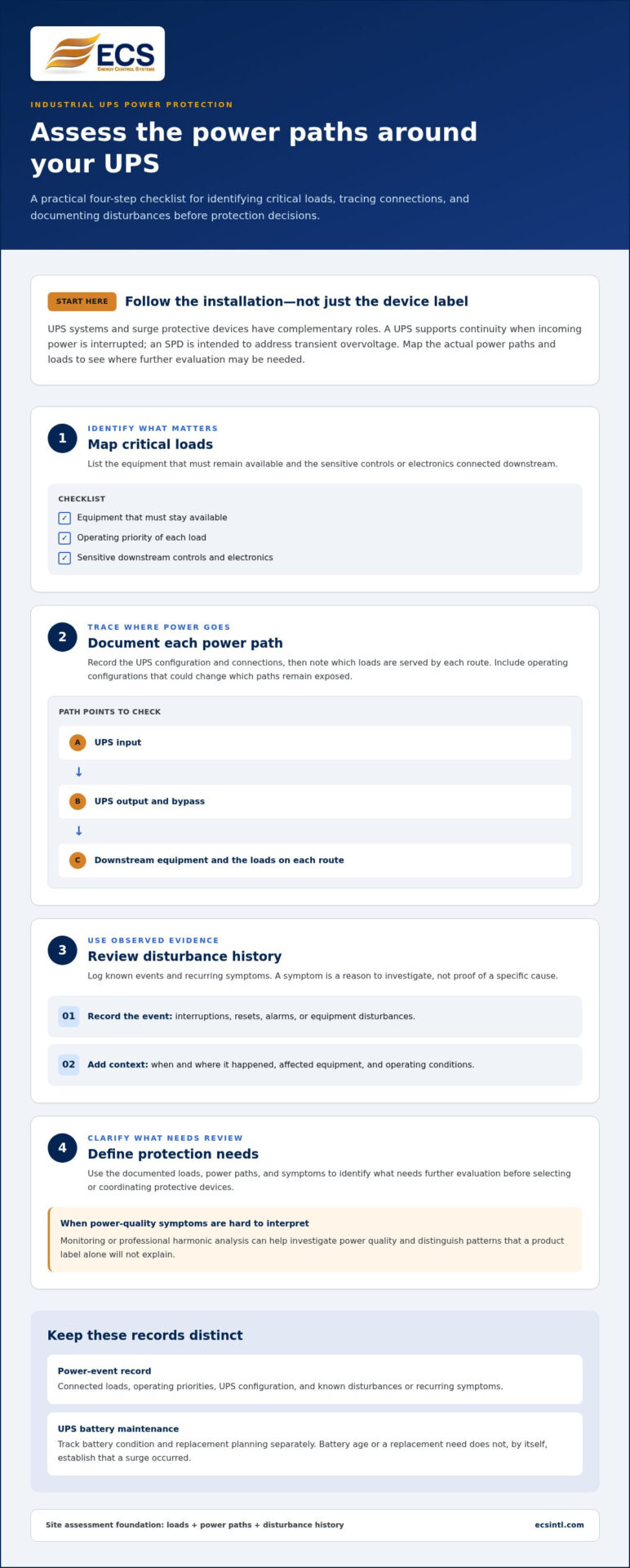
- Map critical loads. List the equipment that must remain available, its operating priority, and the sensitive controls or electronics connected downstream.
- Trace each power path. Document the UPS topology and connections through its input, output, and bypass. Include downstream equipment and note which loads are served by each route, so the assessment doesn’t overlook a path that may remain exposed when operating conditions change.
- Review disturbance history. Record known interruptions, resets, alarms, or equipment disturbances, along with when and where they occurred. A recurring symptom is a reason to investigate, not proof of a specific cause.
- Define protection needs. Use the documented loads, paths, and symptoms to identify what needs further evaluation before selecting or coordinating protective devices.
What to document before selecting or coordinating protection
Keep a concise record of connected loads, operating priorities, UPS configuration, and known power events. For recurring symptoms, note the affected equipment, operating conditions, and timing. Monitoring or professional harmonic analysis can help investigate power quality and distinguish patterns that a product label alone won’t explain. The NEMA Surge Protection Institute on SPDs offers background on surge protective devices; for industrial context, this surge protective device guide connects SPD concepts to broader power-quality planning.
Track UPS battery condition and replacement planning as separate maintenance tasks. Battery age or a replacement need doesn’t, by itself, establish that a surge occurred. Keeping battery records separate from disturbance logs helps ground troubleshooting in evidence. When recurring power-quality symptoms are difficult to interpret, professional harmonic analysis can help inform the assessment.
Choosing the Next Step for Industrial UPS Surge Protection
The right next step depends on what your site review reveals. If you’re unsure which equipment is most exposed, begin by listing critical loads and the power paths serving them. If the concern is how disturbances could travel through the installation, focus on connections around the UPS, including input, output, and bypass. When symptoms recur or their cause is unclear, professional harmonic analysis can help build a clearer picture of power quality.
Turn site findings into a coordinated protection plan
Bring the findings together before deciding on surge protection for industrial UPS systems. Summarize known disturbances, critical loads, existing UPS equipment, and unanswered questions about the electrical environment. This creates a practical foundation for protection planning and helps distinguish what’s understood from what needs further investigation.
Energy Control Systems provides UPS and surge protection hardware, along with professional harmonic analysis. Analysis can help investigate site conditions, while equipment choices should reflect the needs identified in that review. The SineTamer LA Series is one ECS surge-protection offering. Use your documented power paths, critical loads, and disturbance history to guide how it fits into the wider protection plan.
Keep the plan specific to your installation. Document the loads that matter most, the power paths serving them, and the disturbances you’re trying to understand. Then use those findings to guide the next conversation, rather than relying on a product label to answer every question. You can share your site findings with Energy Control Systems as part of your power-quality planning.
Take the Next Step Toward a More Resilient Power Plan
Use your site findings to shape a practical power-quality review. Identify the loads that matter most, note what you still need to understand, and decide which questions should guide the assessment. That preparation can help your team move forward with greater clarity instead of relying on assumptions.
For surge protection for industrial ups, Energy Control Systems offers professional harmonic analysis and SineTamer LA, RM, and ST-PCMF Series products, alongside UPS systems. These options support different parts of power-quality planning, from investigating site conditions to addressing identified equipment-protection needs.
Discuss your industrial power-quality requirements with Energy Control Systems. Share your critical loads, UPS configuration, and known disturbances to start a focused conversation about your site.
Frequently Asked Questions
Can an industrial UPS protect equipment from every power surge?
No. An industrial UPS shouldn’t be assumed to stop every surge from reaching every connected device. Protection depends on the UPS design, the disturbance, and the wider installation. For example, equipment connected to a separate branch circuit may not share the same protection path as a load supplied by the UPS. Review the equipment documentation and full system layout before relying on UPS protection alone.
Should a surge protector be plugged into an industrial UPS?
Not automatically. Adding a plug-in surge protector downstream can affect the intended power arrangement, and compatibility depends on the UPS and protective device. Don’t daisy-chain power strips or add a device based only on its label. Follow the equipment manufacturers’ guidance and consider the connection as part of the complete power path, especially for critical control or process equipment.
Can surge protection prevent industrial UPS battery failure?
No. Surge protection isn’t a substitute for battery inspection or maintenance, and a battery problem doesn’t prove a surge occurred. For instance, a UPS runtime that falls below operational needs calls for checking battery condition and replacement history, not assuming the cause. Keep battery records separate from disturbance logs so troubleshooting can follow evidence rather than a guess.
When should an industrial facility consider harmonic analysis?
Consider harmonic analysis when recurring power-quality concerns remain unexplained, or when changes to equipment or operating patterns raise questions about electrical conditions. For example, if alarms or control interruptions appear during particular production periods, record their timing and affected equipment before investigating. Professional analysis can help characterize power-quality conditions and inform decisions about UPS and surge protection needs.

Article by
Jeff Edwards
Founder of ECS International Inc. Edwards travels and speaks extensively in Latin America, Asia and Africa on the subject of power quality; transients and mitigating their impact on profitability. After graduating from Texas Tech University in Lubbock Texas, Edwards spent 9 years in the Telecommunications sector prior to founding Energy Control Systems in 1987 as a Texas based corporation selling surge suppression and UPS systems. The company has evolved into a global power quality products and energy efficiency concern with operations spanning South America, Asia, Europe and Africa.
Disclaimer
Some of the above information may be the opinion of the author.