

You are standing on the factory floor at 2:00 AM, staring at a frozen VSD and wondering why a brand-new motor just burned out again. It’s a frustrating, expensive cycle that drains your budget and your sleep. You know that standard surge suppression isn’t enough. However, deciding on the specific SineTamer RM vs LA series configuration can feel like a high-stakes gamble with your infrastructure’s health. We understand the weight of that decision. It’s not just about hardware; it’s about the relief that comes from knowing your assets are truly safe.
You deserve a facility that runs with predictable, boring consistency. We promise to help you discover the technical differences between these two powerhouses so you can eliminate industrial downtime and protect your sensitive electronics once and for all. This article provides a clear comparison of the 10-mode versus 7-mode protection levels. We also explain how the Frequency Attenuation Network technology restores total operational stability to your facility, giving you the validation you need to choose best-in-class protection for your team.
Key Takeaways
- Move beyond basic surge suppression by understanding how the Frequency Attenuation Network® filters out the silent electrical noise that destroys sensitive PLCs.
- Identify the ideal placement for the SineTamer RM vs LA series by using LA units for total path protection at service entrances and RM units for individual equipment.
- Master the technical difference between 10-mode and 7-mode protection to ensure your infrastructure isn’t left vulnerable to surges on overlooked electrical paths.
- Secure your peace of mind and professional reputation with a 25-year warranty that guarantees your facility remains a stable environment in a chaotic power landscape.
Beyond Basic Suppression: The SineTamer LA and RM Families
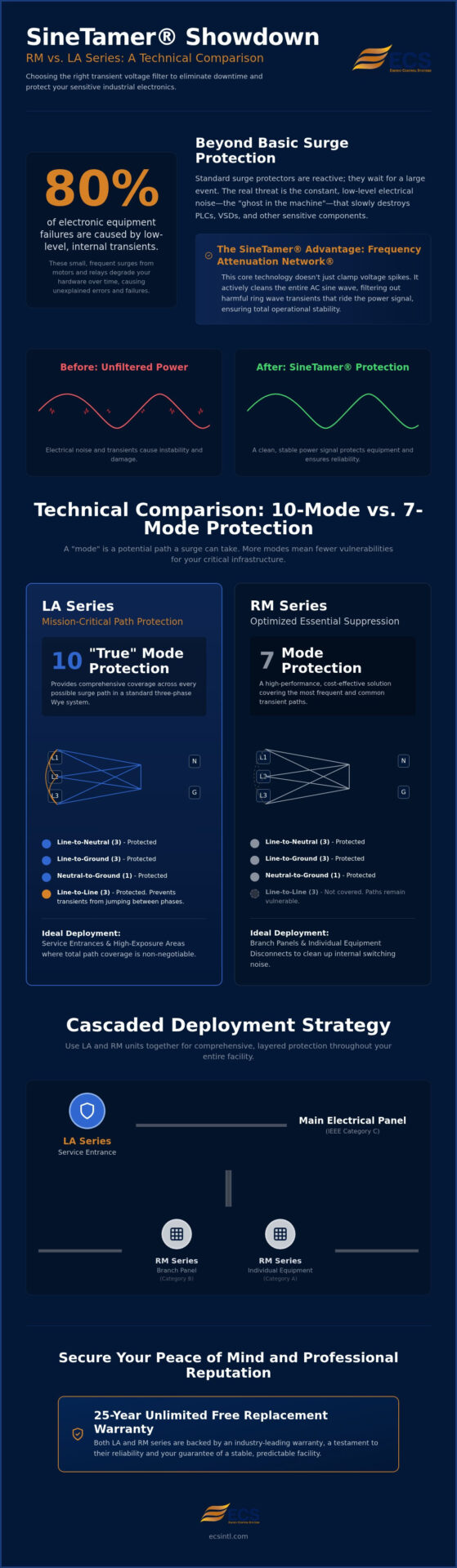
Standard surge protectors are reactive. They wait for a disaster. But for a facility manager, the real disaster isn’t always a lightning strike. It’s the “ghost in the machine” that causes a PLC to reboot or a VSD to lose its programming without warning. This is where the SineTamer RM vs LA series changes the conversation. While most people understand how surge protectors work at a basic level, SineTamer operates as a sophisticated transient voltage disturbance filter. It doesn’t just clamp high-voltage spikes; it cleans the power signal entirely.
Both families are engineered to survive and thrive in IEEE Category C, B, and A environments. They don’t just sit idle. They actively stabilize your infrastructure, providing a steady hand in a chaotic electrical landscape. By focusing on transient filtering rather than simple surge suppression, these units address the root cause of operational instability.
The Silent Killer: Why Transients Matter
External events like lightning get the headlines, but they aren’t the primary threat to your uptime. Industry data suggests that 80% of electronic equipment failures are caused by low-level, internal transients. These are generated every time a motor starts or a relay clicks. They are small. They are frequent. Over time, they degrade sensitive components until your hardware simply gives up. SineTamer stops this erosion, protecting your investment from the inside out and ending the cycle of unexplained communication errors.
The SineTamer Advantage: Frequency Attenuation
The secret to this protection is the Frequency Attenuation Network®. Whether you are evaluating the SineTamer RM vs LA series, this core technology remains the foundation of your facility’s defense. Standard devices only care about voltage peaks. SineTamer tracks the AC sine wave itself. By identifying and eliminating ring wave transients that “ride” the power signal, it provides a level of stability that generic devices cannot match. This technology restores your personal agency. You no longer have to react to mysterious failures. Instead, you can trust your equipment to perform, knowing that our 25-year unlimited free replacement warranty stands as a testament to this seasoned protector’s reliability.
Technical Comparison: 10-Mode vs. 7-Mode Protection
The technical heart of the SineTamer RM vs LA series debate lies in how many “doors” you choose to lock. In electrical engineering, a “mode” of protection refers to the path a surge or transient can take through your system. Electricity always follows the path of least resistance. If your protective device doesn’t cover a specific path, the surge will simply bypass the filter and strike your sensitive components. Choosing the right mode isn’t just a technical detail. It’s about ensuring your peace of mind when the next storm or industrial switching event occurs.
Both series offer various peak surge current options to handle different levels of exposure. However, the fundamental difference is how they map to your facility’s wiring. If you are unsure which configuration fits your specific transformer setup, you can explore our full range of SineTamer solutions to find the perfect match for your infrastructure.
The LA Series: Mission-Critical Path Protection
The LA series is a “True 10-Mode” device. In a standard three-phase Wye system, this means it provides protection across every possible connection: Line-to-Neutral (3), Line-to-Ground (3), Line-to-Line (3), and Neutral-to-Ground (1). Most standard protectors ignore the Line-to-Line paths. This is a mistake. Transients often jump between phases, and the LA series stands as a seasoned protector to stop them. Use the LA series at service entrances and high-exposure areas where total path coverage is non-negotiable.
The RM Series: Optimized Essential Suppression
The RM series is a 7-mode unit. It covers the most frequent transient paths: Line-to-Neutral, Line-to-Ground, and Neutral-to-Ground. It is a cost-effective, high-performance solution designed for branch panels and individual equipment disconnects. While it lacks the Line-to-Line protection of the LA series, it still utilizes the same Frequency Attenuation Network® technology. This makes the RM series an ideal stabilizer for downstream loads where the primary goal is cleaning up internal switching noise rather than defending against massive external surges.
- LA Series: 10-Mode coverage, includes Line-to-Line protection, best for service entrances.
- RM Series: 7-Mode coverage, optimized for branch panels and essential equipment.
- Both: Feature a 25-year unlimited free replacement warranty and UL 1449 4th Edition listing.
Deployment Strategy: Matching Your Facility Needs
You’ve analyzed the technical modes. Now it’s time to map them to your floor plan. The decision between the SineTamer RM vs LA series comes down to where you need the most muscle. Think of your facility like a fortress. You don’t just guard the front gate; you secure the vault, too. Proper deployment restores your personal agency, allowing you to stop reacting to failures and start managing a stable environment.
Where the LA Series Wins
The LA series is your front-line defender. It’s built for main distribution panels and facilities that endure heavy lightning exposure. If you need to shield your entire infrastructure from unpredictable grid-side disturbances, this is your solution. It provides the heavy-duty filtration required to stop external transients before they ever reach your sensitive interior circuits. For a deeper dive into these heavy-duty units, consult our SineTamer LA Series guide.
Where the RM Series Excels
Localized protection requires a different touch. The RM series is perfect for PLC cabinets, SCADA systems, and sensitive automation equipment. It’s the ideal stabilizer when space is tight but the stakes for uptime are high. Because it’s optimized for essential loads, it provides a cost-effective way to ensure your most expensive electronics aren’t degraded by internal switching noise. You can learn more about these versatile units in our SineTamer RM Series guide.
Performance depends on the details. Lead length is critical. Every extra inch of wire between the panel and the device adds impedance, which slows down the response time. Keep your leads as short as possible. Aim for under six inches. We also recommend internal installation whenever possible. This minimizes the distance the transient has to travel before it’s filtered, maximizing the effectiveness of the Frequency Attenuation Network®.
This isn’t just a hardware purchase. It’s a commitment to your professional peace of mind. Our 25-Year Unlimited Free Replacement Warranty acts as a stability promise. It ensures that your facility remains a calm harbor in a chaotic technological landscape. You’ve done the work. You’ve chosen the best. Now, enjoy the silence of a facility that finally works exactly how it should.
Restore Stability to Your Industrial Infrastructure
Choosing between the SineTamer RM vs LA series is more than a technical decision; it’s a commitment to your facility’s long-term health. You now understand that the LA series offers the heavy-duty, 10-mode path protection required for service entrances, while the RM series provides optimized, 7-mode suppression for sensitive downstream electronics. Both utilize our proprietary Frequency Attenuation Network® to filter out the silent electrical noise that standard devices miss. This technology has been shown to reduce industrial downtime by up to 80% in many environments.
You don’t have to face these high-stakes decisions alone. With our 25-year unlimited free replacement warranty and global technical support, we stand as your seasoned protector in a chaotic power landscape. It’s time to stop the cycle of unexplained errors and reclaim your professional peace of mind. Contact our technical team for a site analysis and custom SineTamer recommendation today. We are ready to help you build a more resilient, stable future for your operation.
Frequently Asked Questions
What is the primary difference between SineTamer RM and LA series?
The main distinction lies in the number of protection modes each unit provides. The LA series is a true 10-mode device that offers total path coverage, while the RM series is a 7-mode unit optimized for essential loads. While both utilize our Frequency Attenuation Network® technology, the LA series covers Line-to-Line paths that the RM series does not. This makes the SineTamer RM vs LA series choice a matter of whether you need to protect a main distribution panel or a specific piece of downstream equipment.
Does the SineTamer LA series protect against lightning better than the RM series?
Yes, the LA series is better suited for facilities with heavy lightning exposure because it covers every possible electrical path. Lightning creates massive surges that can jump between phases. Because the LA series includes Line-to-Line protection, it acts as a more comprehensive shield for your entire infrastructure. It’s the seasoned protector you want at your main distribution panel to stop high-energy external threats before they ever reach your sensitive interior circuits.
Can I use the RM series at my facility service entrance?
We generally don’t recommend using the RM series at a main service entrance if your facility has high exposure to external surges or lightning. While the RM series is a high-performance unit, it’s specifically designed for branch panels and localized protection near individual equipment. For service entrances, the 10-mode protection of the LA series is the best-in-class choice for total path coverage. Selecting the correct SineTamer RM vs LA series configuration ensures your facility remains a stable environment during chaotic weather events.
What does “10-mode protection” actually mean for my equipment?
10-mode protection means that every possible electrical path in a three-phase Wye system is covered. This includes Line-to-Neutral, Line-to-Ground, Neutral-to-Ground, and Line-to-Line connections. Without this level of coverage, a surge could find an unprotected path and damage your sensitive PLCs or VSDs. It’s about closing every loophole. This comprehensive approach restores your personal agency and gives you total peace of mind knowing your assets are safe from every possible angle.
Article by
Jeff Edwards
Founder of ECS International Inc. Edwards travels and speaks extensively in Latin America, Asia and Africa on the subject of power quality; transients and mitigating their impact on profitability. After graduating from Texas Tech University in Lubbock Texas, Edwards spent 9 years in the Telecommunications sector prior to founding Energy Control Systems in 1987 as a Texas based corporation selling surge suppression and UPS systems. The company has evolved into a global power quality products and energy efficiency concern with operations spanning South America, Asia, Europe and Africa.
Disclaimer
Some of the above information may be the opinion of the author.