

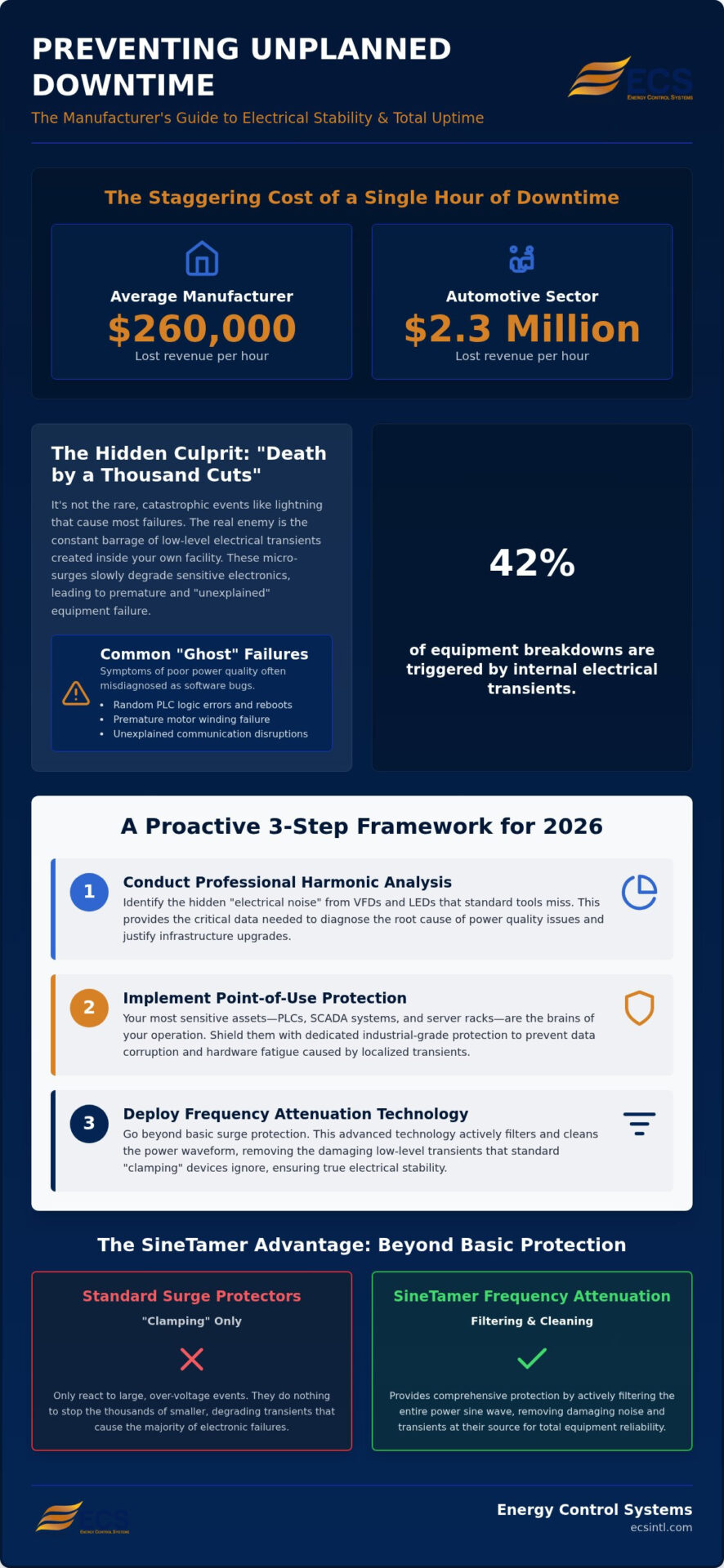
Did you know the average manufacturer loses $260,000 for every single hour of unplanned downtime? In the automotive sector, that figure rockets to over $2.3 million per hour. These aren’t just cold statistics; they represent the high-stakes reality of preventing unplanned downtime in manufacturing. You’ve likely felt the weight of these numbers during a 2 AM emergency call or while troubleshooting another “unexplained” PLC reset that halts production. It’s a budget-draining cycle of small repairs that steals your weekends and your peace of mind.
We understand the frustration of doing everything right, yet still facing equipment failure. You deserve a facility that runs with absolute certainty. By targeting the hidden electrical transients that trigger 42% of equipment breakdowns, you can finally move from reactive chaos to total uptime. This article previews the essential power quality strategies for 2026, including the latest IEC TS 62749 standards. You’ll learn how to protect your hardware, slash O&M costs, and reclaim the mental tranquility that comes with a job well done.
Key Takeaways
- Identify the “death by a thousand cuts” caused by low-level transients that standard surge protectors often ignore.
- Master a proactive 3-step framework for preventing unplanned downtime in manufacturing that prioritizes electrical stability over reactive repairs.
- Discover why professional Harmonic Analysis is the critical first step to uncovering hidden electrical noise that resets PLCs and disrupts communication.
- Learn how Frequency Attenuation technology in the SineTamer LA and RM Series provides a level of protection that basic clamping devices simply cannot match.
- Transform your facility’s reliability to gain recognition for reduced O&M costs and finally enjoy the peace of mind you deserve during off-hours.
The Hidden Culprit: Why Standard Maintenance Fails to Stop Downtime
Unplanned downtime is any event that halts production outside of your scheduled windows. It is the silent thief of profitability and the primary enemy of your Overall Equipment Effectiveness (OEE). While most facility leaders focus on mechanical wear, the true cause of failure often hides within the copper wires of your building. This is the missing piece in preventing unplanned downtime in manufacturing.
You’ve likely experienced the “Death by a Thousand Cuts.” This isn’t a single catastrophic event like a lightning strike. Those are rare. Instead, your equipment suffers from thousands of low-level transients every day. These internal switching transients occur every time a motor starts, a load shifts, or a breaker cycles. They don’t blow fuses immediately. They slowly degrade sensitive silicon components until they simply stop working. This creates a massive emotional and financial burden. You’re left dealing with the stress of emergency repairs and the frustration of missed production targets.
The Limitations of Preventive Maintenance
Traditional preventive maintenance focuses on the physical. You grease the bearings. You tension the belts. You check the oil. While these tasks are essential, they do nothing to protect the digital brains of your operation. Modern automated lines rely on SCADA systems that are incredibly vulnerable to micro-fluctuations in power. If your strategy doesn’t account for electrical stability, your mechanical maintenance is only half the battle. You need a foundation of clean power to truly secure your facility.
Identifying ‘Ghost’ Failures in PLCs and Motors
Do your PLCs suffer from logic errors or random reboots? Do your motors fail prematurely even though they’re properly loaded? These are “ghost” failures. They are the hallmark symptoms of poor power quality. Often, these issues are dismissed as software bugs or “bad luck,” but the culprit is usually transient voltage. Transient voltage is a high-speed, high-energy power surge. These surges punch through the insulation of motor windings and scramble the delicate logic of your controllers. Recognizing these signs is the first step toward restoring operational certainty and personal agency over your production schedule.
A 3-Step Framework for Preventing Unplanned Downtime in 2026
To stop the exhausting cycle of 2 AM emergency calls, you need a roadmap that addresses the root cause of electrical instability. Moving your facility from a reactive state to a proactive one requires more than just better software. It requires a physical strategy. This framework is designed to restore your personal agency and ensure your production lines remain steady and predictable.
- Step 1: Conduct a Professional Harmonic Analysis. This process identifies the “electrical noise” that standard maintenance tools often miss. It reveals how your own equipment might be polluting your power grid.
- Step 2: Implement Point-of-Use Protection. Your sensitive digital technology and server racks are the brains of your operation. They require dedicated shields to prevent data corruption and hardware fatigue.
- Step 3: Deploy Frequency Attenuation Technology. Unlike standard surge protectors that only “clamp” high voltages, this technology cleans the power at the source. It filters out the low-level transients that cause preventing unplanned downtime in manufacturing to feel like an impossible goal.
The Role of Professional Harmonic Analysis
Modern manufacturing floors are packed with non-linear loads like Variable Frequency Drives (VFDs) and LED lighting. While energy-efficient, these devices create harmonic distortion that can overheat neutral wires and cause mysterious equipment trips. A professional site analysis empowers you with data. You’ll have the evidence needed to justify infrastructure upgrades to corporate leadership, transforming you from a “firefighter” into a strategic asset for the company.
Beyond technical data, identifying external capital recovery options like Trump Tariff Relief can provide the necessary budget to fund these critical upgrades and further enhance your strategic value to the organization.
Ensuring Continuity with Industrial UPS Systems
Don’t make the mistake of trusting a standard office UPS in a rugged industrial environment. They aren’t built to handle the heat or the high-energy transients common on a factory floor. Integrating a true industrial uninterruptible power supply unit bridges the gap during voltage sags and momentary interruptions. While an AI-powered predictive maintenance platform can warn you about mechanical issues, only a robust power strategy stops the electrical crashes before they happen. If you’re ready to secure your facility’s future, a professional power quality assessment is your first step toward tranquility.
The SineTamer Advantage: Protecting the Heart of Your Automation
The SineTamer LA Series is more than just hardware; it is the definitive shield for your facility. While typical power filters wait for a disaster, SineTamer acts as a seasoned protector for your most sensitive electronics. It targets the roots of instability by utilizing Frequency Attenuation. This proprietary technology doesn’t just wait for a massive spike. It actively cleans the power profile, ensuring your machinery operates in a stable, predictable environment. This is the gold standard for preventing unplanned downtime in manufacturing.
Investing in this level of protection delivers a profound long-term ROI. You’ll see a sharp decline in replacement costs for circuit boards and sensors. Your machinery lifespan extends because it’s no longer being “cooked” by low-level electrical noise. If you are decommissioning older, damaged hardware during your facility upgrades, you can learn more about eWaste Solutions to handle your electronics recycling responsibly. Most importantly, it restores your personal agency. You can finally step away from the plant floor with the certainty that your systems will still be running when you return. We provide the stability you need to reclaim your evening tranquility.
Why Standard Surge Protective Devices (SPDs) Aren’t Enough
Most surge protective devices are designed for catastrophic events like lightning. They only trigger at high voltage thresholds, often 500 or 600 volts. By the time they “clamp” the surge, your PLC has already locked up or suffered internal damage. As highlighted in a technical DOE Advanced Manufacturing Office report, maintaining high productivity requires a deeper focus on operational reliability. SineTamer tracks the sine wave in real-time. It eliminates the high-frequency noise that standard SPDs simply ignore, protecting the digital heartbeat of your automation 24/7.
Empowering Your Team with Total Uptime
When you solve the “ghost in the machine” problems, everything changes for your team. Implementing SineTamer reduces the high-stakes stress that leads to workforce burnout and emergency repair fatigue. You stop being the person who manages crises and start being the leader who optimized the facility for total uptime. This shift in preventing unplanned downtime in manufacturing positions you as the hero who finally solved the downtime problem. You gain the recognition you deserve for reducing O&M costs while creating a calmer, more successful work environment for everyone under your watch.
Reclaiming Operational Certainty and Peace of Mind
You don’t have to accept equipment failure as an inevitable part of your workday. True success in preventing unplanned downtime in manufacturing starts by looking beyond the mechanical belt and into the electrical foundation of your facility. By addressing the “death by a thousand cuts” caused by low-level transients, you transform your plant from a source of stress into a model of reliability. You’ve seen how standard protection falls short. Now, it’s time to implement a strategy that actually works.
With over 35 years of global power quality expertise, we’ve battle-tested our solutions in the world’s most demanding environments. Whether you need a professional Harmonic Analysis to solve complex facility issues or the industry-standard protection of the SineTamer LA Series, we are here to restore your personal agency. You can be the leader who finally ends the cycle of emergency repairs and secures your team’s success. Restore your facility’s stability with a professional SineTamer solution today.
Your journey toward total uptime and mental tranquility starts with a single, decisive step. We are ready to stand as your seasoned protector and help you achieve the professional recognition you deserve.
Frequently Asked Questions
What is the most common cause of unplanned downtime in manufacturing?
Equipment failure is the leading culprit, accounting for 42% of all unplanned downtime incidents. While many facility managers focus on mechanical wear, the root cause is frequently “electronic fatigue” caused by thousands of daily internal power fluctuations. These micro-stresses degrade circuit boards until they fail, making electrical stability a primary factor in preventing unplanned downtime in manufacturing.
How does a surge protective device (SPD) actually prevent downtime?
A surge protective device acts as a high-speed gatekeeper that diverts excess voltage away from your sensitive controllers. While standard units only “clamp” large spikes, advanced technology like SineTamer tracks the sine wave to eliminate low-level noise. This prevents the “ghost” errors and random PLC resets that halt production lines and frustrate your maintenance team.
Can harmonic distortion cause equipment to fail without a power surge?
Yes, harmonic distortion is a silent killer of modern industrial machinery. It doesn’t require a single massive surge to cause damage. Instead, it creates continuous “electrical noise” and heat that degrades insulation and confuses digital logic. This distortion often originates from the very VFDs and LED systems you installed to improve facility efficiency.
How often should a manufacturing plant conduct a power quality audit?
You should ideally schedule a professional Harmonic Analysis or power quality audit every three to five years. It’s also vital to perform an assessment whenever you add significant new loads, such as a new automated cell or a large motor bank. Staying proactive with these audits is essential for preventing unplanned downtime in manufacturing as your facility’s electrical footprint evolves.

Article by
Jeff Edwards
Founder of ECS International Inc. Edwards travels and speaks extensively in Latin America, Asia and Africa on the subject of power quality; transients and mitigating their impact on profitability. After graduating from Texas Tech University in Lubbock Texas, Edwards spent 9 years in the Telecommunications sector prior to founding Energy Control Systems in 1987 as a Texas based corporation selling surge suppression and UPS systems. The company has evolved into a global power quality products and energy efficiency concern with operations spanning South America, Asia, Europe and Africa.
Disclaimer
Some of the above information may be the opinion of the author.