

The biggest electrical threat to your plant isn’t a violent lightning strike hitting the utility feed. It’s the silent, continuous micro-transients generated right on your factory floor. When automated machinery freezes without warning, preventing industrial downtime from power surges becomes an urgent battle to protect your line and stop thousands of dollars per minute in lost output.
Few things drain an operations team faster than 2 a.m. emergency calls, chasing ghost faults, and replacing blown control boards with no obvious culprit. You shouldn’t have to manage a facility in perpetual firefighting mode. In this guide, you’ll discover how to isolate destructive electrical transients at the machine level, protect sensitive robotics, and permanently eliminate costly production halts. We will walk through the modern, cascaded protection strategies you need to restore stability and turn erratic equipment into predictable, reliable operations.
Key Takeaways
- Discover why standard utility lightning arresters fail to protect sensitive electronics from high-frequency internal switching events.
- Master the 3-tier cascaded suppression model essential for preventing industrial downtime from power surges across automated assembly lines.
- Learn how isolating branch panels shields microprocessors and PLCs from destructive electrical noise generated by nearby heavy inductive loads.
- Identify the critical testing procedures, including harmonic analysis and ground loop audits, required to eliminate chronic electrical disruptions permanently.
The Hidden Surge Epidemic: Why Internal Transients Paralyze Industrial Machinery
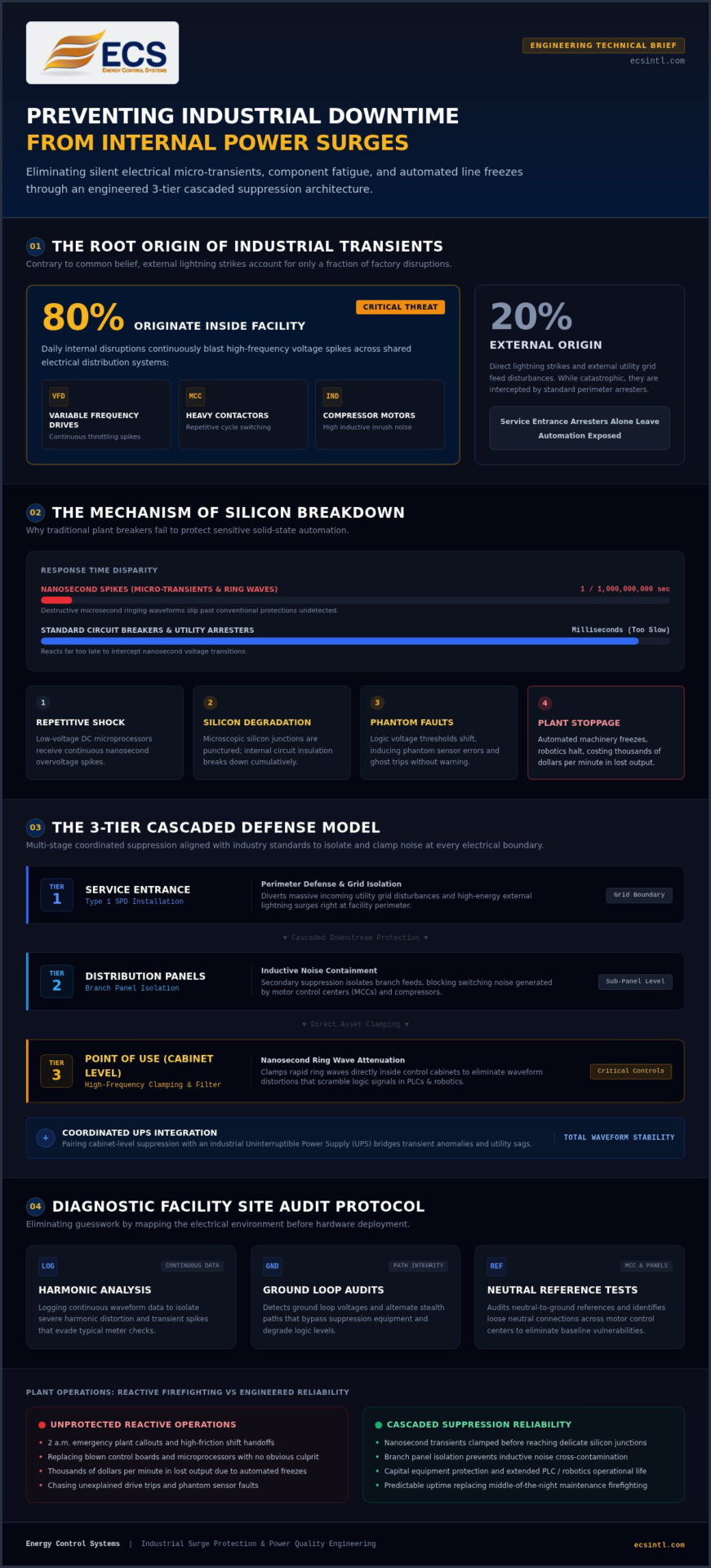
Most operations teams view power surges as explosive, external lightning strikes. While direct strikes grab headlines, they aren’t what silently dismantles modern production floors. Instead, an estimated 80% of electrical transients originate inside your facility. Every time variable frequency drives throttle, heavy contactors cycle, or compressor motors switch on, they blast high-frequency voltage spikes across your shared electrical distribution. Successfully preventing industrial downtime from power surges requires isolating these daily internal disruptions. Installing a basic surge protector only at the service entrance leaves sensitive automation exposed to continuous electrical shock from within.
The Anatomy of Component Fatigue in Automated Controls
Miniature microprocessors and programmable logic controller (PLC) boards run on sensitive, low-voltage direct current. When microsecond ringing transients wash over these control circuits, they gradually puncture microscopic silicon junctions. The damage is rarely instant; it is cumulative. Each nanosecond transient degrades internal insulation, shifts logic thresholds, and triggers phantom sensor faults that halt production lines without an obvious trigger.
Standard circuit breakers and utility-grade arresters react in milliseconds, far too late to intercept nanosecond voltage spikes. For maintenance leaders, this repetitive electrical abuse creates immense personal friction: chronic reactive firefighting, unexplained drive trips, and exhausting middle-of-the-night emergency plant calls. Achieving complete operational reliability means stopping these destructive micro-transients before they slowly ruin your high-dollar capital equipment.
A 3-Tier Cascaded Strategy for Preventing Industrial Downtime from Power Surges
Relying on a single line of defense leaves critical automation vulnerable. True plant resilience requires an engineered, multi-layered architecture aligned with established industry standards. A cascaded defense distributes suppression across three coordinated tiers:
- Tier 1: Service Entrance. Heavy-duty Type 1 units divert massive grid disturbances and external utility surges right at your facility perimeter.
- Tier 2: Distribution Panels. Secondary suppression isolates branch panels, containing inductive switching noise from motor control centers and compressors.
- Tier 3: Point of Use. Dedicated devices clamp high-frequency ringing transients directly at sensitive automation controls.
This multi-stage architecture delivers comprehensive protection, preventing industrial downtime from power surges before electrical noise reaches your microprocessors. For facilities commissioning new production lines or advanced automated cells, working with custom robotic system integrators like rwcinc.com helps ensure that robotic tooling, automation simulations, and control hardware are planned with optimal reliability in mind.
Coordinating Point-of-Use Filtering with Primary Panel Suppression
Standard panel arresters divert large surges, but they allow rapid ring waves to slip past. Delicate robotics, high-speed packaging machinery, and SCADA nodes require immediate, localized attenuation. Integrating an engineered surge protective device directly inside control cabinets eliminates waveform distortions that scramble logic signals.
Pairing cabinet-level suppression with an industrial uninterruptible power supply bridges transient anomalies and utility sags. You protect capital investments, stop frantic emergency repairs, and gain the predictability your team deserves.
Executing Facility Site Audits to Permanently Eliminate Downtime Risks
Guesswork cannot solve chronic electrical faults. Before installing hardware, engineers must map the electrical environment through thorough diagnostic Harmonic Analysis. Logging continuous waveform data reveals severe harmonic distortion, loose neutral connections, and ground loop voltages that create stealthy alternate paths for destructive transients. Aligning your facility with recognized industrial surge protection standards ensures your grounding network actively supports suppression equipment rather than bypassing it.
Auditing neutral-to-ground references across motor control centers and distribution panels isolates baseline vulnerabilities. This technical evaluation lays the groundwork for preventing industrial downtime from power surges, transforming erratic power feeds into clean, predictable circuits tailored precisely to your plant’s topology.
Empowering Maintenance Teams from Firefighting to Total Reliability
Armed with precise site data, plants can deploy targeted defenses like the SineTamer LA Series to shield heavy distribution networks against brutal electrical spikes. Moving from frantic emergency repairs to an engineered protection plan does more than protect machinery; it restores your personal peace of mind.
You don’t have to stay stuck in reactive firefighting mode. When you stop nuisance PLC lockups and safeguard capital investments, you gain internal executive recognition as a driver of plant reliability. Reclaim your schedule, protect your team, and take control of operational uptime with a comprehensive engineering site evaluation.
Reclaim Operational Certainty and Protect Your Facility Floor
Stopping mysterious PLC lockups and chaotic emergency repairs starts with recognizing that clean power is an engineered defense. Implementing a coordinated, three-tier shield and validating your grounding network transforms intermittent headaches into predictable operations. Successfully preventing industrial downtime from power surges requires dedicated frequency-tracking suppression designed specifically to protect sensitive microprocessors from internal switching wear.
Since 1987, Energy Control Systems has delivered proven industrial protection across 40+ countries, empowering facility leaders to trade middle-of-the-night fire drills for total operational calm. You have the power to protect your line and reclaim your schedule. Contact Energy Control Systems to audit your facility and eliminate surge-related downtime and secure true long-term reliability.
Frequently Asked Questions
Why do power surges still shut down equipment if our main switchgear has a surge arrester?
Main switchgear arresters only divert catastrophic external lightning strikes and gross utility surges. They can’t catch the high-frequency switching transients generated downstream by your own variable frequency drives and compressors. Effectively preventing industrial downtime from power surges requires point-of-use suppression directly at machine control cabinets to stop internal ring waves that service entrance units completely ignore.
How do internal micro-transients damage industrial automation if no breaker trips?
Breakers react to prolonged thermal overloads and short circuits, taking milliseconds to trip. In contrast, switching micro-transients strike and vanish in nanoseconds. This speed allows high-voltage spikes to bypass trip mechanisms entirely. Over time, these recurring spikes degrade silicon junctions inside microprocessors, causing memory corruption, mysterious PLC freezes, and unexpected board failures without ever tripping an overcurrent device.
What is the difference between a standard surge arrester and an engineered transient suppression device?
Standard arresters act as basic voltage threshold clamps designed strictly for gross energy diversion during major faults. Engineered transient suppression devices, such as the SineTamer series, utilize active frequency tracking. They monitor the alternating current sine wave dynamically, attenuating low-level ringing transients and high-frequency noise that easily bypass passive clamping components, ensuring sensitive automated lines stay operational.
Can uninterruptible power supply (UPS) units replace dedicated surge protective devices in automated plants?
No, a UPS cannot replace dedicated surge protective devices. An industrial UPS maintains steady voltage during blackouts or sags, but extreme voltage spikes can easily destroy its sensitive internal inverter. Installing engineered surge suppression ahead of the UPS protects the battery backup system itself, forming a complete defense that is vital for preventing industrial downtime from power surges.

Article by
Jeff Edwards
Founder of ECS International Inc. Edwards travels and speaks extensively in Latin America, Asia and Africa on the subject of power quality; transients and mitigating their impact on profitability. After graduating from Texas Tech University in Lubbock Texas, Edwards spent 9 years in the Telecommunications sector prior to founding Energy Control Systems in 1987 as a Texas based corporation selling surge suppression and UPS systems. The company has evolved into a global power quality products and energy efficiency concern with operations spanning South America, Asia, Europe and Africa.
Disclaimer
Some of the above information may be the opinion of the author.