

A surge can damage industrial equipment without leaving a visible mark. Identifying power surge damage in industrial equipment means looking for sudden resets, communication faults, unstable outputs, or component failures, then assessing the affected system through visual inspection and electrical and operational testing. Signs may appear after a storm or emerge later as recurring faults.
It’s frustrating when a machine stops working and the cause isn’t obvious. This guide explains which industrial and electronic equipment is vulnerable, what damage can look like, and how to evaluate a suspected surge safely. You’ll also learn what can affect repair costs, how downtime affects efficiency, and how surge protection and power-quality analysis can help reduce future disruption.
Key Takeaways
- Look beyond visible damage: resets, communication faults, and unstable outputs can point to surge-related problems.
- Prioritize PLCs, motors, drive systems, and other connected electronics when assessing equipment vulnerability.
- Weigh repair needs alongside downtime, fire risk, and lost production when considering the impact of surge damage.
- Use inspection, testing, and power-quality analysis to understand system conditions and inform protection decisions.
Repair costs, safety, and operational efficiency
A surge can leave hidden faults as well as failed parts, so repair decisions can affect both safety and production.
Repair Costs and Equipment Downtime
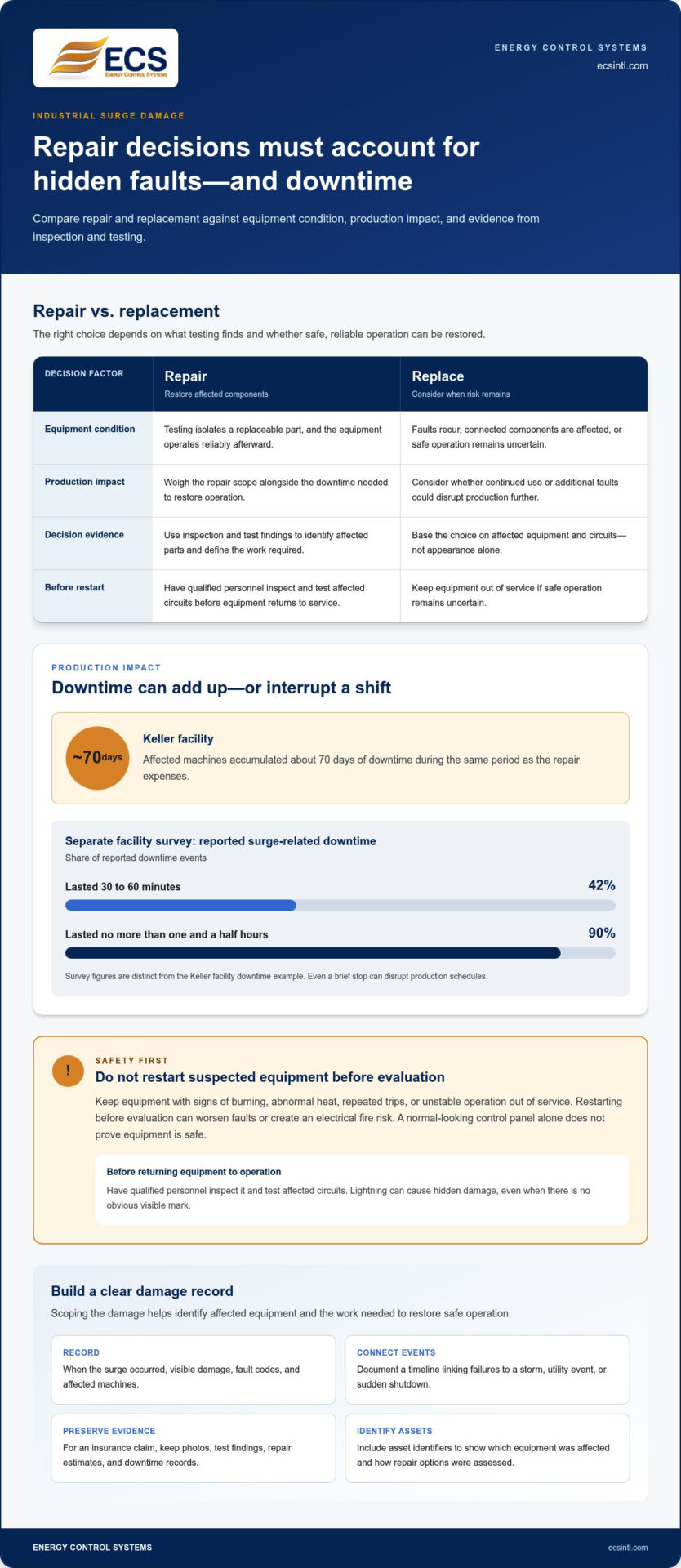
Repair costs include restoring damaged components and managing lost operating time. At the Keller facility, affected machines accumulated about 70 days of downtime during the same period as those repair expenses. A separate facility survey found that 42% of reported surge-related downtime lasted 30 to 60 minutes, while 90% lasted no more than one and a half hours. Even a brief stop can disrupt production schedules.
Repair Versus Replacement Decisions
The decision depends on the condition of damaged components and the cost and operational impact of continued use. Repair may make sense when testing isolates a replaceable part and the equipment operates reliably afterward. Replacement may be more appropriate when faults recur, connected components are affected, or safe operation remains uncertain. Compare the scope of repairs with potential downtime and the equipment’s role in production.
Damage Scoping and Repair Options
Scoping the damage identifies affected equipment and the work needed to restore safe operation. Record when the surge occurred, visible damage, fault codes, and affected machines. For an insurance claim, preserve photos, test findings, repair estimates, and downtime records. Include asset identifiers and a timeline linking failures to a storm, utility event, or sudden shutdown. These details help document the cause and show how repair options were assessed.
Risks of Restarting Suspected Equipment
Restarting equipment before evaluation can expose weakened components to another operating cycle, worsen faults, or create an electrical fire risk. Keep equipment with signs of burning, abnormal heat, repeated trips, or unstable operation out of service. Have qualified personnel inspect it and test affected circuits before restarting. Lightning can cause hidden damage, so an apparently normal control panel alone does not prove the equipment is safe to operate.
Industrial and electronic equipment vulnerable to surges
Surges can affect equipment connected to a facility’s electrical system, even when machines show no visible damage. Programmable logic controllers (PLCs), motors, and drive systems are vulnerable because they rely on electrical components to control production. A PLC fault can disrupt signals to several machines, while a damaged motor drive can interrupt the process it powers.
Solar and wind installations also include exposed equipment. Surges can damage inverters, controllers, and transformers, affecting how energy is converted or managed. In data centers, servers, storage systems, and networking hardware can suffer damage, data loss, or service interruptions. A power line can carry surge energy into connected electrical equipment and linked systems. Lightning can also induce voltage in long cables without a direct strike on the facility.
In the United States, the National Electrical Code addresses grounding and bonding in Article 250. Grounding, equipment type, and installation all matter when evaluating protection.
A voltage spike reaching 110% or more above normal operating voltage is the stated surge threshold. Even brief events can damage sensitive components, and equipment may show faults later rather than immediately. That makes replacement decisions harder if inspection focuses only on obvious damage.
For facilities reviewing power conditions and continuity needs, Harmonic Analysis can help inform a clearer assessment of electrical equipment and potential downtime concerns.
Electrical system and equipment evaluation
When identifying power surge damage in industrial equipment, trace the voltage event through the electrical system and compare possible sources with equipment symptoms. Surges can originate inside a facility through motor starts, switching operations, or automated equipment cycling. Utility disturbances and weather can cause external events. Connected power and communication wiring can carry surge energy between devices.
Build the assessment around these checks:
- Map the pathway: Trace affected circuits, connected equipment, and communication links. This pathway analysis helps with identifying power surge damage in industrial equipment when several devices show related faults. Note whether problems followed a storm, switching event, or equipment start.
- Inspect components: Look for visible damage, then test sensors, PLCs, power supplies, communication devices, and network infrastructure. Brief transient events may leave little visible evidence.
- Assess grounding: Check that grounding connections are secure and the grounding system meets facility requirements. Surge protection devices divert excess voltage to ground, so grounding condition matters.
- Test performance: Combine visual inspection with quantitative and operational testing. Compare equipment behavior with normal operation to uncover latent damage or unstable outputs.
A lightning-related event can weaken components without causing immediate failure, while repeated voltage exposure can gradually impair controls and communication systems. Base repair decisions on evidence from affected equipment and circuits, not appearance alone.
Protection also needs evaluation in its actual installation environment. Surge protection devices cannot eliminate every risk; performance depends on installation, equipment, grounding, and environmental conditions. Validate protection at connected equipment, then review whether the electrical system’s pathways and grounding support the intended protection. Assess your facility’s power quality to clarify where further evaluation can help.
Energy Control Systems: Uninterruptible Power Supplies (UPS)
Energy Control Systems offers Uninterruptible Power Supplies (UPS) to support facilities planning for interruptions that affect critical equipment. A UPS can help maintain power to connected loads when utility supply is interrupted, supporting continuity while operators respond. It complements, rather than replaces, surge protection devices and the evaluation of grounding, circuits, and damaged components.
For recurring faults, resets, or unexplained equipment behavior, Energy Control Systems’ Harmonic Analysis can assess power-quality conditions across the electrical system. The findings can clarify whether power quality is involved and help inform protection planning. A UPS may be relevant when a sudden loss of supply threatens essential operations, but it does not repair equipment already damaged by a surge.
Contact Energy Control Systems to discuss UPS or Harmonic Analysis for your facility.
Build a More Resilient Power Plan
A disciplined approach to identifying power surge damage in industrial equipment can also inform planning for future interruptions. Use inspection and testing findings to determine which loads need continuity support and where surge protection deserves attention. This gives your team a practical basis for prioritizing equipment instead of reacting only after another disruption.
Energy Control Systems offers the SineTamer LA Series, SineTamer RM Series, and SineTamer ST-PCMF Series. These products can support a broader discussion about power quality and protection needs, alongside Uninterruptible Power Supplies (UPS) and Harmonic Analysis.
Take the next step toward a plan grounded in your facility’s needs. Contact Energy Control Systems for support, and move forward with greater clarity and confidence.
Frequently Asked Questions
What are common signs of power surge damage in industrial equipment?
Common signs include unexplained alarms, blown fuses, scorched terminals, damaged circuit boards, or equipment that behaves differently after a disturbance. A PLC might show input or output errors while nearby components appear normal. Compare alarm timestamps with operator logs and recent storm or switching activity; a cluster of new faults across connected equipment can offer a stronger clue than one isolated symptom.
How can technicians distinguish surge damage from normal equipment failure?
Technicians compare the timing, pattern, and distribution of faults with the equipment’s maintenance history. A worn bearing usually affects one machine, while a sudden set of faults across connected controls may point to a shared electrical event. Review fault logs, recent component replacements, operating conditions, and similar unaffected equipment to see whether failures align with a common power or communication pathway.
Which industrial components are most vulnerable to electrical surges?
Electronic control and signal components are especially vulnerable, including PLC input and output modules, sensors, communication ports, and circuit boards. Variable-frequency drives can also be affected through their control electronics and power-conversion components. The most exposed parts depend on how equipment connects to power, network cables, and other interfaces, so trace each machine’s connections rather than checking only its main power feed.
How do you safely inspect industrial equipment after a suspected power surge?
Keep equipment out of operation until qualified personnel can assess it under the facility’s safety procedures. Don’t open energized enclosures or touch damaged wiring. Start with external observations, such as display messages, unusual odors, or visible damage, and record equipment identifiers and alarm history. A technician can then isolate relevant circuits and conduct internal inspection and testing using appropriate procedures.
What diagnostic tests can confirm power surge damage in motors, PLCs, and drives?
No single test proves that a surge caused the damage. Technicians combine test results with fault history and event timing. For motors, they can assess winding resistance and insulation condition. For PLCs, review diagnostic indicators and test affected inputs, outputs, and communications. For drives, examine stored fault codes and test power and control sections using procedures appropriate to the model.

Article by
Jeff Edwards
Founder of ECS International Inc. Edwards travels and speaks extensively in Latin America, Asia and Africa on the subject of power quality; transients and mitigating their impact on profitability. After graduating from Texas Tech University in Lubbock Texas, Edwards spent 9 years in the Telecommunications sector prior to founding Energy Control Systems in 1987 as a Texas based corporation selling surge suppression and UPS systems. The company has evolved into a global power quality products and energy efficiency concern with operations spanning South America, Asia, Europe and Africa.
Disclaimer
Some of the above information may be the opinion of the author.