

Your most expensive electronic assets aren’t usually destroyed by a single massive surge. Instead, they’re slowly dismantled by a million tiny stabs of electrical noise. This “electronic rust” is the true quiet killer of modern infrastructure. If you’ve ever dealt with unexplained downtime or PLC logic errors that vanish upon a simple reboot, you’ve experienced the devastating power quality effects on electronic components firsthand. It’s a frustrating, invisible cycle that drains your maintenance budget and your team’s morale.
We understand the psychological weight of waiting for the next failure. You deserve a facility where “intermittent” isn’t a standard part of the daily vocabulary. This article will show you how to identify these silent disturbances before they lead to another costly replacement. We’ll explore how implementing a comprehensive protective shield can extend the life of your sensitive PCBs and finally eliminate those phantom errors. You’re about to discover a clear roadmap to restore operational sanity and gain the professional recognition you deserve for stabilizing your facility’s heartbeat.
Key Takeaways
- Learn why “electronic rust” is often more destructive than a single surge and how it silently erodes your critical hardware.
- Understand the power quality effects on electronic components caused by low-level transients that create micro-pitting in sensitive circuits.
- Identify the subtle warning signs of failing infrastructure, such as freezing automation interfaces, before they turn into a total system breakdown.
- Discover why traditional voltage clamping is insufficient and how frequency-tracking attenuation provides the protective shield your equipment deserves.
- Gain a clear strategy to eliminate intermittent logic errors and restore the operational sanity your team needs to thrive.
The Hidden Cost of Power Quality: How Electrical Noise Degrades Electronics
You often see the damage long before you see the smoke. Most people assume electrical failure looks like a charred circuit board after a massive storm. In reality, power quality effects on electronic components are usually a slow, physical erosion of semiconductor materials. It is a cumulative process. Think of it as a constant, microscopic bombardment that weakens your infrastructure every single hour. You aren’t losing equipment to a single strike; you’re losing it to a thousand tiny cuts.
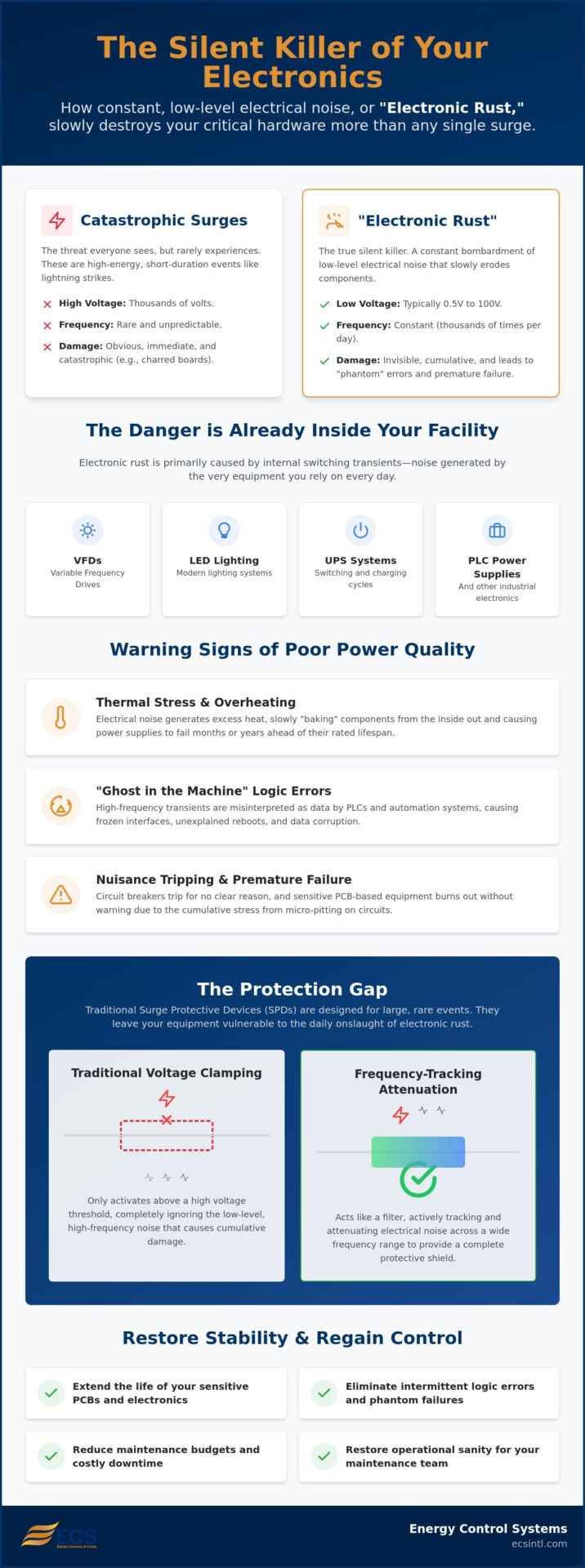
We call this “electronic rust.” While a lightning strike is a catastrophic event that everyone notices, internal switching transients are the true danger. These low-level spikes, often ranging from 0.5V to 100V, occur thousands of times a day within your facility. They cause micro-pitting in circuits, slowly eating away at the integrity of your microprocessors. Your Variable Frequency Drives (VFDs), LED lighting, and even UPS switching cycles are the primary sources of this internal chaos. They don’t blow the fuse. They just wear out the machine until it quits.
Thermal Stress and Component Lifespan
Voltage distortion creates more than just noise. It generates heat. This happens because poor power quality leads to increased reactive power within your system. This extra energy doesn’t do any useful work. Instead, it simply bakes your components from the inside out. By 2026 standards, temperature-induced failure rates for LCD displays and PC power supplies have become a primary concern for facility managers. Standard surge protective devices are built to stop massive, rare surges. They often miss these chronic, heat-generating micro-events that happen well below their clamping thresholds. Your equipment is left vulnerable to a slow death by thermal stress.
The ‘Ghost in the Machine’: Logic Errors and Data Corruption
Electrical noise is also a communication breakdown. High-frequency transients are frequently interpreted as “false data” by PLC and SCADA communication lines. This leads to those maddening “ghost” errors that force a system reset without any clear hardware failure. It’s a psychological drain on your maintenance team. You’re left chasing shadows in the code when the problem is actually in the copper. These transients can reset digital technology without warning, ruining production schedules and stealing your peace of mind. Restoring stability requires looking beyond simple voltage protection and addressing the frequency of the noise itself.
Identifying the Symptoms: Is Your Facility Suffering from Poor Power Quality?
You know that sinking feeling when a critical production line stops for no apparent reason. Often, these failures are dismissed as “bad luck” or aging hardware. But if you look closer, a clear pattern emerges. You might see power supplies failing months before their rated lifespan or sensitive PCB-based equipment burning out without warning. These aren’t just random glitches. They are the visible power quality effects on electronic components that haven’t yet reached a total system collapse. You’re seeing the symptoms of a facility under constant electrical stress.
Common warning signs include:
- Nuisance tripping of circuit breakers with no clear load increase.
- Automation interfaces “freezing” or requiring a hard reboot to restore logic.
- Unexplained motor heating that degrades winding insulation years ahead of schedule.
- Network switches and server rack equipment that need frequent resets to maintain connectivity.
The Power Quality Audit: Beyond the Multimeter
Your standard handheld multimeter is a reliable tool, but it’s simply too slow to catch the real killers. It averages voltage over time. It misses the high-speed transients that happen in microseconds. To truly see what’s happening inside your copper, you need a professional Harmonic Analysis. This process maps the unique “electrical fingerprints” of your facility to identify where the noise is coming from. Harmonic distortion is the silent equipment killer that eats your profit margin and hides in plain sight.
Calculating the Real ROI of Protection
The true return on investment isn’t just found in a ledger. It’s found in your daily quality of life. Imagine moving from a state of constant “firefighting” to one of strategic management. When you eliminate these “ghost errors,” you aren’t just fixing a machine. You’re increasing your status and respect within the organization. You become the steady hand that brought stability to a chaotic environment. If you’re tired of waiting for the next failure, a professional harmonic assessment is your first step toward total facility tranquility.
Restoring Stability: Implementing a Protective Shield for Your Infrastructure
Stopping the silent degradation of your facility requires a fundamental shift in strategy. For decades, the industry relied on “clamping” voltage, essentially waiting for a massive surge to occur before reacting. This approach is no longer enough. To combat the modern power quality effects on electronic components, you must move toward frequency-based attenuation. You need a system that doesn’t just wait for a disaster; it actively filters out the high-frequency noise that causes “electronic rust” every single day.
We recommend creating a “Zone of Protection.” This strategy involves isolating your most sensitive electronics from the industrial noise generated by your own equipment. By implementing the SineTamer LA Series, you provide a frequency-tracking shield that cleans the power before it reaches your delicate microprocessors. In cases where voltage sags or momentary outages threaten your uptime, integrating uninterruptible power supply systems provides the necessary bridge to maintain total operational continuity.
The SineTamer Advantage: Frequency Tracking vs. Standard SPDs
Standard surge protective devices are often blind to the low-level transients that destroy 2026-era micro-electronics. SineTamer is different. It tracks the AC sine wave in real-time, identifying and neutralizing disturbances that other devices ignore. For your data-critical assets, the SineTamer RM Series serves as the final line of defense. It’s specifically designed to protect rack-mount components from the high-frequency events that lead to data corruption and hardware failure. It’s about protecting the “brain” of your operation.
Your Path to Mental Tranquility and Uptime
The transition from anxiety-ridden downtime to stable, predictable operations is a profound relief. You shouldn’t have to spend your weekends worrying about which PLC will fail next. Restoration begins with a clear, logical plan. It’s time to reclaim your personal agency and restore the stability your facility deserves. Your next step is simple. Request a technical site analysis to identify your facility’s unique vulnerabilities. We’ll help you build a shield that protects your equipment, your budget, and your peace of mind.
Secure Your Infrastructure and Your Peace of Mind
You now understand that the most dangerous threats to your facility aren’t always the ones you can see. They are the silent, high-frequency transients that erode your assets from the inside out. By recognizing the early warning signs of power quality effects on electronic components, you can stop “electronic rust” before it leads to a total production halt. We’ve spent decades since our founding in 1987 helping global industrial leaders move from the stress of constant firefighting to the tranquility of stable operations.
Our proprietary SineTamer frequency-tracking technology provides the specific shield your sensitive micro-electronics require to thrive. You don’t have to face these technical complexities alone. We offer comprehensive support, ranging from deep-dive site analysis to hardware implementation. It’s time to reclaim your personal agency and restore the steady heartbeat of your facility. Restore your facility’s stability. Contact ECS for a professional site analysis today.
Your success and mental well-being are our highest priorities. Let’s build a more reliable, stress-free future together.
Frequently Asked Questions
How does poor power quality physically damage a microprocessor?
Poor power quality causes physical damage through a process called micro-pitting. Low-level transients, often under 100V, strike the delicate silicon layers of the microprocessor thousands of times each day. These strikes create microscopic pits that weaken the semiconductor material over time. It isn’t a single event but a cumulative erosion. This is the core of the power quality effects on electronic components that lead to premature failure. Eventually, the hardware simply can’t maintain its logic and quits.
Can a UPS alone protect my electronic components from power quality issues?
A standard UPS is designed to bridge the gap during power sags or outages, but it isn’t a total solution. While it provides battery backup, many units don’t filter out the high-frequency transients or “electronic noise” generated by downstream equipment. In fact, some UPS switching cycles can actually introduce new transients into your system. You need a dedicated frequency-tracking shield to ensure your components are truly protected from the chronic degradation caused by low-level noise.
What is the difference between a surge and a transient in industrial electronics?
The primary difference lies in magnitude and duration. A surge is typically a massive, high-voltage event like a lightning strike or a utility transformer failure. Transients are much smaller but happen thousands of times daily. These low-level spikes are often generated internally by VFDs or LED lighting. While a surge causes immediate smoke, transients cause the slow, invisible power quality effects on electronic components that lead to maddening intermittent logic errors and “ghost” reboots.
How do harmonics affect the temperature of office and industrial devices?
Harmonics increase the internal temperature of devices by creating reactive power that doesn’t do useful work. This extra energy is dissipated as heat within transformers, power supplies, and motors. This internal “baking” accelerates the aging of insulation and sensitive capacitors. In office environments, this often leads to the premature death of PC power supplies. In industrial settings, it causes motors to run hot, significantly shortening their winding life and leading to unexpected downtime.

Article by
Jeff Edwards
Founder of ECS International Inc. Edwards travels and speaks extensively in Latin America, Asia and Africa on the subject of power quality; transients and mitigating their impact on profitability. After graduating from Texas Tech University in Lubbock Texas, Edwards spent 9 years in the Telecommunications sector prior to founding Energy Control Systems in 1987 as a Texas based corporation selling surge suppression and UPS systems. The company has evolved into a global power quality products and energy efficiency concern with operations spanning South America, Asia, Europe and Africa.
Disclaimer
Some of the above information may be the opinion of the author.