

What if a network fault isn’t a network problem at all? A voltage sag, surge, or harmonic distortion can disrupt switches, routers, and other sensitive equipment, making the impact of power quality on network equipment easy to overlook. Intermittent failures are especially frustrating: replacing hardware or resetting devices may restore service temporarily without addressing the underlying cause.
A structured investigation can help narrow down what’s happening. Record when faults occur, which devices are affected, and whether their symptoms coincide with power events. Then compare those details with equipment logs and power-quality evidence. This article explains how electrical disturbances can trigger resets, errors, and interruptions, and how to distinguish the roles of surge protection, UPS systems, and Harmonic Analysis. Start with evidence so the response fits the problem.
Key Takeaways
- The impact of power quality on network equipment can appear as resets, errors, or outages, even when the network hardware seems to be at fault.
- Record affected devices, event duration, operating conditions, and whether failures occur at the same time.
- Compare incident timestamps with equipment logs and power-supply conditions before settling on a cause or mitigation.
- Match the response to the evidence: surge protection addresses transient events, while a UPS supports equipment during supply interruptions.
How Power Quality Affects Network Equipment: Disturbances Behind Resets and Outages
Power quality describes the characteristics of an electrical supply, including its voltage, frequency, and waveform, and how consistently they support equipment operation. The overview of Electric power quality explains these characteristics and why deviations can matter. For network hardware, the impact of power quality on network equipment may show up as unexpected reboots, dropped links, or service interruptions. Those symptoms are clues, but they don’t identify the cause on their own.
Which power disturbances can disrupt switches, routers, and servers?
Different disturbances can produce similar symptoms. A voltage sag is a brief drop that may affect a sensitive power supply or trigger a reset. A swell raises voltage, while a longer interruption can shut equipment down or interrupt its power supply. Transients are sudden, brief changes that may stress components. Harmonics distort the supply waveform and may contribute to abnormal operation or added equipment stress. The effect depends on the disturbance and the equipment, so none of these outcomes is inevitable.
Look for patterns across devices and events. If several devices restart or lose power at nearly the same time, investigate whether they share a supply or electrical condition. If only one switch reports errors, check local causes too, such as a failing port, cabling issue, configuration change, cooling problem, or device fault. Packet loss and link failures are useful clues, not proof of an electrical problem.
Use the impact of power quality on network equipment as a diagnostic possibility, then compare device behavior with power conditions and other evidence. This can help prevent unnecessary hardware replacement or mitigation that doesn’t address the cause.
How to Investigate Power-Quality Problems Affecting Network Equipment
Intermittent faults are difficult to diagnose when network and electrical records are reviewed separately. Work through a consistent sequence to connect events before choosing a response:
- 1. Document symptoms. Record affected devices, alarms, event duration, operating conditions, and whether failures happen together. Note relevant changes around the incident, such as load shifts or equipment start-ups.
- 2. Correlate timestamps. Align network alerts and device resets with the incident timeline. Simultaneous failures across devices may point to a shared condition; an isolated failure may suggest a local issue.
- 3. Inspect equipment logs. Look for reboots, power-supply warnings, interface drops, and recurring error patterns in switch, router, and server logs. Compare these findings with checks of cabling, configuration, cooling, and hardware.
- 4. Assess supply conditions. Use appropriate power-quality monitoring to examine voltage variations, interruptions, transients, and harmonic distortion around the affected equipment.
What evidence helps confirm a power-quality cause?
Look for evidence that lines up in time, not just a familiar symptom. A power event that coincides with resets across devices sharing a supply strengthens the case for further investigation, but site context still matters. Interpret measurements alongside equipment logs, operating conditions, and the electrical setup. ECS’s Harmonic Analysis guide explains how analysis can help investigate power-quality conditions.
Comparing incident records with power-quality measurements turns a suspected impact of power quality on network equipment into a testable diagnosis. Energy Control Systems provides professional Harmonic Analysis to help assess electrical disturbances and their relationship to equipment behavior. Learn more in the Energy Control Systems Harmonic Analysis information.
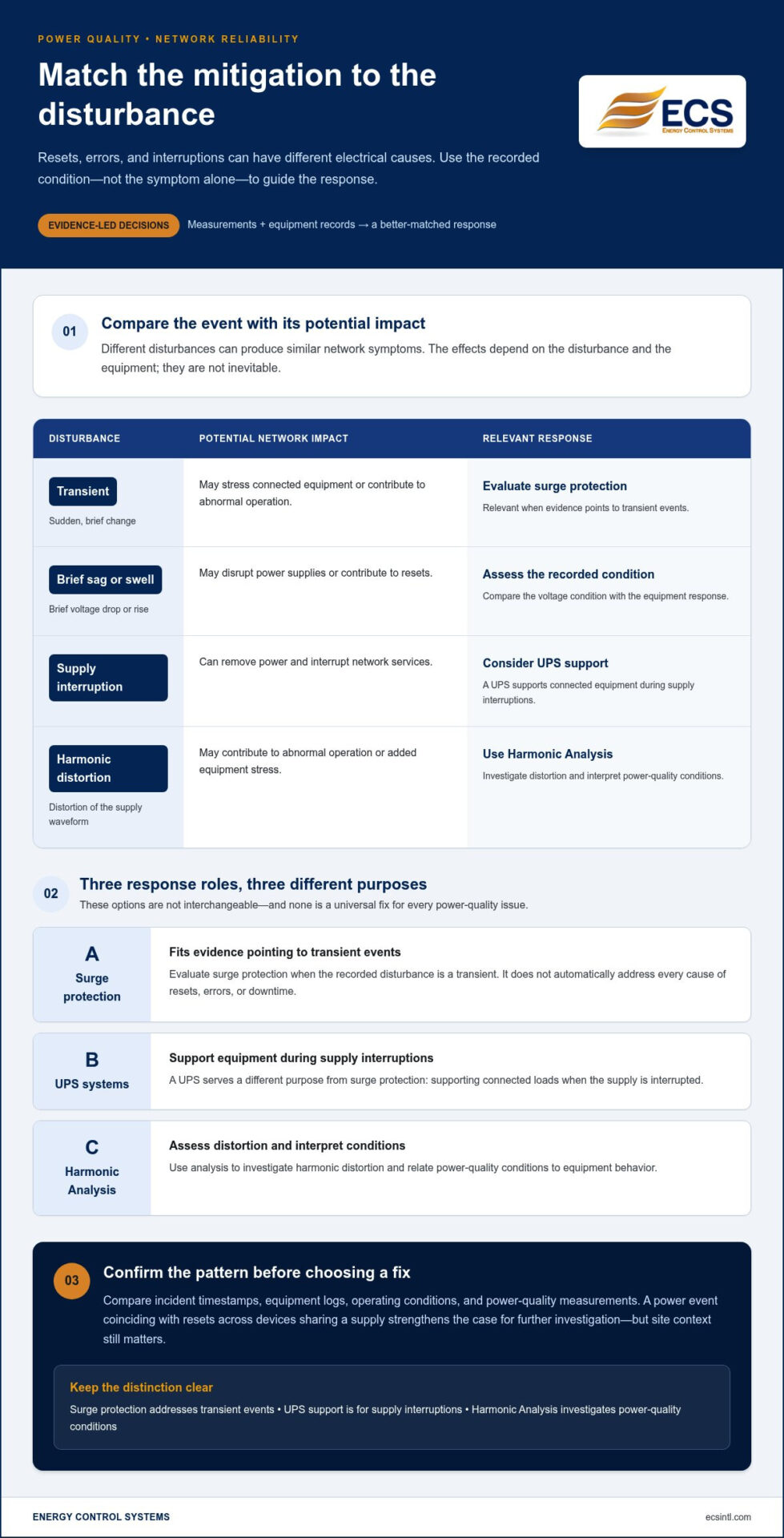
Match Power-Quality Mitigation to the Network Equipment Problem
The right response depends on the disturbance identified. A protective device aimed at one type of event won’t automatically address every cause of resets, errors, or downtime. Use measurements and equipment records to guide the decision.
| Disturbance | Potential network impact | Relevant response category |
|---|---|---|
| Transient | May stress connected equipment or contribute to abnormal operation. | Evaluate surge protection. |
| Brief voltage sag or swell | May disrupt power supplies or contribute to resets. | Assess the recorded voltage condition and equipment response. |
| Supply interruption | Can remove power and interrupt network services. | Consider UPS support for connected loads. |
| Harmonic distortion | May contribute to abnormal operation or equipment stress. | Use Harmonic Analysis to investigate conditions. |
When do surge protection, UPS systems, and harmonic analysis fit?
Surge protection is relevant when evidence points to transient events. A UPS serves a different purpose: supporting equipment during supply interruptions. Neither should be treated as a solution to every power-quality issue. Harmonic Analysis helps assess distortion and interpret power-quality conditions, so mitigation decisions can follow evidence rather than guesswork. The surge protective device guide and UPS guide explain these roles in more detail.
Energy Control Systems offers the SineTamer LA, RM, and ST-PCMF Series for surge protection, as well as UPS systems and Harmonic Analysis. Choose a response based on the disturbance measured, not on a symptom alone. Explore ECS power-quality solutions to learn more.
Build a More Reliable Network with Evidence-Led Power Decisions
The impact of power quality on network equipment can be difficult to distinguish from ordinary hardware or connectivity faults. Start by documenting symptoms, comparing incident times with equipment logs, and assessing power conditions before selecting a response. Surge protection, UPS support, and Harmonic Analysis address different needs, so let the evidence guide the choice.
Energy Control Systems offers professional Harmonic Analysis, UPS systems, and SineTamer surge protection series to support power-quality management. A diagnosis-led approach helps you understand what’s happening before deciding how to respond.
Explore Energy Control Systems’ power-quality solutions to take a practical next step toward steadier network operations.
Frequently Asked Questions
What is power quality, and why does it matter to network equipment?
Power quality describes how consistently an electrical supply’s voltage, frequency, and waveform support equipment operation. Sags, swells, interruptions, transients, and harmonic distortion can affect sensitive power supplies and may contribute to device resets or service interruptions. A reset or network alarm alone doesn’t prove an electrical cause. Review equipment logs alongside electrical evidence to determine whether the events coincide.
Can poor power quality cause network equipment to reset or lose connectivity?
Yes. Supply disturbances can contribute to resets or interrupted operation, depending on the equipment and conditions. The impact of power quality on network equipment may include a brief loss of connectivity, but not every dropped link or outage is electrical. Compare device-event times with power-quality records, and check network configuration, cabling, and hardware for other possible causes.
Does a surge protector solve every power-quality problem affecting network equipment?
No. Surge protection addresses transient overvoltage risks, but it doesn’t resolve every power disturbance. A supply interruption may call for UPS support, while suspected harmonic distortion calls for investigation. The right response depends on the condition identified. Diagnose first, then choose mitigation that fits the evidence rather than treating one device as a universal fix.
How can I tell whether a network outage is caused by a power-quality issue?
Compare timestamps from network logs, device resets, and power-quality monitoring to see whether events align. Note whether multiple devices fail together, and record operating conditions around the outage. Timing patterns can support an electrical cause, but cabling, configuration, cooling, and device faults should also be considered. Professional Harmonic Analysis can help interpret measurements and assess the conditions behind an outage.

Article by
Jeff Edwards
Founder of ECS International Inc. Edwards travels and speaks extensively in Latin America, Asia and Africa on the subject of power quality; transients and mitigating their impact on profitability. After graduating from Texas Tech University in Lubbock Texas, Edwards spent 9 years in the Telecommunications sector prior to founding Energy Control Systems in 1987 as a Texas based corporation selling surge suppression and UPS systems. The company has evolved into a global power quality products and energy efficiency concern with operations spanning South America, Asia, Europe and Africa.
Disclaimer
Some of the above information may be the opinion of the author.