

You’ve likely watched a perfectly good circuit board fail for no apparent reason, leaving you with a mounting repair bill and hours of lost productivity. It’s frustrating because the grid didn’t even flicker. Most professionals don’t realize that nearly 80 percent of electrical damage comes from internal transients generated right inside their own walls. Learning how to protect sensitive electronics from power surges requires looking beyond the occasional lightning strike and focusing on the constant electrical noise that quietly degrades your microprocessors.
We understand the high stakes of industrial downtime and the psychological burden of managing unstable systems. You deserve a work environment where your infrastructure just works. This guide provides the professional strategies and hardware insights you need to reclaim control over your power quality. We will examine the latest 2026 updates to UL 1449 and IEEE C62.41.2 standards, explain the difference between surges and transients, and show you how a layered defense with SineTamer technology can finally restore your mental tranquility.
Key Takeaways
- Identify the difference between catastrophic spikes and “electronic rust” to stop the silent degradation of your most expensive microprocessors.
- Master the “Zone of Protection” concept to understand how to protect sensitive electronics from power surges using a strategic, multi-layered defense.
- Move beyond basic suppression with frequency attenuation technology that filters the high-frequency noise standard devices simply cannot see.
- Secure your professional reputation and your equipment’s lifespan by implementing a robust shield that addresses the 80 percent of transients generated internally.
- Gain true mental tranquility by pairing SineTamer hardware with a UPS to maintain data integrity and total system uptime during any power event.
Understanding the Threat: Surges vs. Transient Voltages
Equipment failure shouldn’t be a mystery. You’ve likely experienced the frustration of a critical machine stopping without a clear cause, leaving your team scrambling for answers. These “no-fault-found” events create operational chaos and erode your professional confidence. To understand how to protect sensitive electronics from power surges, you must first distinguish between a catastrophic surge and the silent killer known as transient voltage.
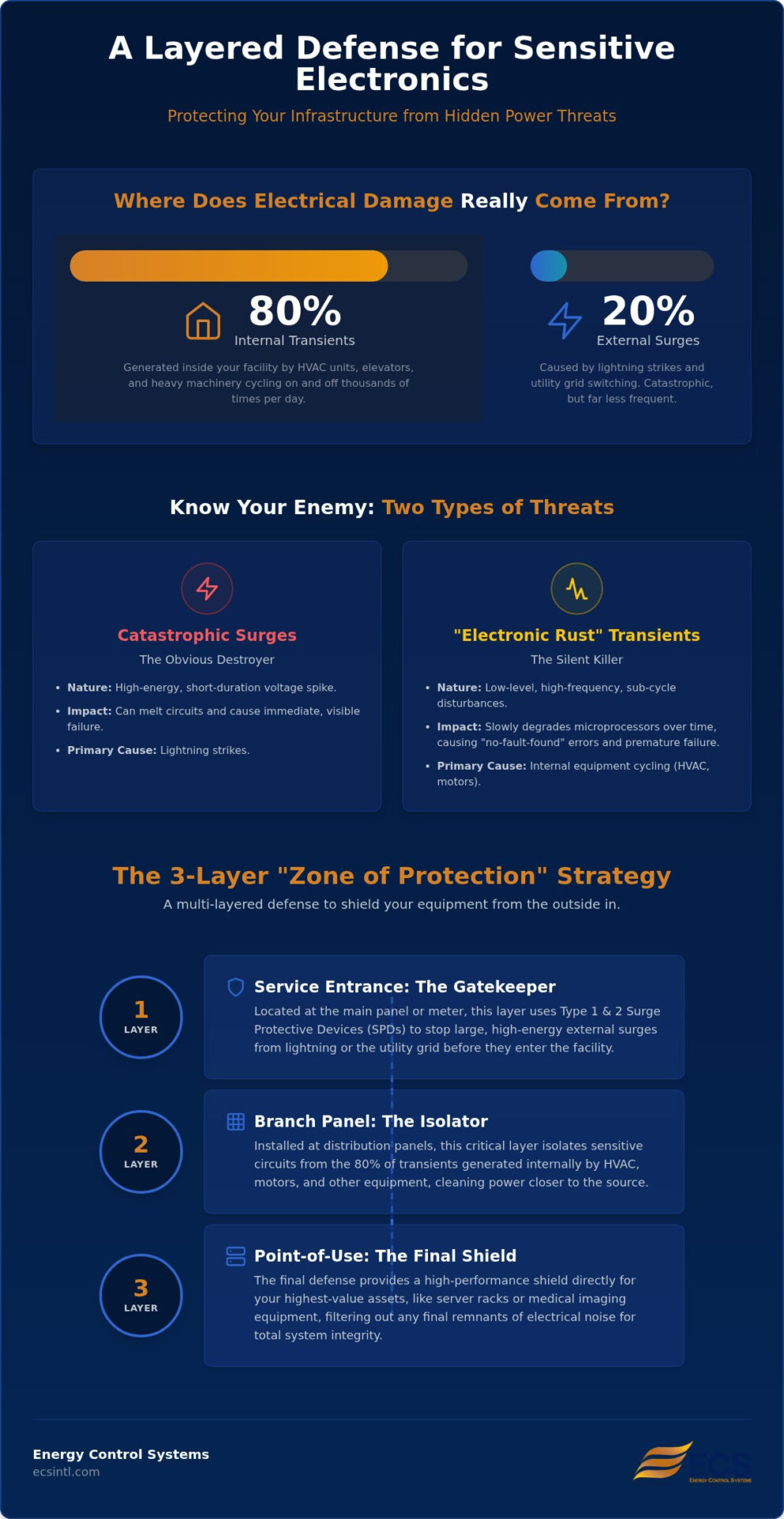
A power surge is a high-energy, short-duration voltage spike that can melt circuits instantly. While lightning is the most famous culprit, it isn’t the most frequent. A Surge protector is designed to divert this excess energy safely to the ground. However, the real threat to your facility’s stability often comes from “electronic rust.” This term describes low-level transients that don’t cause immediate smoke but slowly degrade microprocessors over time. It’s a cumulative process of destruction that standard suppression often ignores.
Common Causes of Electrical Disturbances
Most professionals blame the utility company for power issues. While grid switching and lightning are significant external factors, they only account for about 20 percent of disturbances. The remaining 80 percent are generated inside your own facility. Every time an HVAC unit cycles, an elevator moves, or heavy machinery starts up, it creates a disturbance. We define transient voltage as a high-frequency sub-cycle disturbance that occurs thousands of times every day. These internal events are the primary reason why equipment fails prematurely.
Why Sensitive Electronics are at Higher Risk
Modern technology is more vulnerable than the rugged hardware of the past. Today’s microprocessors operate at much lower voltages and tighter tolerances. This makes delicate PLC and SCADA systems highly sensitive to even minor fluctuations. The cumulative effect of these unseen power quality issues leads to unexplained reboots and hardware degradation. You don’t have to accept this instability as an inevitable cost of doing business. Protecting your equipment restores your personal agency and ensures long-term operational success. It’s about moving from a state of constant anxiety to one of absolute technical certainty.
3 Essential Layers for Protecting Sensitive Electronics
Relying on a single surge strip to protect an entire facility is a gamble you don’t have to take. True infrastructure stability requires a “Zone of Protection” strategy that shields your equipment from the outside in. This layered approach restores your personal agency over your technical environment. It empowers you to achieve professional success by eliminating the “no-fault-found” errors that plague unshielded systems. Understanding how to protect sensitive electronics from power surges starts with building a defense that recognizes no single device can do it all.
Layer 1: The Service Entrance
The first line of defense sits at your building’s main panel or meter. This layer uses Type 1 and Type 2 surge protective devices to stop large external surges before they ever enter your facility. Think of these as the gatekeepers. They handle the high-energy events from the utility grid or lightning strikes that would otherwise incinerate your delicate internal components in milliseconds.
Layer 2: Branch Panel Protection
As we discussed, 80 percent of disturbances are generated internally. This is why branch panel protection is critical. By installing the SineTamer LA Series at the distribution panels serving mission-critical automation or servers, you isolate these circuits from the noise created by your own HVAC systems or elevators. This layer provides localized suppression that cleans the power before it reaches your most sensitive microprocessors.
Layer 3: Point-of-Use and Rack Protection
The final layer provides a high-performance shield for your highest-value assets. Whether you’re protecting medical imaging equipment or a server room, the SineTamer RM Series offers specialized rack-mount protection that filters out the final remnants of electrical transients. This comprehensive strategy ensures total uptime and provides the mental tranquility you deserve. It’s time to move toward a more stable future by choosing the right surge protective devices for your specific facility needs.
Advanced Power Quality: Beyond Simple Suppression
Standard surge suppression often stops at “clamping.” If the voltage hits a specific limit, the device shunts it. But what about the high-frequency noise that never reaches that threshold? This is the missing piece in how to protect sensitive electronics from power surges effectively. Advanced power quality management requires frequency attenuation. While standard SPDs wait for a disaster, SineTamer hardware actively filters the electrical noise that standard components simply ignore. It’s the difference between surviving a storm and thriving in a clean electrical environment.
Maintaining data integrity during a power event is equally vital. Integrating an uninterruptible power supply (UPS) ensures your systems don’t just survive a surge but continue to operate smoothly through momentary drops or outages. When you combine this hardware with Harmonic Analysis, you can identify the silent killers within your distribution network before they cause a total breakdown. This shift in strategy moves your team from a stressful culture of reactive repairs to one of proactive stability and technical confidence.
The SineTamer Advantage for Industry
Clamping voltage is a common metric, but it isn’t the only one that matters for your facility’s health. Most devices only react when voltage exceeds a fixed level. SineTamer is different. It tracks the sine wave to eliminate transients at the source, regardless of the voltage level. This proprietary frequency attenuation technology provides a level of protection that consumer-grade hardware cannot match. It addresses the “electronic rust” we discussed earlier, ensuring your microprocessors remain pristine and functional for years longer than unshielded counterparts.
Calculating the ROI of Protection
Investing in professional-grade suppression pays for itself by significantly extending the life of your sensitive hardware. You’ll see the impact in reduced maintenance costs and fewer emergency PCB replacements. Beyond the balance sheet, there is the value of mental tranquility. Knowing your infrastructure is safe allows you to focus on strategic growth rather than constant troubleshooting. It restores your personal agency and ensures you’re recognized as a source of stability within your organization. You have the right to a stress-free work environment, and proper power quality is the foundation of that promise.
Secure Your Infrastructure and Your Peace of Mind
The “electronic rust” of internal transients doesn’t have to be a silent threat to your facility’s success. True operational stability comes from a multi-layered Zone of Protection that addresses both catastrophic spikes and the constant noise of modern power. By implementing professional strategies, you effectively solve the mystery of “no-fault-found” equipment failures. Mastering how to protect sensitive electronics from power surges is about more than just hardware; it’s about reclaiming your personal agency and ensuring your systems remain a beacon of reliability.
Since 1987, we’ve served as global power quality experts, battle-testing our proprietary SineTamer Frequency Attenuation technology in the world’s most demanding environments. We understand the high-stakes pressure you face every day. Our mission is to restore your mental tranquility by providing a steady hand in a chaotic technological landscape. You don’t have to manage these logistical challenges alone. Your journey toward total uptime and professional recognition starts with a single proactive step.
Request a Technical Site Analysis to Protect Your Infrastructure
Take control of your power quality today and enjoy the relief that comes with a truly resilient infrastructure. We’re here to help you build a future where your equipment just works.
Frequently Asked Questions
Is a power strip with surge protection enough for my computer?
A standard power strip is rarely enough for mission-critical hardware. It only provides Type 3 protection at the point of use. To truly understand how to protect sensitive electronics from power surges, you must look at the entire facility. These strips don’t filter the high-frequency transients that cause “electronic rust” or stop massive external spikes at the main panel. Relying on them alone leaves your expensive microprocessors vulnerable to 80 percent of internal disturbances.
How often should I replace my surge protection devices?
You should plan to replace your surge protection devices every three to five years. Most units rely on Metal Oxide Varistors that sacrifice themselves with each surge they divert. Even if the unit appears functional, its suppression capacity diminishes over time. Replacing them proactively restores your mental tranquility and ensures your shield remains battle-tested. If your facility experiences a major electrical event, replace the units immediately to maintain your stability.
Can a UPS system protect my electronics from a lightning strike?
A standard UPS system is not a substitute for high-energy surge protection against lightning. While a UPS provides critical battery backup and cleans minor power fluctuations, a direct or nearby lightning strike carries millions of volts. You need a dedicated Type 1 or Type 2 SPD at your service entrance to handle that level of energy. Pairing a UPS with SineTamer hardware provides the ultimate layered defense for your data integrity.
What is the difference between a surge arrester and a surge suppressor?
The primary difference lies in the voltage levels and installation location. A surge arrester is typically installed on the line side of the main breaker to handle high-voltage external events. A surge suppressor is designed for lower-voltage applications inside the building. Using both ensures you’re protected from both utility-side disasters and the daily transients generated by your own machinery. This combination restores your personal agency over a chaotic electrical environment.

Article by
Jeff Edwards
Founder of ECS International Inc. Edwards travels and speaks extensively in Latin America, Asia and Africa on the subject of power quality; transients and mitigating their impact on profitability. After graduating from Texas Tech University in Lubbock Texas, Edwards spent 9 years in the Telecommunications sector prior to founding Energy Control Systems in 1987 as a Texas based corporation selling surge suppression and UPS systems. The company has evolved into a global power quality products and energy efficiency concern with operations spanning South America, Asia, Europe and Africa.
Disclaimer
Some of the above information may be the opinion of the author.