

The most dangerous part of a brownout isn’t the moment your machines lose power; it’s the split second the voltage tries to recover. This silent killer creates a two-stage assault that stresses sensitive components during the sag and destroys them during the subsequent transient surge. You’ve likely spent too many hours dealing with unplanned downtime that costs thousands per hour, feeling the psychological weight of wondering when the next grid event will strike. It’s a frustrating position to be in, especially when standard surge protection often fails to catch these low-level, high-frequency events.
Knowing how to protect equipment from brownouts requires a strategy that addresses both the dip and the recovery. You deserve a work environment where your infrastructure is stable and your professional reputation is secure. In this 2026 guide, we’ll dive into the dual-layered strategies you need to neutralize voltage sags and the dangerous transients that follow them. We will explore how advanced technologies like SineTamer and updated IEC 2026 power quality standards can help you regain control over your facility’s electrical health and restore your personal agency.
Key Takeaways
- Learn why brownouts are “silent killers” that damage equipment by forcing it to operate at starved energy levels rather than shutting down completely.
- Discover the essential steps for how to protect equipment from brownouts by identifying your facility’s critical path and shielding assets from 1ms power interruptions.
- Understand why standard surge protection often fails during voltage recovery and how specialized suppression targets the high-frequency transients that follow a sag.
- Shift from a reactive “fix-it” mindset to a proactive power management strategy that restores your personal agency and operational peace of mind.
Understanding the Silent Threat: What Brownouts Actually Do to Your Infrastructure
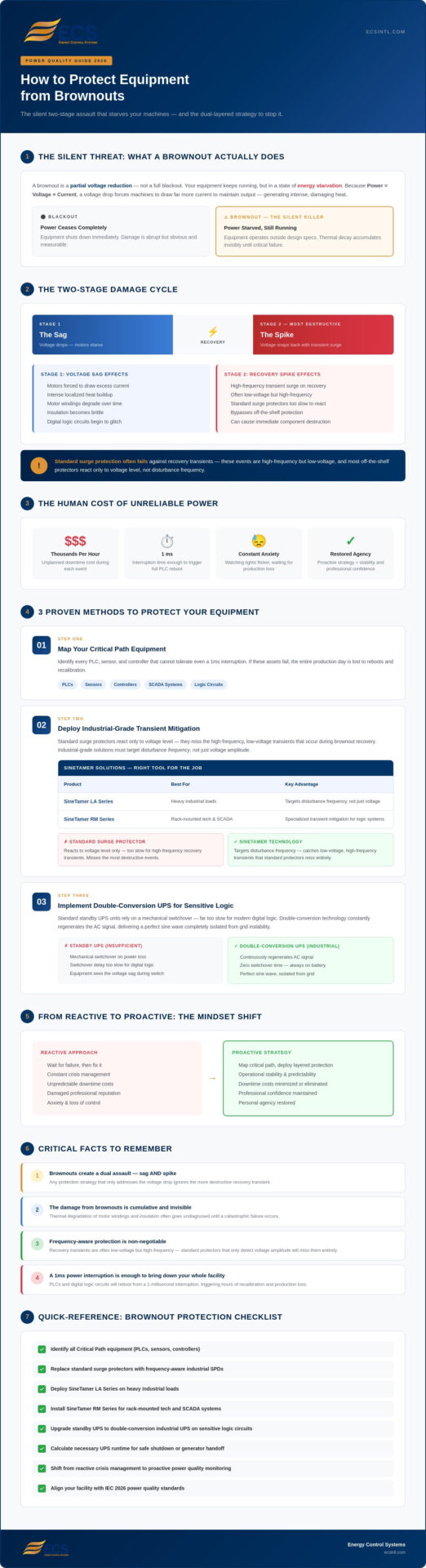
A brownout is a partial voltage reduction that forces industrial components to operate outside their design parameters. Unlike a total blackout, where power simply ceases, a brownout keeps your equipment running in a state of starvation. It is a lingering, agonizing stress test for every motor and power supply in your facility. When the grid becomes overloaded during a heatwave or a storm, the voltage drops, but the demand for work from your machinery remains the same.
To truly understand What is a brownout? you must look at the physical toll it takes on your hardware. Because power is the product of voltage and current, a drop in voltage forces your equipment to draw significantly more current to maintain its output. This extra current creates intense, localized heat. Over time, this thermal stress causes motor windings to degrade and insulation to become brittle. It is a slow, expensive decay that often goes undiagnosed until a critical failure occurs.
The Two-Stage Damage Cycle: Sag and Spike
The danger comes in two distinct waves. Stage 1 is the Sag. This is the period of thermal stress where motors overheat and digital logic circuits begin to glitch. However, the most destructive moment is often Stage 2: The Spike. When the grid finally stabilizes and the voltage snaps back to normal, it frequently carries a massive transient surge. These recovery transients are high-frequency events that can bypass standard surge protection. Most off-the-shelf protectors are simply too slow to react. Learning how to protect equipment from brownouts requires a strategy that accounts for both the starving sag and the violent recovery spike.
The Human Cost: Anxiety and Lost Agency
There is a heavy psychological burden that comes with unreliable power. You know the feeling of watching the lights flicker and waiting for the other shoe to drop. It is a state of constant, low-level anxiety. When production stops, the financial loss is visible, but the damage to your professional reputation within the company is harder to measure. You deserve a work environment defined by stability rather than crisis management. Taking proactive steps to manage power quality isn’t just about saving hardware. It’s about restoring your personal agency and ensuring you remain the steady hand that keeps the facility moving forward.
Strategic Protection: 3 Proven Methods to Safeguard Sensitive Electronics
You can’t shield every single lightbulb in your facility, but you can protect the heartbeat of your operation. Effective defense starts with a layered approach. First, identify your Critical Path equipment. These are the PLCs, sensors, and controllers that cannot tolerate even a 1ms interruption. If these fail, your entire production day is lost to reboots and recalibration. Second, deploy industrial-grade surge protective devices that are engineered for the factory floor. Finally, implement double-conversion power backups for your most sensitive logic circuits. This three-step framework is the foundation of how to protect equipment from brownouts effectively.
Implementing Uninterruptible Power Supplies (UPS) for Continuous Stability
Standard standby UPS units are often recommended as a quick fix, but they are insufficient for industrial automation. They rely on a mechanical switchover that is simply too slow for modern digital logic. A true industrial uninterruptible power supply uses double-conversion technology to constantly regenerate the AC signal. This means your equipment receives a perfect sine wave, completely isolated from the grid’s instability. By calculating your necessary runtime, you can ensure enough power for a safe shutdown or a seamless transition to a generator during a sustained voltage drop.
The Role of SineTamer LA and RM Series in Transient Mitigation
For heavy industrial loads, the SineTamer LA Series acts as a seasoned protector for your infrastructure. Unlike standard surge suppressors that only react to high voltage levels, SineTamer targets the frequency of the disturbance. This is vital when learning how to protect equipment from brownouts, as the recovery transients are often low-voltage but high-frequency. For your rack-mounted technology and SCADA systems, the SineTamer RM Series provides this same specialized mitigation in a compact form. It ensures your data stays intact and your facility remains stable. If you’re ready to secure your facility’s future, you can request a technical site analysis to identify your specific vulnerabilities.
Beyond Hardware: Achieving Long-Term Operational Peace of Mind
True protection isn’t just about the hardware you install today. It’s about a fundamental shift in how you view your facility’s health. Moving from a reactive “fix-it” mindset to proactive power quality management is the final step in mastering how to protect equipment from brownouts. This transition replaces the anxiety of the unknown with a structured, data-driven sense of control. You deserve to lead your team with confidence, knowing that your infrastructure is secured against the whims of the grid.
Regular technical site analysis is the cornerstone of this stability. By identifying weak points before they lead to a catastrophic failure, you reclaim your personal agency. You are no longer at the mercy of the next storm or grid overload. Instead, you are the architect of your facility’s resilience. This proactive stance doesn’t just save equipment. It safeguards your professional reputation and ensures your operations remain a source of pride rather than a source of stress.
Why Harmonic Analysis is Your Early Warning System
Restoring Personal Agency and Status
Implementing a robust protection strategy transforms your role within the organization. You move from being a “firefighter” who responds to crises to a strategic leader who prevents them. This shift is where your professional status is truly restored. Working with a battle-tested global partner like Energy Control Systems provides the expertise needed to navigate a chaotic technological landscape. We are here to help you achieve the mental tranquility and operational success you’ve earned. Let us help you turn power quality into a competitive advantage for your facility.
Secure Your Infrastructure and Restore Your Peace of Mind
You now understand that brownouts are more than just flickering lights; they are a two-stage assault on your facility’s heartbeat. By identifying your critical path and deploying specialized suppression for recovery transients, you’ve mastered the fundamentals of how to protect equipment from brownouts. True operational stability, however, requires a shift from the exhaustion of crisis management to the clarity of proactive leadership. You deserve a facility where the grid’s instability no longer dictates your daily stress levels or threatens your production schedule.
Energy Control Systems brings over 35 years of industrial power protection expertise to your side. Our proprietary SineTamer technology is used worldwide to neutralize the high-frequency transients that standard devices miss. Combined with our comprehensive Harmonic Analysis services, we provide the data and the protection needed to restore your personal agency and professional status. It’s time to stop waiting for the next power event and start building a resilient, predictable future for your organization.
Contact Energy Control Systems for a Professional Power Quality Assessment today. You’ve worked hard to build your professional reputation and your facility’s success. We are ready to stand with you as a seasoned protector, ensuring your infrastructure remains a source of pride and stability.
Frequently Asked Questions
Can a brownout damage equipment if it doesn’t turn off completely?
Yes, a brownout can cause severe damage even when your machines stay powered on. This state of energy starvation forces motors to draw higher current to maintain torque, which generates excessive heat and degrades internal insulation. It’s a slow, thermal decay that often leads to premature failure. You shouldn’t have to wait for a total burnout to realize your infrastructure is under attack; consulting with HVAC and refrigeration experts like yourcoolguy.com can help you proactively identify these thermal vulnerabilities.
Will a standard surge protector block brownout-related damage?
No, a standard surge protector is generally ineffective against the complexities of a brownout. These devices are designed to clamp high voltage spikes, but they don’t respond to the prolonged low-voltage starvation that characterizes a sag. Most off-the-shelf units are also too slow to catch the high-frequency recovery transients that occur when power is restored. Effective protection requires a strategy focused on how to protect equipment from brownouts using frequency-sensitive suppression.
How is a brownout different from a voltage sag?
The primary difference between a brownout and a voltage sag is the duration of the event. A voltage sag is a brief dip that typically lasts from a few cycles to a few seconds. A brownout is a sustained reduction in voltage that can last for minutes or even hours. Both events create dangerous instability, but the prolonged nature of a brownout significantly increases the risk of the thermal damage you fear.
What is the best way to protect a PLC or SCADA system from brownouts?
The most reliable way to secure your PLC or SCADA system is through a combination of a double-conversion UPS and specialized transient suppression. A double-conversion UPS ensures your sensitive logic receives a steady, regenerated sine wave regardless of grid fluctuations. Pairing this with the SineTamer RM Series provides a final layer of defense against high-frequency noise. This dual-layered approach is the gold standard for how to protect equipment from brownouts in digital environments.

Article by
Jeff Edwards
Founder of ECS International Inc. Edwards travels and speaks extensively in Latin America, Asia and Africa on the subject of power quality; transients and mitigating their impact on profitability. After graduating from Texas Tech University in Lubbock Texas, Edwards spent 9 years in the Telecommunications sector prior to founding Energy Control Systems in 1987 as a Texas based corporation selling surge suppression and UPS systems. The company has evolved into a global power quality products and energy efficiency concern with operations spanning South America, Asia, Europe and Africa.
Disclaimer
Some of the above information may be the opinion of the author.