

A motor running hot or vibrating may be responding to a distorted electrical supply, rather than failing on its own. If you’re investigating how harmonics affect induction motors, the symptoms can be familiar, but they don’t prove harmonics are the cause. Overload, voltage imbalance, mechanical wear, and other power-quality issues can also affect operation.
Harmonic voltage and current can increase motor losses and temperature, reduce efficiency, and contribute to changes in torque and vibration. This article explains those effects and why symptoms alone aren’t enough to identify the source. You’ll learn what operating and electrical information to gather, what other conditions to consider, and when professional harmonic analysis can help clarify what’s happening. A clearer picture of the supply gives your team a more useful starting point for the next investigation.
Key Takeaways
- Understanding how harmonics affect induction motors starts with distinguishing recurring waveform distortion from brief transients in the supply.
- Harmonic sequence fields can interact with the motor’s rotating field, contributing to additional losses and changes in operation.
- When symptoms appear, record the motor’s load and operating conditions alongside the timing of heat, vibration, or noise.
- Professional harmonic analysis can help characterize power-quality conditions when measurements or recurring symptoms leave the cause unclear.
How harmonics affect induction motors: from distorted supply to motor losses
Voltage and current harmonics are waveform components with frequencies that are integer multiples of the supply’s fundamental frequency. On a 60 Hz system, for example, the third harmonic is 180 Hz. Harmonics contribute to recurring waveform distortion, unlike transients, which are brief, sudden voltage changes. The distinction matters when deciding what to investigate: the surge protective device guide explains surge and transient protection, while Harmonics in Electrical Power Systems provides broader background on harmonic components and their effects.
The fundamental supply creates the motor’s main rotating magnetic field. Harmonics add fields that can interact with it, inducing additional currents and losses in the stator and rotor. In practical terms, a distorted supply can increase electrical losses, raise motor temperature, and affect smooth operation.
Why harmonic frequency and sequence matter inside the motor
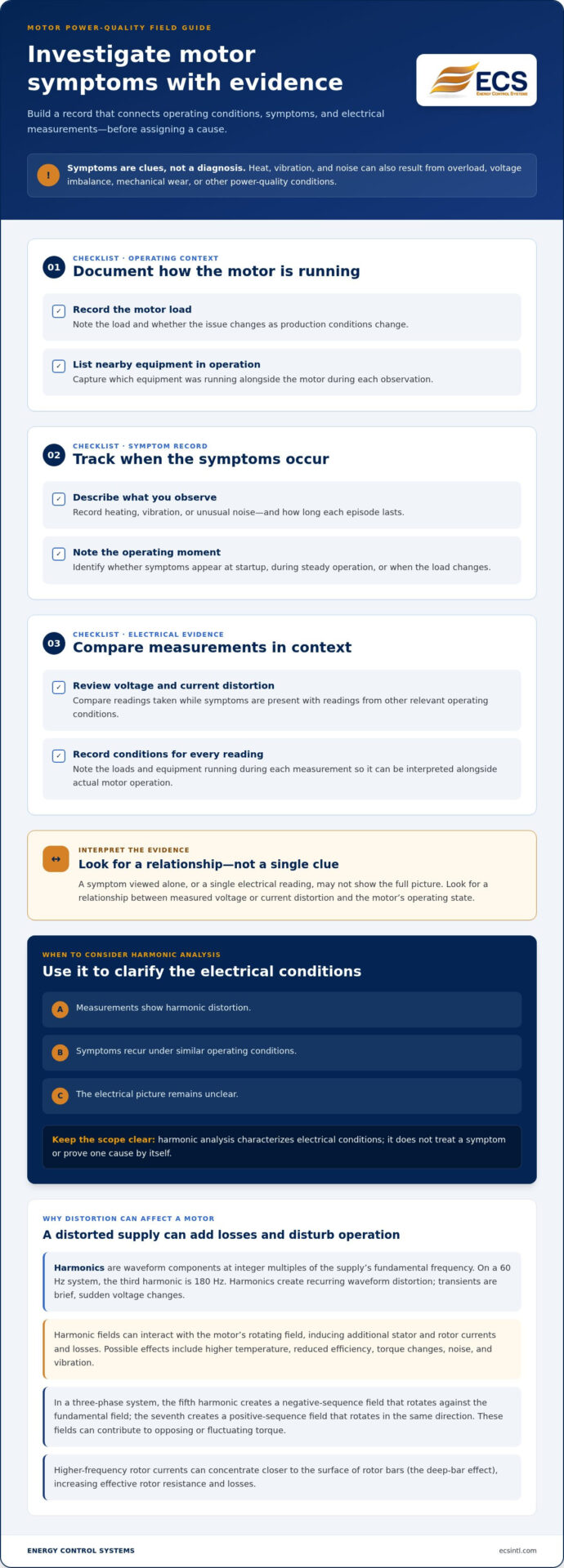
In a three-phase system, harmonic fields can rotate in different directions. The fifth harmonic creates a negative-sequence field that rotates against the fundamental field, while the seventh creates a positive-sequence field that rotates in the same direction. These fields can induce rotor currents and contribute to opposing or fluctuating torque.
Higher-frequency rotor currents can also concentrate closer to the surface of rotor bars, a behavior known as the deep-bar effect. This can increase effective rotor resistance and losses. Together, these mechanisms help explain why the effects of harmonics on induction motors may include additional heating, torque pulsations, noise, or vibration. But these symptoms don’t establish harmonics as the cause. Treat them as clues to investigate, not as a diagnosis.
How to investigate suspected harmonic effects on an induction motor
A hot, noisy, or vibrating motor calls for a methodical investigation, not a quick conclusion. To assess how harmonics affect induction motors in your facility, build a record that connects symptoms and operating conditions with electrical measurements.
- Document the operating state. Note the motor’s load, which equipment is running nearby, and whether the issue changes with production conditions.
- Record the symptoms. Track when heating, vibration, or unusual noise occurs, how long it lasts, and whether it appears during startup, steady operation, or a change in load.
- Review power-quality measurements. Compare voltage and current distortion while the motor is experiencing symptoms with readings from other relevant operating conditions. Record what loads were running for each measurement so the readings can be interpreted in context.
What evidence helps separate harmonics from other causes?
Temperature, vibration, and noise describe what the motor is doing, not why. Mechanical wear or misalignment, changing load, and other electrical conditions such as voltage imbalance can produce overlapping signs. The timing and operating context help narrow the possibilities, but they don’t replace measurement.
Harmonic analysis measures and interprets electrical waveforms. It should not start with the assumption that harmonics are responsible. Look for a relationship between measured voltage or current distortion and the motor’s operating state. A single reading, or a symptom viewed in isolation, may not show the full picture.
Correlate a motor symptom with power-quality measurements before assigning it a cause.
If electrical conditions remain unclear, professional harmonic analysis can help characterize them and inform what to investigate next.
When harmonic analysis can clarify induction-motor power-quality problems
Professional harmonic analysis can be useful when measurements show harmonic distortion, symptoms recur under similar operating conditions, or the electrical picture remains unclear. It helps characterize power-quality conditions so decisions can be based on evidence rather than assumptions about how harmonics affect induction motors. The findings can guide the next investigation without treating one reading as proof of a particular cause.
Keep the scope clear: harmonic analysis examines electrical conditions. Sinetamer® is engineered surge and transient protection for ultrasensitive microprocessor-based devices. It serves a different power-quality purpose and is not a remedy for harmonic distortion. For a separate look at surge and transient protection for facilities, the SineTamer LA Series infrastructure guide covers that topic.
Turn measurements into a clearer next step
Before a focused power-quality discussion, gather the motor’s operating context: load conditions, which equipment was running, when symptoms appeared, and any available voltage or current measurements. Record the conditions for each reading, too. This helps place electrical measurements alongside actual operating conditions without treating a symptom as a diagnosis.
Energy Control Systems provides professional harmonic analysis and has worked in power quality since 1987. The analysis can give your team clearer information about the electrical environment and a more informed basis for deciding what to investigate next.
Explore Energy Control Systems power-quality solutions for support in understanding your facility’s power-quality needs.
Make your next power-quality decision with confidence
Uncertainty can leave a motor problem unresolved. Rather than settling on a cause based on symptoms, use operating context and electrical evidence to guide the next investigation. Understanding how harmonics affect induction motors can help your team ask more focused questions and make better-informed power-quality decisions.
ECS International’s professional harmonic analysis can help characterize electrical conditions. Its technicians average 15 years in the Power Quality industry, bringing an experienced perspective to the investigation. When you’re ready to pursue clearer insight, explore ECS power-quality solutions.
Start with the evidence you have. A focused next step can make a complex problem easier to investigate.
Frequently Asked Questions
Can harmonics cause an induction motor to overheat?
Yes. Harmonic currents can add losses in motor windings and the rotor, raising operating temperature, especially under demanding load. But heat alone doesn’t identify the cause. Overloading, restricted cooling, or voltage imbalance can also contribute. Compare temperature trends with load conditions and power-quality measurements before deciding whether harmonics are involved or changing equipment.
Do voltage harmonics affect an induction motor differently from current harmonics?
Yes, though the effects are connected. Voltage harmonics distort the waveform applied to the motor, while harmonic currents flowing through the motor contribute to electrical losses. Current distortion can also create voltage distortion as it flows through system impedance. Understanding how harmonics affect induction motors means considering both measurements, since one reading alone may not show the full electrical picture.
Can a variable frequency drive create harmonics that affect an induction motor?
Yes. A variable frequency drive can draw non-sinusoidal current from the supply, contributing to harmonic distortion upstream. Its output to the motor is also a switched waveform, which is different from supply-side harmonics. The motor’s operating behavior depends on the drive and electrical system, so assess measurements in context rather than assuming the drive is causing a problem.
Will surge protection eliminate harmonics in an induction motor?
No. Surge protection addresses transient overvoltage events, not ongoing waveform distortion from harmonics. Sinetamer® is engineered surge and transient protection for ultrasensitive microprocessor-based devices; it shouldn’t be treated as a harmonic filter or motor-harmonic remedy. If measurements point to distortion, harmonic analysis can help characterize the electrical conditions and inform the next step.

Article by
Jeff Edwards
Founder of ECS International Inc. Edwards travels and speaks extensively in Latin America, Asia and Africa on the subject of power quality; transients and mitigating their impact on profitability. After graduating from Texas Tech University in Lubbock Texas, Edwards spent 9 years in the Telecommunications sector prior to founding Energy Control Systems in 1987 as a Texas based corporation selling surge suppression and UPS systems. The company has evolved into a global power quality products and energy efficiency concern with operations spanning South America, Asia, Europe and Africa.
Disclaimer
Some of the above information may be the opinion of the author.