

The average manufacturing facility loses $260,000 every single hour a critical machine sits idle. You’ve likely felt that weight on your shoulders as you stand over a motor that refuses to cooperate. Your vibration analysis looks perfect, the heat signatures are normal, and yet the trips continue. It’s an exhausting cycle that turns your workday into a series of mechanical ghost hunts while you’re tasked with diagnosing unexplained machinery malfunction under intense pressure. We understand the frustration of doing everything right and still facing unpredictable behavior. You deserve a facility that runs with stability and a schedule that isn’t dictated by the next mystery.
The truth is that your machinery isn’t haunted. It’s often the physical victim of low level electrical transients that bypass standard mechanical checks. We’re going to give you the tools to identify and eliminate these elusive disturbances for good. This guide provides a clear diagnostic path based on the latest 2026 updates to standards like NFPA 70E and IEC 60034-1. You’ll learn how to move beyond reactive repairs and restore total operational stability. It’s time to stop the guesswork and secure your reputation as the definitive fixer in your organization.
Key Takeaways
- Stop chasing mechanical ghosts by shifting your focus to the low-level electrical transients that standard vibration and heat diagnostics often miss.
- Master a systematic framework for diagnosing unexplained machinery malfunction by correlating specific equipment errors with facility-wide electrical events.
- Learn why monitoring the standard 60Hz sine wave isn’t enough and how to identify the high-frequency noise that triggers PLC resets and sensor glitches.
- Discover how frequency attenuation technology in the SineTamer LA Series provides a definitive shield for your sensitive automation components.
- Restore your facility’s stability and reclaim your personal agency by eliminating the psychological burden of unpredictable equipment behavior.
The Frustration of the “Unexplained”: Why Mechanical Diagnostics Aren’t Enough
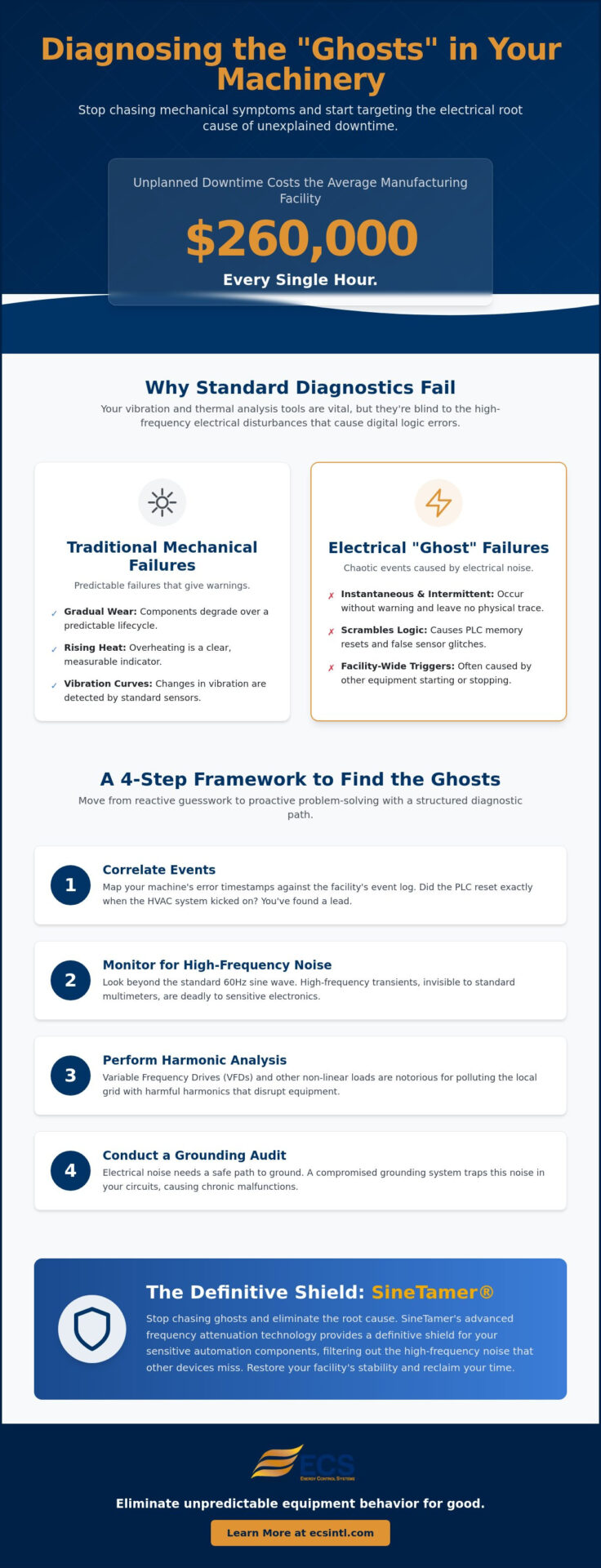
Few things are as demoralizing as a machine that refuses to work for no apparent reason. You’ve checked the bearings. You’ve analyzed the lubrication. The vibration sensors say everything is within tolerance. Yet, the line is down again. This is the reality of diagnosing unexplained machinery malfunction. It isn’t a mechanical failure in the traditional sense; it’s a digital logic error caused by “electrical ghosts.” These are low-level transients that don’t carry enough energy to blow a fuse, but they carry enough noise to scramble a PLC’s memory or trigger a false sensor glitch. While vibration and thermal imaging are vital, they miss the vast majority of power-related disturbances that reside in the high-frequency spectrum.
Mechanical vs. Electrical Failure Signatures
Understanding the difference between these failures is the first step toward restoring your peace of mind. Mechanical failures are usually polite; they give you warnings through gradual wear, rising heat, or a predictable vibration curve. Electrical failures are chaotic. They are instantaneous and intermittent. They leave no physical trace and are often triggered by other equipment starting or stopping elsewhere in your facility. This often leaves traditional fault detection and isolation protocols focused on the wrong symptoms, leading to weeks of wasted effort.
The High Cost of the “Ghost Hunt”
The cost of these mysteries is staggering. With the average manufacturing facility losing $260,000 per hour during unplanned downtime, you can’t afford to replace parts that aren’t broken. Beyond the financial loss, there is a heavy psychological burden. It erodes team morale and damages your standing with management when “fixes” don’t stick. You shouldn’t have to spend your weekends on a ghost hunt. Implementing high-performance protection like the SineTamer LA Series stops the noise at the source, allowing you to reclaim your time and your reputation as a leader who gets results.
A Systematic Framework for Diagnosing Electrical Machinery Malfunctions
When mechanical diagnostics hit a dead end, you need a structured approach to find the “electrical ghosts” haunting your line. You don’t have time for guesswork. You need a path that leads to a resolution. To effectively diagnose and repair faults in complex electrical equipment, we recommend a four step systematic framework. This process moves you from reactive troubleshooting to proactive protection.
Step one is correlation. Map your machine’s error timestamps against the facility’s event log. Did the HVAC system kick on at the exact moment the PLC reset? If so, you’ve found your culprit. Step two involves voltage monitoring. You must look beyond the standard 60Hz sine wave. High frequency noise often hitches a ride on the power line, invisible to the naked eye but deadly to sensitive electronics. Step three requires a professional Harmonic Analysis. Variable Frequency Drives (VFDs) are notorious for polluting the local grid with non-linear loads. Finally, perform a grounding audit. Noise needs a safe path out of the machine logic. If your grounding is compromised, that noise stays in the circuit, causing the very issues you’re trying to solve while diagnosing unexplained machinery malfunction.
Identifying the Silent Killers: Transients and Harmonics
Dirty power is a silent killer. While standard surge protective devices are designed to stop massive voltage spikes from lightning, they’re often too slow to catch high-speed, logic-disrupting transients. These micro-surges degrade components over time, leading to mysterious motor overheating and premature failure. If you suspect your power quality is the root cause, reaching out for a professional power quality assessment can save your facility hundreds of thousands in lost revenue.
Tools for the Modern Diagnostic Hero
The standard multimeter is a staple in every toolbox, but it has a fatal flaw. It’s too slow. It averages readings over time, meaning it completely misses micro-second events that cause digital memory loss. You need the truth. Specialized power quality loggers capture the high speed data management needs to see before approving a solution. These tools move you from “I think” to “I know,” restoring your status as the expert who provides stability in a chaotic environment.
Eliminating the Root Cause: Implementing High-Performance Power Quality Solutions
Once you’ve identified the electrical root causes, the focus shifts from investigation to resolution. You don’t have to stay in a cycle of reactive repairs. Implementing a high-performance solution like the SineTamer LA Series marks the end of the ghost hunt. Unlike standard surge strips that only react to massive voltage spikes, SineTamer utilizes frequency attenuation technology. This stops the high-frequency noise that standard devices ignore, protecting your sensitive automation from the inside out. It’s a shift from constant firefighting to strategic leadership. You’re no longer just fixing things; you’re stabilizing the entire operation.
A common objection we hear is, “We already have a UPS.” While an uninterruptible power supply is essential for battery backup, it remains vulnerable to the same transients that fry your PLCs. In fact, a UPS needs high-quality surge protection to survive the harsh industrial environment. By integrating State-of-the-Art Techniques for Fault Diagnosis with robust hardware, you create a layered defense. This ensures your backup systems don’t fail when you need them most, especially during the critical moments of power restoration.
The SineTamer Advantage for Industrial Infrastructure
The LA Series is built for the trenches. It’s designed to withstand the vibration, heat, and electrical chaos of a modern factory floor. We advocate for a 360-degree protection approach. This means securing everything from the main service entrance down to the individual PLC on the line. This comprehensive shield ensures that internal transients created by your own motors don’t reach your sensitive logic controllers. It’s about protecting the heart of your production from every angle.
Restoring Agency and Peace of Mind
You’ve felt the pressure of diagnosing unexplained machinery malfunction while the clock ticks and revenue vanishes. That weight shouldn’t be yours to carry alone. We’re here to help you reclaim your schedule and your professional status. By eliminating the electrical noise that causes the majority of unexplained failures, SineTamer helps restore 99.9% of power-related uptime to your facility. It’s time to trade the anxiety of the unknown for the tranquility of a line that simply runs.
Secure Your Production and Your Peace of Mind
The process of diagnosing unexplained machinery malfunction doesn’t have to be a source of endless stress. You’ve seen how mechanical diagnostics often fail to capture the high-frequency transients that disrupt modern automation. By implementing a systematic framework and moving toward frequency attenuation technology, you can finally stop the cycle of unplanned downtime. You have the right to a stress-free work environment where your equipment performs exactly as intended. It’s about more than just hardware; it’s about your quality of life.
It’s time to leverage our 35+ years of power quality expertise and join a global network of professionals in over 50 countries who have reclaimed their facility’s stability. Our proprietary SineTamer technology provides the protection your sensitive electronics need to survive in a chaotic electrical landscape. Don’t let another mystery reset derail your production or your professional reputation. Take the first step toward total operational tranquility today. We are here to act as your partner in restoration.
Request a Professional Harmonic Analysis and Stop the Downtime. You’ve fought the ghosts long enough; let’s restore the stability you deserve.
Frequently Asked Questions
What is the difference between a mechanical malfunction and an electrical one?
Mechanical malfunctions usually show their hand through rising temperatures or increasing vibration levels over time. They follow a predictable failure curve that you can track with standard maintenance tools. Electrical issues are different because they occur instantaneously and often leave no physical evidence behind. While a worn bearing is easy to spot during a teardown, an electrical logic error leaves you diagnosing unexplained machinery malfunction with a clean machine that simply won’t run.
Can low-level electrical noise really cause a machine to stop without blowing a fuse?
Low level electrical noise can absolutely shut down a production line without ever tripping a breaker or blowing a fuse. These transients don’t contain enough energy to melt a wire, but they carry enough high frequency interference to scramble the digital “brain” of your equipment. It is like a whisper in a crowded room that causes a vital misunderstanding. The power is still flowing, but the logic instructions are lost, leading to the mysterious resets that haunt your facility.
How do I know if my machinery malfunction is caused by harmonics?
You can identify harmonic distortion by looking for symptoms like excessive heat in motors that aren’t under heavy load or a strange, high pitched hum coming from your transformers. If your facility relies heavily on Variable Frequency Drives (VFDs), you’re at a higher risk for these non linear loads. A professional analysis is the only way to confirm if “dirty power” is the root cause of your equipment’s erratic behavior and restore the operational stability you need.
Is a standard surge protector enough for a CNC machine or PLC?
A standard surge protector is usually insufficient for protecting complex CNC machines or PLCs because it only reacts to massive voltage spikes like lightning. These devices completely ignore the high frequency noise and low level transients that cause the majority of digital glitches. You need technology specifically designed for frequency attenuation to filter out the noise that bypasses standard protection. This ensures your automation remains stable and your workday stays predictable, moving you away from the stress of constant troubleshooting.

Article by
Jeff Edwards
Founder of ECS International Inc. Edwards travels and speaks extensively in Latin America, Asia and Africa on the subject of power quality; transients and mitigating their impact on profitability. After graduating from Texas Tech University in Lubbock Texas, Edwards spent 9 years in the Telecommunications sector prior to founding Energy Control Systems in 1987 as a Texas based corporation selling surge suppression and UPS systems. The company has evolved into a global power quality products and energy efficiency concern with operations spanning South America, Asia, Europe and Africa.
Disclaimer
Some of the above information may be the opinion of the author.