

What if the “no fault found” error on your PLC isn’t a ghost in the machine, but a silent killer hiding in your power lines? You’ve likely felt that sinking frustration when a critical production line stops for no apparent reason. It’s more than just a technical glitch; it’s a threat to your facility’s stability and your peace of mind. You shouldn’t have to live with the anxiety of unexplained downtime or the high cost of premature equipment failure. We understand the weight of these burdens.
By effectively diagnosing industrial power quality issues, you can move from reactive chaos to proactive protection. This guide will teach you how to identify and resolve the hidden electrical disturbances that bypass standard protection. We’ll explore how professional harmonic analysis can stop nuisance resets, extend equipment lifespan, and finally restore a sense of calm to your production environment.
Key Takeaways
- Uncover why standard protection often fails against “silent killers” like high-frequency noise. Identifying these microscopic disturbances is the first step toward reclaiming your production schedule.
- Master a proven framework for diagnosing industrial power quality issues by documenting failure patterns and performing targeted visual inspections. This structured approach moves you from guesswork to certainty.
- Transition from reactive repairs to a 360-degree protection strategy that covers your facility from the service entrance to the point of use. Safeguard your most sensitive equipment by addressing the root cause of electrical instability.
- Learn how frequency attenuation through the SineTamer LA Series provides the ultimate defense for sensitive PLCs and VFDs. Restore your personal agency and professional status by eliminating nuisance resets for good.
Recognizing the Symptoms of Industrial Power Quality Disturbances
At its core, understanding what is power quality means evaluating the fitness of electrical power to drive your consumer devices. It is not just about the lights staying on. It is about the precision and health of every component on your floor. When you are diagnosing industrial power quality issues, you are often hunting for “silent killers.” These low-level transients are too small to trigger standard Metal Oxide Varistors (MOVs) but strong enough to degrade sensitive electronics over time. They bypass traditional defenses with ease.
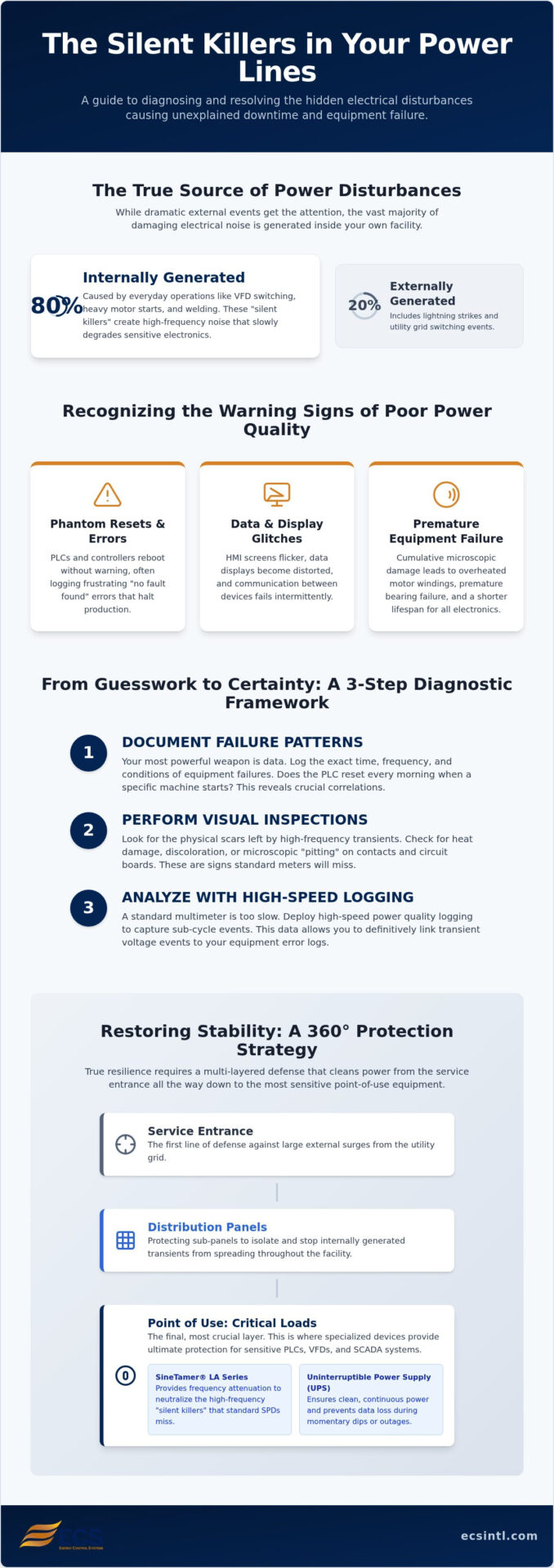
While a lightning strike is a dramatic external event, it only accounts for about 20% of disturbances. The remaining 80% are generated internally by VFD switching and heavy motor starts. These “ghost errors” take a heavy emotional toll. They leave maintenance teams feeling powerless and managers facing a massive financial drain. Unplanned downtime costs the world’s largest manufacturers an estimated $1.4 trillion annually. You shouldn’t have to guess why your line stopped again.
From PLC Communication Errors to Motor Burnouts
Standard surge protective devices often fail because they only clamp high-voltage spikes. They ignore high-frequency noise. This oversight leads to a frustrating cycle of hardware replacement. Look for these specific warning signs in your facility:
- Controllers that reboot without warning or log “no fault found” errors.
- Flickering HMI screens or distorted data displays.
- Overheated motor windings and premature bearing failure.
A transient voltage is a sub-cycle disturbance that erodes component integrity and causes microscopic damage every time it occurs. Diagnosing industrial power quality issues requires looking past the obvious and addressing this cumulative decay. You deserve a production environment that works as hard as you do.
A Step-by-Step Framework for Diagnosing Root Causes
Solving chronic downtime requires a methodical approach. First, you must document the exact timing and frequency of equipment failures. Does the PLC reset every morning at 8:00 AM? This data is your most powerful weapon. Next, perform a visual inspection for heat damage or “pitting” on contacts. These physical scars often reveal the presence of high-frequency transients that standard meters miss. Diagnosing industrial power quality issues effectively means looking beyond simple voltage readings.
You need to deploy high-speed power quality logging to catch sub-cycle events. A standard multimeter is simply too slow for this task. Once you have the data, analyze the relationship between large load switching, such as a heavy motor start, and your error logs. This correlation often exposes the internal noise sabotaging your production. If the burden of these “ghost errors” feels overwhelming, a professional harmonic analysis can provide the clarity and stability you deserve.
The Role of Professional Harmonic Analysis
Sometimes, the problem is deeper than simple transients. Professional harmonic analysis uncovers non-linear load distortions that create a “dirty” electrical stream. This identifies the difference between nuisance trips and actual overcurrent events. Expert site analysis is essential when failures persist despite basic filtering. Diagnosing industrial power quality issues with professional tools ensures you aren’t just treating symptoms, but curing the root cause of instability.
Mitigation Strategies: Restoring Agency to Your Facility
You have finished diagnosing industrial power quality issues. Now, you need a shield. True resilience comes from a 360-degree protection strategy. This means securing your facility from the service entrance all the way down to the point of use. You deserve a system that doesn’t just survive surges but actively cleans the power your sensitive electronics rely on every day. It’s about protecting your equipment and your peace of mind.
The SineTamer LA Series stands as the industry standard for frequency attenuation. It targets the “silent killers” that bypass standard MOVs. For your critical SCADA and PLC bridges, an uninterruptible power supply (UPS) ensures you never lose data during a momentary dip. The relief of a stabilized system is palpable. Maintenance costs drop. Production becomes predictable. You finally regain a sense of control over your production environment.
Implementing SineTamer and UPS Solutions
Standard surge suppression is reactive. It only waits for a massive spike. In contrast, SineTamer uses frequency-based tracking to neutralize low-level noise before it reaches your sensitive processors. For your IT and control room, protecting SineTamer RM Series rack-mounted assets is a vital step in diagnosing industrial power quality issues and implementing a permanent fix.
True power quality is found in the absence of noise, not just the suppression of surges. By integrating these solutions, you empower yourself to achieve professional success and recognition. You are no longer the one chasing ghosts. You are the one who secured the facility and restored stability to the team.
Secure Your Production Legacy and Restore Peace of Mind
You’ve moved beyond the frustration of “ghost errors” and “no fault found” results. By diagnosing industrial power quality issues with a structured framework, you’ve taken the first step toward reclaiming your facility’s stability. You now understand that standard protection isn’t enough to stop the microscopic noise that erodes your equipment’s lifespan. You deserve a work environment where production is predictable and your expertise is recognized.
SineTamer is engineered to attenuate 99% of internal transients, protecting over $100 billion in global assets. It’s time to stop chasing ghosts and start leading with certainty. Request a Professional Site Analysis and Restore Your Uptime. Your journey toward operational relief starts with a single, decisive action. We’re here to help you protect your equipment and your future.
Frequently Asked Questions
What are the most common causes of industrial power quality issues?
Most disturbances originate inside your facility through the operation of non-linear loads like variable frequency drives and heavy motor starts. These internal events create high-frequency noise that standard protection misses. While external lightning strikes are dramatic, the daily switching of your own equipment often causes the most cumulative damage to sensitive electronics. You deserve a system that handles both.
How can I tell if my PLC errors are caused by electrical noise?
You can identify noise-related failures when your PLC logs “no fault found” or resets without a clear mechanical cause. If these errors coincide with a large motor starting or a shift change, you are likely diagnosing industrial power quality issues. Other telltale signs include flickering display screens or data corruption that disappears after a manual reboot.
Can harmonic distortion damage my electric motors over time?
Harmonic distortion causes excessive heat buildup in motor windings and accelerates the degradation of insulation. This “silent killer” leads to increased vibration and premature bearing failure, shortening the motor’s lifespan significantly. You shouldn’t have to accept frequent motor burnouts as a cost of doing business. Professional analysis can identify these distortions before they cause a total failure.
What is the difference between a surge and a transient?
A surge is typically a large, high-voltage spike caused by lightning or grid failures, while a transient is a sub-cycle, high-frequency disturbance. Standard surge protectors only clamp the massive spikes. Transients are much smaller but occur thousands of times daily, slowly eroding the integrity of your automation components. Restoring your facility’s health requires a solution that addresses both.

Article by
Jeff Edwards
Founder of ECS International Inc. Edwards travels and speaks extensively in Latin America, Asia and Africa on the subject of power quality; transients and mitigating their impact on profitability. After graduating from Texas Tech University in Lubbock Texas, Edwards spent 9 years in the Telecommunications sector prior to founding Energy Control Systems in 1987 as a Texas based corporation selling surge suppression and UPS systems. The company has evolved into a global power quality products and energy efficiency concern with operations spanning South America, Asia, Europe and Africa.
Disclaimer
Some of the above information may be the opinion of the author.