

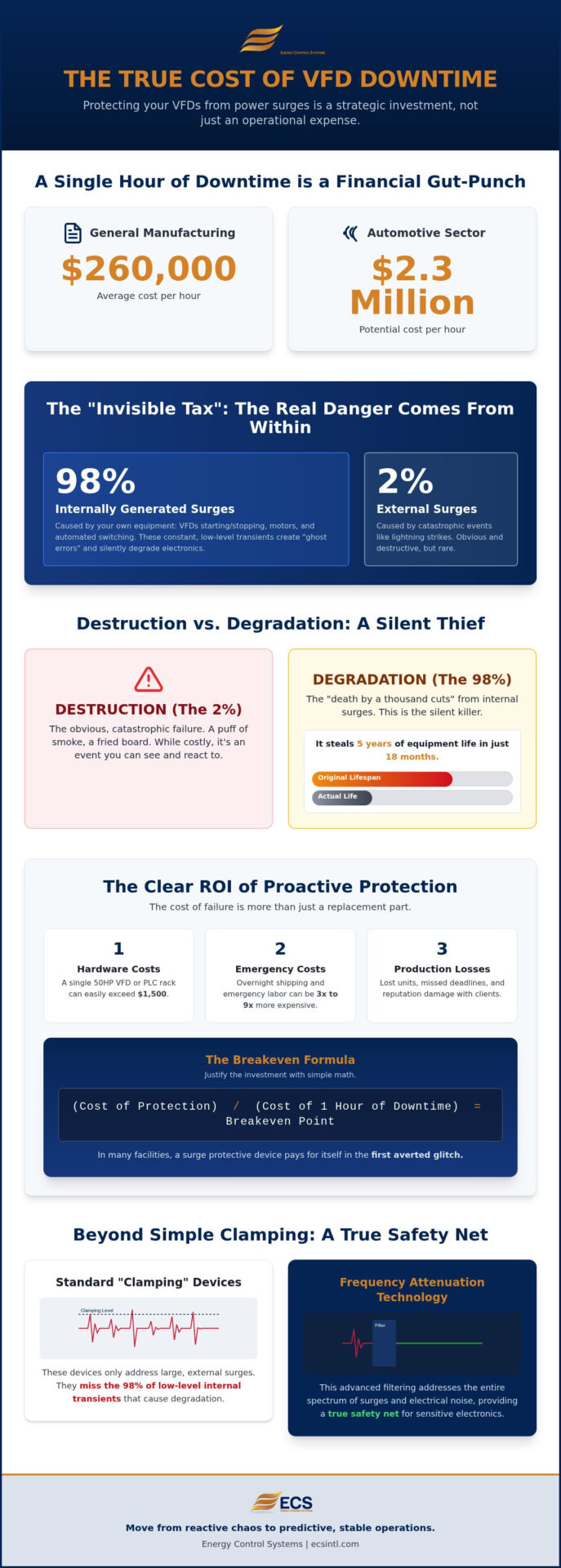
A single hour of unplanned downtime in a manufacturing plant now costs an average of $260,000. In the automotive sector, that figure can exceed $2.3 million. You’ve likely felt the gut-punch of a midnight call reporting a failed drive or a stalled line. It’s a heavy burden to carry. Protecting VFDs from power surges isn’t just about preserving hardware; it’s about reclaiming your time and your reputation for operational excellence.
We understand the pressure you face to cut O&M costs while maintaining reliability. It’s easy for management to view surge protection as an optional expense until a critical PLC or VFD fries. You deserve a work environment where technology supports your success instead of creating constant anxiety. This guide will help you discover the hidden financial impact of transients and show you exactly how to calculate the true return on investment for professional-grade protection.
We’ll examine the actual cost of reactive repairs, which can be nine times more expensive than planned maintenance. You’ll learn how to justify high-quality solutions to your board by speaking the language of ROI. It’s time to move from the chaos of equipment glitches to the tranquility of a stabilized, predictable facility.
Key Takeaways
- Identify the “Invisible Tax” of low-level transients that silently degrade your electronics long before a catastrophic failure occurs.
- Master the ROI calculation for protecting VFDs from power surges by accounting for both immediate hardware costs and long-term production losses.
- Recognize why standard clamping devices miss 98% of internally generated surges and how frequency attenuation provides a true safety net.
- Discover how the SineTamer LA Series serves as a strategic asset to protect your reputation and your company’s bottom line.
- Transition from a reactive maintenance cycle to a predictive, stable operation that restores your professional agency and peace of mind.
The Invisible Tax: Why VFD Surge Damage Costs More Than a Repair Bill
You have seen the “ghost errors” on the factory floor. Maybe it is a drive that trips for no apparent reason or a PLC that requires a mid-shift reboot. These aren’t just quirks of the machine; they are symptoms of the Invisible Tax. This tax is the cumulative cost of equipment degradation that standard maintenance budgets often overlook. While a catastrophic lightning strike is easy to understand, it only accounts for about 2% of all surge activity. The real danger comes from within. Protecting VFDs from power surges means addressing the 98% of transients generated internally by your own industrial automation and switching equipment.
Modern digital technology in 2026 is more sensitive than anything we managed a decade ago. Microprocessors are smaller, faster, and far more vulnerable to low-level voltage spikes. When these transients hit, they don’t always cause a puff of smoke. Instead, they cause logic confusion. We understand the frustration this causes you. It isn’t just about a broken circuit board; it is the crushing stress of a halted production line and a looming deadline that you might miss through no fault of your own. A standard surge protector might handle the big hits, but it often ignores the smaller, constant ripples that eat away at your uptime.
Destruction vs. Degradation: The Silent VFD Killer
Destruction is obvious. It is the 2% of events that insurance might cover, though the logistical headache remains yours to solve. Degradation is the 98%. It is the “death by a thousand cuts” that shortens the life of your VFDs and motors through constant thermal and electrical stress. Degradation is a silent thief that steals five years of equipment life in just eighteen months. By the time a drive finally fails, you have already paid for it several times over in lost efficiency and minor glitches.
The Emotional Toll of Operational Failure
When systems fail without warning, you lose your personal agency. You are forced into a reactive, high-stress cycle where you are always putting out fires instead of leading your team. Protecting VFDs from power surges is a strategic move that restores your control over the facility. High power quality isn’t just a technical specification; it is a way for you to gain status and respect within your organization. When the line stays moving, you aren’t just a maintenance lead. You are the steady hand that ensures the company’s success and your own peace of mind.
Calculating the ROI: Protection Cost vs. Industrial Downtime Loss
When a drive fails, the invoice for the replacement hardware is only the tip of the iceberg. You also face the “hard costs” of overnight shipping fees and emergency outside labor rates that can triple your standard maintenance spend. However, the true financial weight lies in the “soft costs.” Every minute your line sits idle, you lose production units, risk reputation damage with key clients, and face potential data loss in your SCADA systems. Industry data shows that billions of dollars was lost globally due to power disturbances that could have been mitigated.
To justify the investment to management, use this simple formula: (Cost of Protection) / (Cost of 1 Hour of Downtime) = The Breakeven Point. In many high-output facilities, a single surge protective device pays for itself in the first averted glitch. Protecting VFDs from power surges isn’t a luxury; it’s a strategic move to cap your financial exposure. It transforms a variable, uncapped risk into a fixed, manageable insurance cost.
The Breakeven Analysis for Industrial Facilities
Consider the one-time cost of a SineTamer LA Series unit. Compare that to the price of a single PLC rack or a 50HP VFD, which can easily exceed $1,500 for the hardware alone. When you factor in that reactive repairs cost three to nine times more than scheduled maintenance, the math becomes undeniable. You aren’t just buying a filter. You are purchasing the certainty that your equipment will reach its full service life without a premature, expensive trip to the scrap heap.
Identifying Hidden Risks Through Diagnostic Analysis
Sometimes the danger isn’t obvious. A professional harmonic analysis can reveal hidden power quality issues that are currently eating away at your components. These “ghost errors” lead to hours of expensive, fruitless troubleshooting that drains your team’s energy. If you’re tired of chasing unexplained trips, you might consider a diagnostic site analysis to prove where your vulnerabilities lie before the next surge strikes.
Beyond Clamping: Why SineTamer is the Strategic Choice for VFDs
Choosing the right equipment for protecting VFDs from power surges often comes down to understanding one vital technical distinction: clamping versus attenuation. Most off-the-shelf surge arresters act like a heavy gate. They only swing shut when a massive voltage spike hits the system. While this prevents a total meltdown, it does nothing to stop the constant, high-frequency noise generated by your own machinery. We believe you deserve better than a solution that only works 2% of the time.
The SineTamer LA Series takes a fundamentally different approach. It is a frequency attenuation system designed to clean the entire power wave. Instead of just waiting for a disaster, it actively filters the 98% of transients that standard clamping devices simply ignore. ECS doesn’t just sell hardware; we restore your control over your facility’s operational future. This is a strategic investment in mental tranquility for you and your entire maintenance team.
Frequency Attenuation vs. Standard Clamping
Standard SPDs are reactive. They wait for a threshold to be crossed before they engage. In contrast, SineTamer acts as a sophisticated filter that constantly removes high-frequency noise. We define frequency attenuation as the removal of high-frequency noise that causes VFD logic errors and servo electric motors to malfunction mid-cycle. By attenuating these frequencies, you eliminate the “ghost in the machine” that leads to unexplained downtime. You stop the degradation process before it can compromise your uptime.
Your Path to Operational Stability
It’s time to stop reacting to VFD failures and start protecting your professional reputation and your facility’s bottom line. Your value to the organization shouldn’t be measured by how quickly you can fix a broken line at 2:00 AM. It should be measured by the stability and predictability you bring to the plant floor. You deserve a facility that runs as smoothly on Friday night as it does on Monday morning. By moving beyond simple clamping, you’re choosing a path of resilience that ensures your equipment reaches its full potential. Let’s move toward a future where technology is a source of strength, not a source of stress.
Take Control of Your Facility’s Power Quality Future
You now have the tools to shift from reactive firefighting to strategic leadership. By recognizing that the “Invisible Tax” of internal transients is a choice rather than a necessity, you can protect your equipment and your team’s valuable time. Protecting VFDs from power surges is no longer an abstract technical goal. It is a clear financial mandate with a measurable ROI that often pays for itself within a single averted glitch.
Since 1987, we have provided battle-tested solutions across the globe. Our proprietary Frequency Attenuation technology doesn’t just wait for a disaster; it cleans the power wave to ensure your industrial automation remains stable. You don’t have to accept the stress of unexplained failures or the burden of midnight repair calls. With our global distribution and support, you have a partner dedicated to your long-term stability.
Restore your operational agency; Request a Technical Site Analysis today. We are here to help you build a more predictable, tranquil facility where you can focus on growth instead of survival. You’ve earned the right to a system that works as hard as you do.
Frequently Asked Questions
Is the cost of high-end surge protection tax-deductible for industrial businesses?
High-quality surge protection is typically treated as a deductible business expense or a capital improvement in an industrial setting. These systems are essential for maintaining the operational life of your infrastructure. Because tax laws fluctuate, it’s vital to speak with your accountant about Section 179 deductions or similar equipment depreciation rules. Investing in your facility’s stability should always be a conversation about long-term financial health and tax efficiency.
How do I calculate the specific cost of downtime for my manufacturing plant?
You calculate downtime by adding your lost production value to your fixed labor and overhead costs. Start with the number of units you fail to produce every hour and multiply that by your profit margin. Then, add the hourly wages of every idle employee. This math is essential when justifying the cost of protecting VFDs from power surges to your management team, as it reveals the true price of inaction.
Can a standard surge strip protect my industrial VFD or SCADA system?
No, a standard surge strip cannot handle the rigorous demands of protecting VFDs from power surges or safeguarding a SCADA system. These consumer devices are meant for low-voltage office equipment; they lack the robust components required for industrial switching transients. Using them in a plant environment is a gamble with your uptime. You need frequency attenuation to filter out the high-frequency noise that causes expensive logic crashes.
What is the average lifespan of a SineTamer LA Series device compared to a standard SPD?
The SineTamer LA Series is built for a service life exceeding 20 years, even in demanding industrial environments. Standard surge protective devices are often sacrificial, meaning they wear out a little more with every spike they encounter. Our frequency attenuation technology is different; it is designed for durability and consistent performance. This long-term reliability restores your personal agency by removing the constant fear of equipment failure.

Article by
Jeff Edwards
Founder of ECS International Inc. Edwards travels and speaks extensively in Latin America, Asia and Africa on the subject of power quality; transients and mitigating their impact on profitability. After graduating from Texas Tech University in Lubbock Texas, Edwards spent 9 years in the Telecommunications sector prior to founding Energy Control Systems in 1987 as a Texas based corporation selling surge suppression and UPS systems. The company has evolved into a global power quality products and energy efficiency concern with operations spanning South America, Asia, Europe and Africa.
Disclaimer
Some of the above information may be the opinion of the author.