

Unplanned downtime in manufacturing now costs an average of $260,000 per hour. It’s a staggering figure, yet you’re likely still struggling to explain why those “random” micro-trips aren’t just normal operational wear and tear. You’re the one answering the 2 a.m. calls while management views electrical instability as an unavoidable cost of doing business. It’s draining, and you deserve better than a reactive work life. We understand that frustration. You aren’t just looking for hardware; you’re looking for stability.
In this guide, you’ll discover exactly how to convince management to invest in power quality by translating technical harmonic distortion into the high-impact financial metrics executives demand. We’ll show you how to move beyond technical specifications to present a business case that wins budget and restores your professional agency. It’s time to turn unpredictable failures into a high-ROI strategy that protects your equipment and your peace of mind.
Key Takeaways
- Stop talking about hardware specifications and start communicating in the language of business risk and asset protection.
- Master the specific metrics, like scrap rates and reboot times, that show you how to convince management to invest in power quality using a total cost of ownership model.
- Leverage professional Harmonic Analysis to provide the undeniable proof points needed to secure executive approval and capital budget.
- Transform your role from a reactive technician to a strategic leader by restoring personal agency and operational predictability to your facility.
Translate Technical Chaos into the Language of Business Risk
Executives don’t wake up thinking about harmonic distortion. They wake up thinking about profitability, market share, and operational predictability. If you want to know how to convince management to invest in power quality, you must stop leading with electrical specifications. They don’t buy surge suppressors; they purchase asset protection and risk mitigation. When you present what power quality is through the lens of business stability, you transform a technical expense into a strategic shield. Low-level transients aren’t just engineering anomalies. They are a silent, constant drain on your company’s profit margins.
Stop Talking About Harmonics and Start Talking About Downtime
Shift the conversation immediately. Replace talk of electrical waveforms with a focus on lost production hours and missed delivery deadlines. Management understands the pain of a line stopping. They don’t always understand that low-level transients are the root cause of those frustrating PLC communication errors and sudden software lockups. These events aren’t random glitches. They are symptoms of an unprotected system that erodes your facility’s output every single day.
When you connect poor power quality directly to premature equipment failure and inflated maintenance labor costs, the business case becomes undeniable. Every hour your team spends on emergency repairs is an hour of wasted capital. Proactive mitigation isn’t just about hardware; it’s about restoring your personal agency and giving leadership the peace of mind they crave. By framing the solution as an executive shield, you’re offering them a way to secure the company’s digital foundation against the chaos of an unstable grid.
How to Build a Financial Business Case for Power Quality
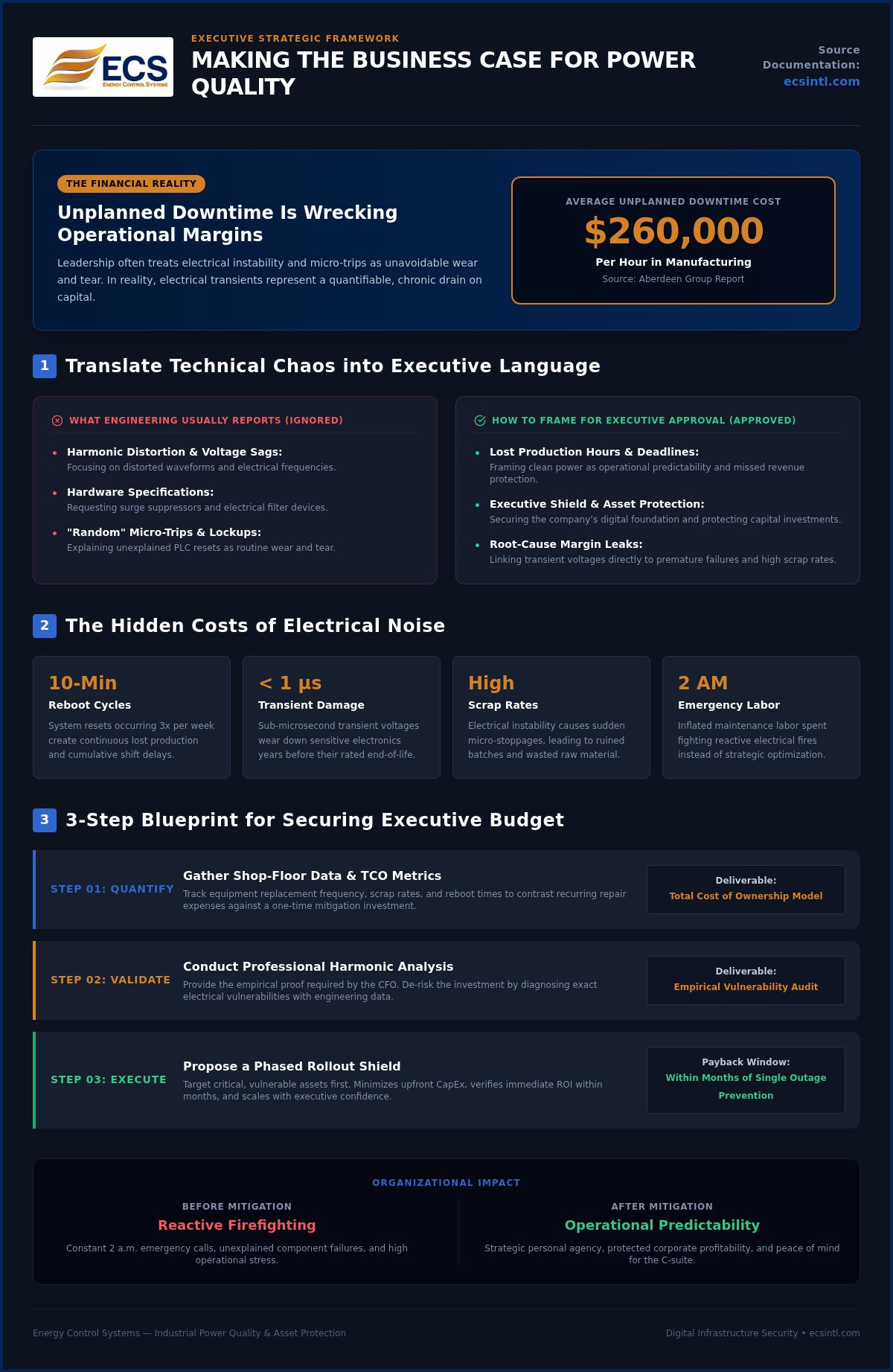
Data is the bridge between the shop floor and the boardroom. To master how to convince management to invest in power quality, you must move beyond technical intuition. Start by gathering hard numbers. Track your equipment replacement frequencies, scrap rates, and those annoying 10-minute reboot times that happen three times a week. These aren’t just minor inconveniences. They are quantifiable leaks in your operational budget. By comparing these chronic, recurring repair costs against a one-time mitigation investment, you create a Total Cost of Ownership (TCO) model that speaks directly to executive priorities.
Calculating the Hidden Costs of Electrical Noise
Industrial downtime isn’t cheap. According to 2024 reports from the Aberdeen Group, unplanned downtime in manufacturing costs an average of $260,000 per hour. Document the exact losses for your specific assembly line. Don’t forget the invisible damage. Sub-microsecond transient voltages cause accelerated component degradation; they wear down your sensitive electronics years before their time. This isn’t just theory. It’s a financial burden you can prove with data.
Present a clear timeline for payback. Most advanced protection solutions pay for themselves within months by simply preventing a single major outage. If you need help quantifying these risks, a professional Harmonic Analysis provides the hard evidence your CFO requires. You’ll move from pleading for budget to presenting a bulletproof ROI model. This strategy guarantees operational predictability and restores your peace of mind. You deserve a facility that works as hard as you do.
Present the Solution as an Executive Shield
You don’t have to demand a massive, site-wide budget all at once to make an impact. When you are mapping out how to convince management to invest in power quality, a phased implementation plan is your strongest asset. Propose a targeted rollout that protects your most vulnerable production assets first. This approach minimizes upfront capital expenditure while validating clear, undeniable results early in the process. You are building a protective wall around the company’s digital foundation step by step.
This strategic framework changes how leadership views your department. By presenting mitigation as a shield for corporate profitability, you restore personal agency to your engineering team and hand peace of mind directly to the C-suite. The constant anxiety of waiting for the next system failure disappears. You move from a state of reactive firefighting to a position of organized control.
Leverage Professional Engineering Data to De-Risk the Investment
Executives crave certainty before they sign off on capital expenditures. Partnering with experts for a professional harmonic analysis provides the empirical proof you need to expose your facility’s exact electrical vulnerabilities. With hard data in hand, you can confidently introduce engineered solutions like a specialized surge protective device to target and destroy the root causes of component stress.
To complete this defense system, integrating an industrial uninterruptible power supply secures critical SCADA systems against unexpected voltage drops. This comprehensive approach removes the guesswork from your infrastructure. It acts as an operational insurance policy that guarantees predictability, elevates your status within the organization, and brings true mental tranquility back to your production floor.
Secure Your Facility’s Future and Your Peace of Mind
You don’t have to accept constant micro-downtime as an unavoidable cost of doing business. By shifting the conversation from technical waveforms to financial risk metrics, you’ve mastered how to convince management to invest in power quality. You’ve seen how documenting hidden costs like scrap rates and premature equipment failure builds an undeniable ROI model. Now, it’s time to turn that strategy into action. We understand the deep frustration of being caught in a reactive loop of emergency repairs. You deserve the stability that comes from a protected digital foundation.
With over three decades of global industrial experience and proprietary SineTamer systems, we provide the comprehensive site analysis and engineered solutions you need to win executive approval. Partner with Energy Control Systems to build your power quality business case today. You’ve got the plan; let’s restore your facility’s predictability and professional agency together.
Frequently Asked Questions
What is the most common mistake when pitching power quality to executives?
The most common mistake is leading with technical specifications rather than business-centric outcomes. Executives don’t buy hardware; they buy risk mitigation and operational predictability. If you focus on electrical waveforms instead of lost revenue, your pitch will likely fail. You must explain how to convince management to invest in power quality by framing the purchase as a strategic insurance policy for the facility.
How do I calculate the ROI of an industrial surge protection system?
You calculate ROI by comparing the total cost of ownership of your current unprotected system against a one-time mitigation investment. Track every cent spent on premature component failures, maintenance labor, and production scrap over the last year. When you show that a SineTamer system pays for itself by preventing just one major equipment failure, the financial case becomes undeniable. It’s about restoring your agency and their profit.
Why do standard surge protectors fail to satisfy executive cost-saving goals?
Standard surge protectors fail executive goals because they only react to high-level surges, like lightning. They ignore the low-level transients and electrical noise that cause 80% of automated equipment failures. Proprietary SineTamer technology addresses these quiet profit-killers that standard devices miss. By targeting the actual root cause of component stress, you provide the long-term reliability and cost-savings that leadership expects from a strategic investment.
Can a professional harmonic analysis help secure project budget approval?
A professional harmonic analysis is the ultimate tool for securing budget approval. It provides the empirical, third-party data needed to de-risk the investment for skeptical leadership. This analysis identifies specific vulnerabilities in your facility that intuition alone can’t prove. Presenting these findings shows you have a high-impact strategy. It transforms a request for funds into a data-driven plan for how to convince management to invest in power quality.

Article by
Jeff Edwards
Founder of ECS International Inc. Edwards travels and speaks extensively in Latin America, Asia and Africa on the subject of power quality; transients and mitigating their impact on profitability. After graduating from Texas Tech University in Lubbock Texas, Edwards spent 9 years in the Telecommunications sector prior to founding Energy Control Systems in 1987 as a Texas based corporation selling surge suppression and UPS systems. The company has evolved into a global power quality products and energy efficiency concern with operations spanning South America, Asia, Europe and Africa.
Disclaimer
Some of the above information may be the opinion of the author.