

Your standard UPS might be the most dangerous “safety net” in your facility. While it’s designed to bridge the gap during a blackout, a generic unit often lacks the muscle to survive the raw power pollution of a modern factory floor. You’ve likely felt the gut-wrenching stress of a PLC communication error or an unplanned reset that wipes out thousands of dollars in production every hour. It’s exhausting to fight fires that shouldn’t exist. We believe you deserve better than a work life defined by technical chaos.
By integrating ups with surge protection for industrial automation, you can finally stop the cycle of premature battery failure. This 2026 strategy guide reveals how to select a UPS that thrives in high-heat environments while meeting the latest NEC 2026 standards. We’ll explore the SineTamer hardware needed to transform your power grid into a fortress of stability, ensuring you’re recognized as the leader who finally stabilized the plant.
Key Takeaways
- Discover why a true industrial UPS must act as a precision power stabilizer for microprocessors rather than a simple battery backup.
- Learn to calculate the True Load of your entire control cabinet to prevent the resets that cost your facility thousands every hour.
- Protect your hardware from “sacrificial” failure by integrating ups with surge protection for industrial automation using a layered defense strategy.
- Master the shift to Online Double-Conversion topology to achieve the zero-millisecond transfer time required for total SCADA and PLC stability.
Beyond the Battery: Why Standard UPS Selection Fails in Industrial Automation
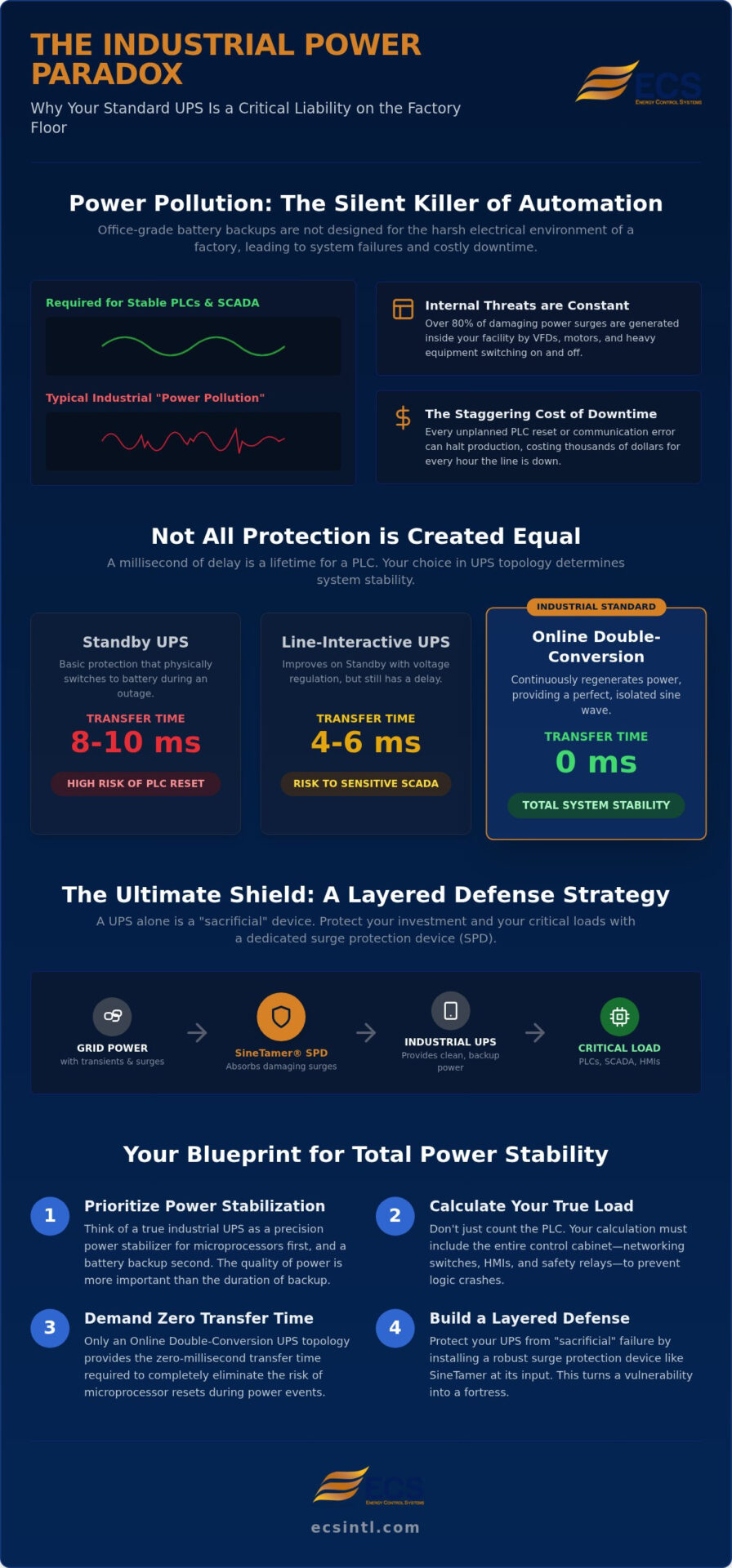
Most people think of a backup battery as a simple insurance policy. On the factory floor, that mindset is dangerous. A standard uninterruptible power supply (UPS) designed for a server room will wither under the relentless “power pollution” of an industrial environment. Massive motors and Variable Frequency Drives (VFDs) generate electrical noise that chokes sensitive electronics. These office-grade units simply aren’t built to filter the high-frequency transients common in heavy manufacturing. You need a stabilizer, not just a battery.
When you’re staring at a flashing red light on a control panel, the cost isn’t just the thousands of dollars lost per hour. It’s the knot in your stomach. It’s the frustration of a PLC that won’t stop resetting. True relief comes when you stop treating backup power as a standalone fix. By integrating ups with surge protection for industrial automation, you transform a vulnerable battery into a battle-tested power quality shield. It’s about restoring your personal agency over the machines you manage.
Identifying the Enemies of Your Automation Rack
Lightning is the rare event everyone fears, yet 80% of transient voltage surges are actually generated inside your own facility. Every time a heavy load switches on or off, it sends a shockwave through your rack. These micro-events degrade components over time, leading to unexplained failures. Power Quality is the foundation of Scada system reliability. Integrating ups with surge protection for industrial automation ensures your PLC communication is shielded from harmonic distortion and the invisible chaos of internal switching. A robust defense using the SineTamer LA Series means zero PLC resets and total operational stability.
5 Critical Criteria for Sizing and Selecting Your Industrial UPS
Selecting the right hardware is where you reclaim control over your facility’s heartbeat. It starts with calculating the True Load of your control cabinet. Don’t just count the PLC. You must include networking switches, HMIs, and safety relays. Integrating ups with surge protection for industrial automation requires a holistic view of this electronic nervous system. If these components lose power for even a few milliseconds, the resulting “logic crash” can take hours to clear. Using standards from the International Society of Automation helps automation professionals streamline processes and improve safety by ensuring every link in the power chain is accounted for.
Comparing UPS Topologies: Standby vs. Line-Interactive vs. Online
Topology defines how your equipment survives a power dip. Standby and line-interactive units rely on a physical relay to switch to battery. That “click” takes time. PLCs and sensitive SCADA gear cannot wait 8 to 10 milliseconds for a relay; they will reset, leaving you to deal with the fallout. An Online Double-Conversion uninterruptible power supply is the only choice for total stability. It constantly runs through an inverter, providing a perfect sine wave with zero-millisecond transfer time. This level of precision is vital for maintaining your mental tranquility during a power event.
Finally, check your environmental ratings. High-heat factory floors are battery killers. Most standard units fail because they can’t handle the ambient temperature of a sealed enclosure. Look for ruggedized designs that protect the internal chemistry from premature failure. If you aren’t sure how your current load stacks up, our team can help you perform a technical site analysis to find the perfect fit for your specific environment.
Building the Shield: Why Your UPS Needs SineTamer Surge Protection
Don’t fall for the “Sacrificial UPS” myth. Many engineers believe the internal circuitry of a UPS is enough to stop a massive surge. It isn’t. A high-energy transient can easily fry a UPS inverter, leaving your critical load unprotected and your budget drained by expensive hardware replacements. Real protection requires a layered defense. By integrating ups with surge protection for industrial automation, you place a dedicated guard at the gate. Using the SineTamer LA Series to protect the UPS input ensures that the surge never reaches the sensitive battery or inverter components. This strategy restores your personal agency, turning you from a reactive fire-fighter into a proactive hero who secures the plant’s future and your own professional reputation.
Integrating SineTamer for Maximum PLC Protection
While big surges grab headlines, low-level transients are the silent killers of automation. They cause the “ghost” resets and logic errors that drive maintenance teams mad. Integrating ups with surge protection for industrial automation allows you to clean up this electrical noise before it confuses your processors. The SineTamer RM Series is the perfect companion for rack-mounted gear. It filters out the high-frequency ring waves that standard surge strips ignore, ensuring your PLCs receive the clean, stable power they need to perform.
To finalize your fail-safe industrial power architecture, ensure your strategy includes these essential steps:
- Install Type 1 or Type 2 protection at the main service entrance to stop external threats.
- Deploy SineTamer units at the UPS input to prevent inverter burnout and battery degradation.
- Utilize rack-mounted suppression for high-density networking and SCADA racks to stop internal noise.
- Conduct periodic harmonic analysis to identify internal noise sources from VFDs and large motors.
While you focus on physical power quality, don’t overlook the security of your web-based control interfaces. To ensure your digital infrastructure is as protected as your hardware, learn more about cside and their real-time monitoring for script-based threats.
Stabilize Your Plant and Reclaim Your Peace of Mind
A battery backup is only half the battle. To achieve total operational stability, you must move beyond the “sacrificial UPS” mindset. You’ve learned that selecting an Online Double-Conversion topology is essential for zero-millisecond transfer times. However, the real transformation happens when you stop internal transients from reaching your sensitive processors. By integrating ups with surge protection for industrial automation, you create a fortress that protects both your hardware and your professional reputation.
Don’t let power pollution dictate your plant’s productivity. Energy Control Systems (ECS) brings 35 years of industrial expertise and proprietary SineTamer technology to your facility, offering global distribution for immediate relief. It’s time to transition from constant firefighting to confident leadership. Secure Your Uptime: Contact ECS for a Technical Site Analysis. You have the power to restore tranquility to your automation rack today.
Frequently Asked Questions
Can I use an office-grade UPS for my PLC rack?
You shouldn’t risk your production on an office-grade unit. These devices are designed for air-conditioned server rooms, not the harsh reality of a factory floor. They lack the robust thermal management and transient suppression needed to survive electrical noise. Industrial automation demands an Online Double-Conversion UPS that treats incoming power as a raw material to be cleaned before it reaches your PLC.
What is the difference between VA and Watts when sizing a UPS for industrial automation?
Watts represent the real power doing work, while VA measures the apparent power the electrical system must provide. In industrial racks, the power factor is often lower than in IT environments. If you don’t account for the difference, you’ll face a system overload. Integrating ups with surge protection for industrial automation requires sizing for the peak VA to ensure total stability.
How often should I replace batteries in an industrial environment?
Expect to replace batteries every three to five years under ideal conditions. However, factory environments are rarely ideal. High ambient temperatures are the primary cause of premature battery death. If your enclosure runs hot, you might need replacements every two years. Regular site analysis and proactive monitoring can prevent the anxiety of a dead battery during a power sag, keeping operations running.
Why does my UPS keep failing despite no major lightning strikes?
Your UPS is likely being worn down by internal power pollution. While lightning is a headline event, the real killers are the daily transients from VFDs and heavy machinery. These micro-surges slowly destroy the UPS inverter. Integrating ups with surge protection for industrial automation provides a shield that stops these internal spikes. It prevents the hardware failure that leads to expensive unplanned downtime.

Article by
Jeff Edwards
Founder of ECS International Inc. Edwards travels and speaks extensively in Latin America, Asia and Africa on the subject of power quality; transients and mitigating their impact on profitability. After graduating from Texas Tech University in Lubbock Texas, Edwards spent 9 years in the Telecommunications sector prior to founding Energy Control Systems in 1987 as a Texas based corporation selling surge suppression and UPS systems. The company has evolved into a global power quality products and energy efficiency concern with operations spanning South America, Asia, Europe and Africa.
Disclaimer
Some of the above information may be the opinion of the author.