

What if the most dangerous threat to your facility’s uptime isn’t a massive lightning strike, but the equipment you just turned on? It is a hard truth to swallow when you’re already under the constant pressure of meeting production KPIs. You might have a surge protector at your main panel, yet you’re still plagued by “ghost” errors and high replacement costs for sensitive electronics. It feels like a losing battle against an invisible enemy. We understand the stress that comes with unstable power; it’s more than just a technical glitch, it’s a drain on your professional peace of mind.
You deserve a workplace defined by stability rather than crisis management. This guide will show you how to master a cascading surge protection strategy to eliminate the 80% of transients generated internally. You’ll learn to build a multi-layered defense using specialized tools like the SineTamer LA and RM Series to guard against both external catastrophes and the silent killers inside your walls. We will walk through the logic of layered protection, showing you how to create a “set and forget” power environment that lowers maintenance costs and restores the professional tranquility you’ve been working so hard to achieve.
Key Takeaways
- Understand why a single SPD at the main panel isn’t enough and how a cascading surge protection strategy creates a multi-layered shield for your entire operation.
- Discover the “80/20 Rule” of power quality and learn to neutralize the silent internal transients that cause 80% of your equipment failures.
- Master a 4-step framework for designing your defense, beginning with a site-wide audit to identify and protect your facility’s most critical nodes.
- Learn how to deploy the SineTamer LA Series for heavy-duty service entrance protection that maintains stability when the grid becomes chaotic.
- Explore specialized point-of-use solutions like the SineTamer RM Series to ensure total uptime for your sensitive servers and digital technology.
What is a Cascading Surge Protection Strategy?
A cascading surge protection strategy is a systematic, multi-layered shield designed to ensure your facility never goes dark. By installing a Surge protector at every critical level of your power distribution, you create a fail-safe environment. This approach recognizes that power quality is a journey, not a single destination at the service entrance. It is about protecting the heart of your operation from every possible angle, giving you the relief that comes with knowing your equipment is truly secure.
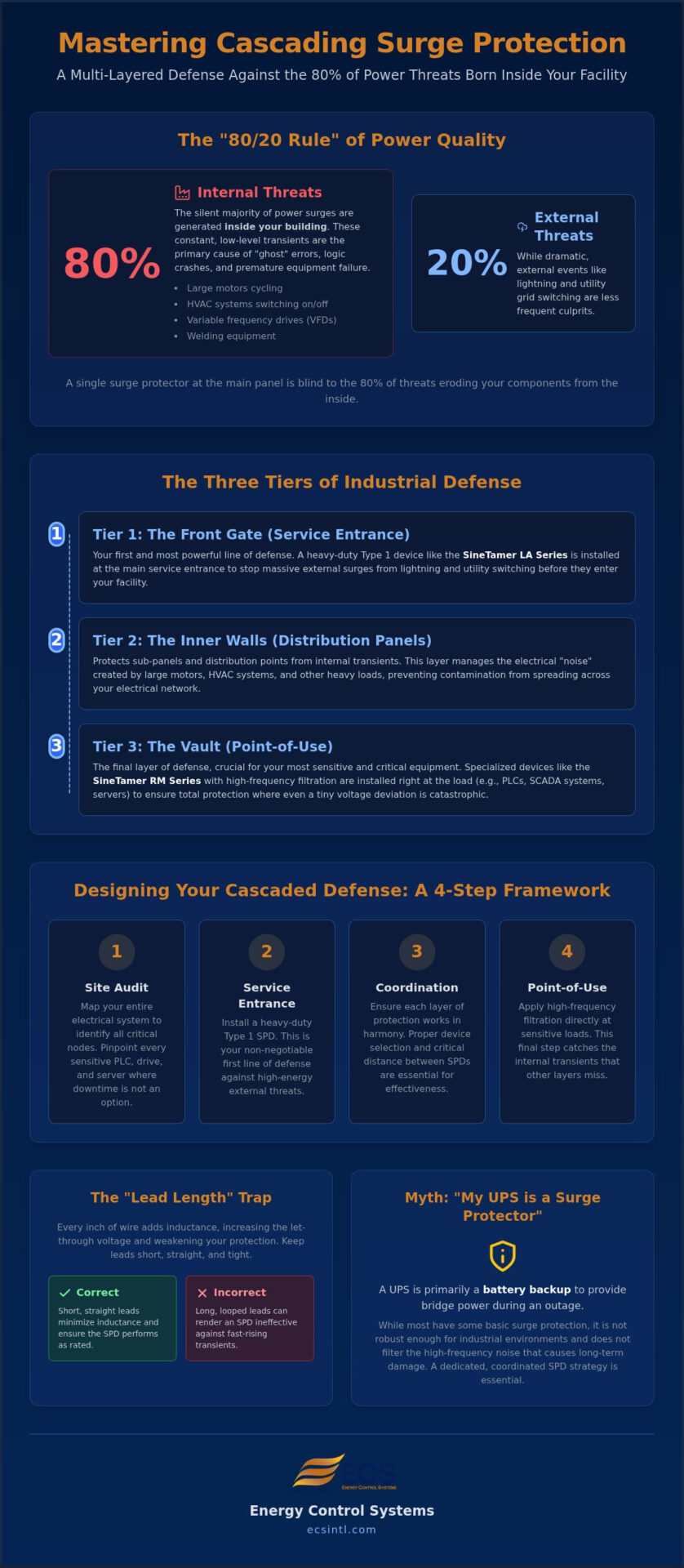
You might worry about lightning, but the reality is more subtle. Statistics show that 80% of electrical transients are generated right inside your building. Every time a large motor cycles or a heavy load switches, it sends a ripple through your sensitive electronics. This constant bombardment leads to “ghost errors” in your automation, those unexplained downtime events that keep you at the plant late on a Friday. We want to help you reclaim that time and eliminate the stress of meeting KPIs under unstable conditions.
Standard devices at the main panel often suffer from high let-through voltage. By the time an external surge reaches your PLC, it is often still powerful enough to cause a logic crash or hardware failure. A single point of protection is a gamble you don’t have to take. By layering your defense, you catch the energy that the first line of defense misses, restoring your personal agency over your facility’s uptime.
The Three Tiers of Industrial Defense
- Tier 1: The Front Gate. This is your service entrance protection, stopping massive utility surges and lightning before they even enter your infrastructure.
- Tier 2: The Inner Walls. Distribution panels manage the switching noise and transients created by large motors and HVAC systems within the facility.
- Tier 3: The Vault. Point-of-use protection for your microprocessors, SCADA systems, and sensitive digital assets where even a tiny voltage deviation can cause a total system crash.
Why Standard SPDs Aren’t Enough
Most standard surge devices are designed only for high-energy spikes. They are effectively blind to the high-frequency noise that erodes your components over time. A true cascading surge protection strategy uses frequency attenuation to catch the low-level transients that standard MOV-based devices simply ignore. This distinction is the difference between a system that merely survives and one that thrives without interruption.
Transient voltage is the silent erosion of electronic components.
Designing Your Cascaded Defense: A 4-Step Framework
Implementing a cascading surge protection strategy is a precision game. It is not just about buying hardware; it is about engineering a environment where your equipment can thrive. While codes like the NEC provide a baseline for safety, your goal is total uptime. This requires a higher standard of technical care. You can move from a state of constant electrical anxiety to one of professional confidence by following this structured path.
- Step 1: The Site Audit. Identify your critical nodes. You must map every sensitive PLC, drive, and server to understand where the “ghost errors” are likely to strike.
- Step 2: The Service Entrance. Install a heavy-duty Type 1 device like the SineTamer LA Series. This is your first line of defense against the massive energy of lightning and utility switching.
- Step 3: Coordination. This is where the math matters. You must ensure that each layer of protection works in harmony rather than fighting the next device in line.
- Step 4: Point-of-Use. Apply high-frequency filtration at the sensitive load. This final layer catches the internal transients that your main panel devices never see.
The Critical Role of Coordination Distance
Physical distance between your protectors determines their effectiveness. If devices are too close, they may not trigger in the correct sequence. If they are too far, the reflected wave of a surge can still damage your gear. This is why NIST research on coordinating SPDs is so vital for industrial engineers. The “Lead Length” trap is the most common failure point. Every inch of wire adds inductance. A mere 6 inches of extra lead length can significantly increase the let-through voltage, rendering your protection useless. Keep your leads short, straight, and tight.
Integrating Uninterruptible Power Supplies (UPS)
Don’t fall for the myth that a UPS is a surge protector. A UPS is primarily a battery system designed to provide bridge power. It does not possess the high-frequency filtration needed to stop damaging transients. You need both. While you calculate your uninterruptible power supply hours for runtime, you must also ensure an SPD is installed upstream to protect the UPS itself. If you’re ready to secure your facility’s future, exploring our SineTamer solutions is the best next step toward mental tranquility.
The SineTamer Advantage in Cascaded Architectures
A successful cascading surge protection strategy requires more than just standard hardware. It requires a solution that understands the delicate nature of modern microprocessors. While generic devices focus on clamping high-voltage spikes, SineTamer targets the high-frequency noise that causes 80% of your electronic failures. This specialized approach is why engineering firms recommend a cascading approach to surge protection for facilities that cannot afford a single minute of downtime.
The SineTamer LA Series serves as your heavy-duty guardian at the service entrance. It is built to survive extreme conditions where standard MOVs often fail. By neutralizing external threats before they penetrate your distribution network, the LA Series provides the initial layer of stability your facility needs to stay operational during severe weather or grid instability. It’s about more than just hardware; it’s about the peace of mind that comes from a battle-tested defense.
Your digital infrastructure requires a more refined touch. The SineTamer RM Series provides specialized rack-mount power quality for your servers and data centers. It doesn’t just stop surges; it cleans the power. This frequency attenuation ensures that the “electrical noise” generated by nearby equipment doesn’t reach your most sensitive microprocessors, preventing the logic crashes that disrupt your production cycle.
Protecting Switchgear and Servo Motors
For localized protection of high-value assets, the SineTamer ST series is the industry standard. It is designed to be installed directly at the point of use, such as switchgear or servo motors. In one reported instance, implementing this level of cascading reduced PLC communication errors at a Fort Worth manufacturing plant, turning a site once plagued by “ghost” errors into a model of reliability. You can stop putting out fires and start leading your facility with confidence.
While protecting your machinery is crucial for uptime, ensuring your finished products reach their destination safely is just as vital for your reputation; you can learn more about OEM Materials & Supplies to see how they provide industrial packaging for manufacturers nationwide.
Harmonic Analysis: The Final Layer
Even the most robust cascading surge protection strategy can be undermined by non-linear loads. This is why periodic harmonic analysis is essential. It helps you identify internal issues that SPDs alone cannot solve, such as overheating transformers or neutral-to-ground voltage problems. By combining SineTamer hardware with deep power quality insights, you restore system balance and achieve true mental tranquility. You aren’t just buying equipment; you’re securing your right to a stress-free work environment.
Restore Your Operational Stability
True operational stability is within your reach when you move beyond basic hardware and embrace a comprehensive cascading surge protection strategy. By auditing your critical nodes and layering SineTamer’s proprietary frequency attenuation technology from the service entrance to the point of use, you aren’t just protecting equipment. You are restoring your own personal agency and securing your reputation as a leader who delivers results, much like the way The CFS Group ensures businesses operate seamlessly through tailored facilities management.
With over 35 years of power quality expertise and a global distribution network, we understand the high stakes of industrial downtime. We are here to help you transition from reactive repairs to proactive facility leadership. It’s time to experience the mental tranquility that comes with a truly stable power environment. Request a Professional Site Analysis and SineTamer Strategy Today and take the first step toward a worry-free infrastructure. Your facility deserves a steady hand, and you deserve a stress-free workday. Let’s build your multi-layered defense together.
Frequently Asked Questions
Does cascading surge protectors increase the clamping voltage?
No, a cascading surge protection strategy actually reduces the let-through voltage that reaches your sensitive equipment. By layering devices, each stage knocks down the residual energy left behind by the previous protector. This ensures that the final voltage hitting your PLC or server is well within its logic tolerance, preventing the hardware stress and “ghost” errors that lead to premature failure and operational downtime.
Can I use different brands of SPDs in a cascaded strategy?
You can use different brands, but it makes technical coordination significantly more difficult. Different manufacturers use varying response times and clamping technologies, which can cause devices to fight each other rather than working in a clean sequence. For the best results and professional peace of mind, we recommend a unified approach using SineTamer’s consistent frequency attenuation technology across every layer of your infrastructure.
What is the minimum distance required between cascaded surge protectors?
A standard rule of thumb is to maintain at least 30 feet of conductor length between your Type 1 and Type 2 devices. This distance provides the necessary impedance to ensure the upstream protector triggers first to handle the bulk of the energy. If your facility layout requires closer mounting, you must use specialized devices like the SineTamer ST series that are specifically engineered to coordinate in tight physical configurations without losing effectiveness.
Is a cascaded strategy necessary if I already have a lightning rod?
Yes, because a lightning rod only protects the physical structure of your building from a direct strike. It does nothing to stop the surges traveling through the power lines or the 80% of transients generated by your own internal motors and switching loads. You need a multi-layered defense to protect your digital assets from the electrical chaos that a lightning rod simply wasn’t designed to handle.

Article by
Jeff Edwards
Founder of ECS International Inc. Edwards travels and speaks extensively in Latin America, Asia and Africa on the subject of power quality; transients and mitigating their impact on profitability. After graduating from Texas Tech University in Lubbock Texas, Edwards spent 9 years in the Telecommunications sector prior to founding Energy Control Systems in 1987 as a Texas based corporation selling surge suppression and UPS systems. The company has evolved into a global power quality products and energy efficiency concern with operations spanning South America, Asia, Europe and Africa.
Disclaimer
Some of the above information may be the opinion of the author.