

An unplanned outage costs more than the repair bill. Its full impact depends on how long service is disrupted, which equipment and operations are affected, and what recovery requires. An electrical reliability improvement plan helps prioritize action by weighing outage consequences against equipment condition and failure risk.
When the power fails, pressure to restore operations is immediate. A sound plan replaces guesswork with a clear view of which assets need attention first. Learn how equipment characteristics and maintenance records can reveal warning signs, how outage costs and risks shape priorities, and how mean time to failure can inform reliability decisions. Together, these factors turn maintenance history into a practical path toward fewer surprises and steadier operations.
Key Takeaways
- Rank equipment by condition, operating characteristics, and importance to identify which assets need attention first.
- Use maintenance records to spot recurring failures and turn inspection findings into planned action.
- Weigh outage duration and operational consequences alongside failure likelihood when prioritizing reliability investments.
- Use mean time to failure as a planning baseline, and consider UPS or Harmonic Analysis when power continuity or power quality is a concern.
Equipment characteristics and maintenance records
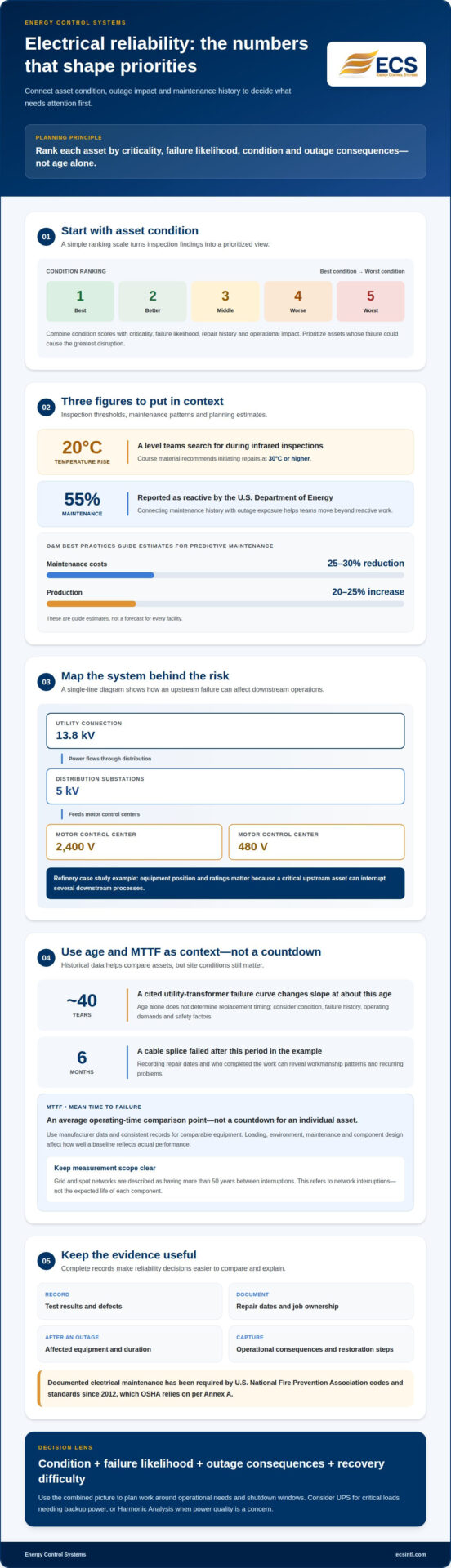
Start with a single-line diagram that maps equipment, voltage levels, and connections. IEEE 3006.2 provides examples for maintenance-focused reliability planning. One refinery case study traced power from a 13.8 kV utility connection through 5 kV distribution substations to motor control centers at 2,400 V and 480 V. This detail shows why equipment ratings and system position matter. A failure affecting a critical upstream asset can interrupt several downstream processes.
To prioritize upgrades, rank each asset by criticality, failure likelihood, condition, and outage consequences. A sample ranking scale runs from 1, best condition, to 5, worst condition. Combine the scores with repair history and operational impact, then direct investment toward assets where failure would cause the greatest disruption. This makes the electrical reliability improvement plan a risk-based sequence, not simply an age-based replacement list.
Assess reliability through inspection findings and maintenance records. Record test results, defects, repair dates, and who completed each job; a cable splice that fails after 6 months illustrates why workmanship history matters. Infrared inspections can flag temperature rises: the course material identifies 20°C as a level teams search for and recommends initiating repairs at 30°C or higher. Increase inspection frequency as equipment approaches acceptable risk thresholds.
In the United States, National Fire Prevention Association codes and standards, which OSHA relies on per Annex A, have required documented electrical maintenance since 2012. For replacement planning, consider condition, failure history, operating demands, and safety factors. A cited utility-transformer failure curve changes slope at about 40 years, but age alone does not determine replacement timing. Higher safety factors can shorten planned replacement timelines.
2. Costs and risks of unplanned outages
An outage’s impact goes beyond repairing failed equipment. Lost production, interrupted processes, restart work, damaged materials, and overtime can compound the disruption. Map the operations that depend on each electrical asset, then estimate how an interruption affects output, recovery, and connected systems. One equipment failure can create several operational costs at once.
Prioritize risks by weighing outage consequences, failure likelihood, and recovery difficulty. A utility interruption affecting a critical process deserves different attention from a brief disturbance affecting nonessential loads. To mitigate major utility disruptions, commercial and industrial facilities often evaluate localized power generation and storage, looking to specialists such as Powerstack Africa Energy Ltd to deploy dedicated solar and battery solutions that maintain operational continuity. After each event, record the affected equipment, duration, operational consequences, and restoration steps. This gives you a stronger basis for investment decisions than repair records alone.
Common planning mistakes include focusing only on repair expenses, treating every load as equally critical, and overlooking dependencies between systems. A plan can also miss recurring problems when maintenance records are incomplete or work orders lack clear failure details. The U.S. Department of Energy reports that 55% of maintenance is reactive, underscoring why teams need to connect maintenance history with outage exposure.
Compare preventive actions against the consequences they address, then sequence work around operational needs and available shutdown windows. The U.S. Department of Energy’s O&M Best Practices Guide estimates that predictive maintenance can reduce maintenance costs by 25-30% and increase production by 20-25%. These are guide estimates, not a forecast for every facility. For another perspective on disruption factors, explore power-quality considerations.
3. Mean Time to Failure (MTTF)
Mean Time to Failure estimates the average operating time before equipment fails. It provides a useful comparison point, not a countdown for an individual asset. Manufacturer data and historical failure records can establish a baseline, especially when equipment operates under similar conditions. Differences in loading, environment, maintenance, and component design affect how closely that baseline reflects actual performance.
Use failure-rate data carefully. The reciprocal of the failure rate gives mean time between failures in years, so a higher failure rate indicates a shorter expected interval. Apply the calculation to comparable equipment and consistent operating records. Mixing asset types or using inconsistent failure definitions can make the result misleading.
Compare the baseline with site history to identify assets that fail sooner than expected. For example, repeated failures within one equipment group may point to operating stress, recurring defects, or maintenance practices that need attention. Check that records define failure consistently, then consider the results alongside asset criticality and outage consequences. MTTF informs priorities, but it shouldn’t determine replacement timing alone.
System-level reliability can differ sharply from individual equipment reliability. Grid and spot networks are described as having more than 50 years between interruptions. That figure describes network interruptions, not the expected life of each component. Keep the measurement’s scope clear when comparing a facility’s equipment with a broader power-distribution system. To connect reliability concerns with practical next steps, discuss your electrical reliability needs.
Energy Control Systems
Energy Control Systems offers options to support specific reliability priorities identified in your assessment. Uninterruptible Power Supplies (UPS) can serve critical loads that need backup power, while Harmonic Analysis can help evaluate power-quality concerns. These offerings address particular needs, not every equipment failure or outage risk.
Use your asset priorities and outage findings to identify where backup power or power-quality analysis could help. If your plan points to either need, Energy Control Systems can help you explore the relevant offering and its role in your electrical system.
Contact Energy Control Systems to discuss your reliability priorities.
Turn reliability priorities into your next step
Next, connect your reliability priorities with the power conditions your facility needs to manage. An electrical reliability improvement plan can guide decisions about where further analysis or equipment options fit, keeping the focus on operational needs rather than assumptions.
For power-quality priorities, Energy Control Systems offers advanced transient voltage surge suppression solutions, including specialized LA Series, RM Series, and ST-PCMF Series devices. The right direction depends on the issues identified in your electrical system and your reliability goals. A clear conversation can help you consider relevant options without losing sight of your plan.
Contact Energy Control Systems to discuss your priorities and explore a practical next step. You can move forward with a clearer basis for electrical reliability decisions.
Frequently Asked Questions
The Cost of an Unplanned Outage?
An unplanned outage can create direct and indirect costs beyond repair work. Estimate lost production, restart labor, disrupted schedules, and materials affected during downtime. For a useful facility-specific estimate, model different outage scenarios and identify which operations stop, which can continue, and what recovery requires. This helps decision-makers compare prevention priorities without relying on generic industry estimates.
What is an electrical reliability improvement plan?
An electrical reliability improvement plan is a working document for deciding how to reduce electrical interruptions and manage equipment failure risk. It connects operational priorities with assigned actions, responsible roles, and review points. For example, a facility can use it to explain why one production area needs an upgrade before another, and how leaders will assess whether the action addressed the original concern.
What steps should an electrical reliability improvement plan include?
Start by stating the operational outcomes the plan should support, such as protecting a critical process or reducing recurring disruptions. Document decisions, responsible roles, the implementation sequence, and how results will be reviewed. Include a process for revising priorities when equipment changes, production needs shift, or new failure information emerges. This keeps the plan useful after its initial approval.
Which electrical reliability metrics and targets should a plan track?
Track interruption frequency and duration, repeat equipment failures, and completion of planned maintenance. Utilities commonly use SAIFI and SAIDI to benchmark distribution reliability. SAIFI measures average customer-interruption frequency during a reporting period. For a facility, establish a baseline from its own records, then set targets around operational needs. Review trends consistently so any apparent improvement reflects sustained performance.
What preventive maintenance improves electrical system reliability?
Preventive maintenance works best as a documented, asset-specific program. Schedule recurring inspections and functional tests for equipment and protective devices, record findings in work orders, and assign follow-up actions for identified defects. Review recurring issues to determine whether maintenance intervals or procedures need adjustment. This helps teams address developing problems during planned work instead of waiting for an operational interruption.

Article by
Jeff Edwards
Founder of ECS International Inc. Edwards travels and speaks extensively in Latin America, Asia and Africa on the subject of power quality; transients and mitigating their impact on profitability. After graduating from Texas Tech University in Lubbock Texas, Edwards spent 9 years in the Telecommunications sector prior to founding Energy Control Systems in 1987 as a Texas based corporation selling surge suppression and UPS systems. The company has evolved into a global power quality products and energy efficiency concern with operations spanning South America, Asia, Europe and Africa.
Disclaimer
Some of the above information may be the opinion of the author.