

What if the VFD isn’t the whole problem? A drive can operate as designed and still contribute to harmonics that interact with other loads. Voltage sags or transients may point to a broader facility issue. That uncertainty makes nuisance trips and unexplained control faults especially frustrating. Understanding the power quality requirements for VFDs starts with the electrical system, not a single filter specification.
This guide explains which power-quality characteristics matter, what to document and measure, and how to interpret results alongside operating conditions and applicable limits. You’ll learn how to distinguish a drive-related concern from a site-wide issue, and when professional Harmonic Analysis can help investigate the findings. The goal is a proportionate next step, not treating every symptom as proof that a VFD needs a filter.
Key Takeaways
- Power quality requirements for VFDs depend on how each drive interacts with the facility’s electrical system and connected equipment.
- Start by documenting symptoms, affected loads, and operating conditions before deciding what to measure.
- Record voltage and current conditions at relevant points, including when symptoms occur, to help interpret disturbances in context.
- Use Harmonic Analysis to investigate measured power-quality conditions, and distinguish harmonic concerns from surges and transients.
How VFDs Affect Power Quality Across the Facility
Power quality describes the electrical supply’s voltage magnitude, frequency, and waveform, and whether those characteristics remain suitable for connected equipment. A variable frequency drive (VFD) controls motor speed by converting incoming power and producing a variable-frequency output. Its input stage can draw current in pulses rather than as a smooth sine wave. This nonlinear behavior may introduce current distortion and harmonics into the facility system. The effect depends on the drive, the electrical system, and other connected loads. For an overview of drive operation, see Variable-frequency drive.
Which power-quality disturbances matter around a VFD?
Harmonics are voltage or current waveform components at frequencies that are integer multiples of the fundamental frequency. They can alter the waveform and interact with equipment elsewhere on the same system. Consider the entire facility when assessing power quality requirements for VFDs, rather than drawing conclusions from the drive alone. Symptoms are clues to investigate, not proof of a VFD-related cause.
- Harmonic distortion: A nonlinear drive input can contribute to distorted current and, depending on system conditions, affect voltage waveform quality.
- Voltage sags or swells: Short-lived drops or rises in voltage can disrupt equipment, but may originate elsewhere in the supply or facility.
- Voltage imbalance: Unequal phase voltages can affect three-phase equipment and warrant investigation beyond the drive.
- Transients: Brief, fast changes in voltage are distinct from sustained harmonic distortion.
- Power factor: This describes how effectively electrical power is used. It is related to, but not interchangeable with, harmonic distortion.
Repeated trips, unusual heating, or erratic behavior from sensitive controls deserve attention, but they don’t identify a root cause on their own. Note which equipment is affected and whether the problem coincides with a change in drive operation. Then distinguish the type of disturbance before choosing a response. This helps avoid treating every power-quality concern as a harmonic problem.
How to Assess VFD Power-Quality Requirements Before Choosing Mitigation
A nuisance trip is a reason to investigate, not a diagnosis. A structured assessment connects reported events to electrical conditions, identifies which loads are affected, and helps you avoid choosing mitigation before defining the problem. For power quality requirements for VFDs, evidence matters more than assumptions.
What should a VFD power-quality assessment examine?
Examine harmonic distortion, voltage conditions, drive and facility load behavior, and the timing of reported symptoms. For each event, record what equipment was running and whether the drive was starting, changing speed, or operating steadily. Compare those notes with voltage and current measurements. Applicable limits depend on the electrical system and relevant standards or utility requirements, so identify the right criteria before judging results against a threshold.
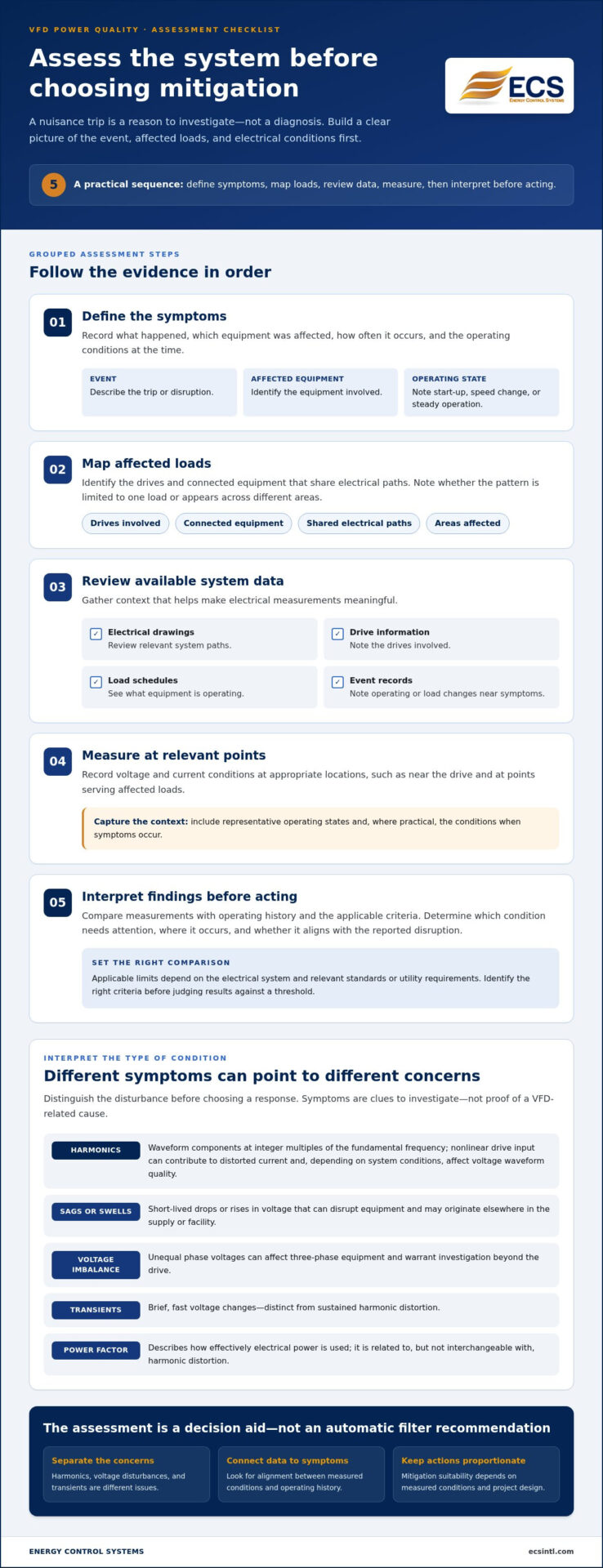
- Define the symptoms. Note the event, affected equipment, frequency of occurrence, and operating conditions. Record whether it happens during a drive start, speed change, or another repeatable state.
- Map affected loads. Identify which drives and connected equipment share electrical paths. If several loads in different areas are affected, note that pattern; it can help distinguish a concern limited to one load from a broader disturbance.
- Review system data. Gather available electrical drawings, drive information, load schedules, and event records. Note changes in equipment operation or load when symptoms occur. This context makes measurements easier to interpret.
- Measure at relevant points. Record voltage and current conditions at appropriate locations, such as near the drive and at points serving affected loads. Capture representative operating states, including the conditions when symptoms occur where practical.
- Interpret before acting. Compare findings with operating history and applicable criteria. Measurements should inform mitigation recommendations by showing which condition needs attention, where it occurs, and whether it aligns with reported disruption.
Mitigation options may address harmonics, voltage disturbances, or other distinct concerns. Their suitability depends on measured conditions and project design, not simply on the presence of a VFD. Energy Control Systems Harmonic Analysis helps investigate measured power-quality conditions and inform a proportionate next step.
Turn VFD Power-Quality Findings into a Practical Action Plan
Measurements are most useful when they lead to a clear priority, not an automatic equipment purchase. Rank findings by the equipment affected, the operational consequences, and how consistently the data supports a link to the reported issue. A disturbance affecting a critical control system may deserve attention before one with little operational impact. Let the evidence guide that decision.
- Address demonstrated risk first. Focus on conditions measured where affected equipment connects, especially when they align with recurring operational symptoms.
- Separate problems by type. Harmonic distortion, voltage variation, and transient events are different concerns and may call for different responses.
- Match the action to the evidence. Consider mitigation when findings indicate a defined issue, and account for the facility and project design.
When is professional harmonic analysis a useful next step?
Professional Harmonic Analysis can help investigate suspected harmonic distortion or broader power-quality concerns when symptoms persist, measurements need interpretation, or the relationship between a drive and affected equipment remains uncertain. It evaluates electrical conditions; it does not by itself guarantee a specific mitigation result, compliance status, or reduction in downtime.
Keep protection functions distinct. Energy Control Systems provides professional Harmonic Analysis to investigate measured power-quality conditions and evaluate specific electrical disturbances.
Energy Control Systems has operated since 1987, and its technicians average 15 years in the Power Quality industry. Energy Control Systems provides professional Harmonic Analysis to help investigate electrical disturbances and inform decisions about next steps. Explore Energy Control Systems power-quality solutions to start investigating your facility’s conditions.
Build a Clearer Path Forward
Make the assessment useful beyond the immediate fault. Keep a record of operating conditions, affected equipment, measurements, and findings. Update it when loads change, new drives are added, or symptoms return. This gives your team a reference for revisiting power quality requirements for VFDs and helps avoid treating each disruption as an isolated mystery.
If measurements raise questions, professional Harmonic Analysis can help investigate the conditions and inform a proportionate next step. ECS International works in more than 40 other countries worldwide. To explore ECS International’s power-quality solutions, visit ECS International power-quality solutions.
Clear evidence puts you in a stronger position to protect operations and make informed decisions. Start with what your facility’s measurements show.
Frequently Asked Questions
Do all VFDs need harmonic mitigation?
No. Whether mitigation is appropriate depends on the drive, the facility’s electrical system, connected equipment, and measured conditions. A drive without related symptoms or concerning measurement results may call for a different response than one associated with recurring equipment disruptions. Assess the power quality requirements for VFDs in the specific installation, then compare options with the identified issue and applicable project or utility requirements.
Can a VFD cause power-quality problems for other equipment?
Yes. A VFD can contribute to electrical disturbances, including harmonic distortion, that may affect other equipment on the system. The effect depends on the installation and operating conditions. If a control fault occurs as a nearby drive changes speed, record the timing and operating state, but don’t treat that connection as proof. Compare the event with system measurements before assigning a cause.
Is harmonic distortion the same as a voltage transient?
No. Harmonic distortion involves waveform components related to the fundamental frequency; a transient is a brief electrical disturbance. They are different conditions, so don’t assume one protective approach addresses both. ECS’s Sinetamer® is an engineered surge and transient protection system for ultrasensitive microprocessor-based devices. Harmonic Analysis, by contrast, is used to investigate power-quality conditions, including suspected harmonic concerns.

Article by
Jeff Edwards
Founder of ECS International Inc. Edwards travels and speaks extensively in Latin America, Asia and Africa on the subject of power quality; transients and mitigating their impact on profitability. After graduating from Texas Tech University in Lubbock Texas, Edwards spent 9 years in the Telecommunications sector prior to founding Energy Control Systems in 1987 as a Texas based corporation selling surge suppression and UPS systems. The company has evolved into a global power quality products and energy efficiency concern with operations spanning South America, Asia, Europe and Africa.
Disclaimer
Some of the above information may be the opinion of the author.