

What if the surge disrupting a PLC never enters through the panel’s main power feed? The control cabinet may have incoming power protection, yet field wiring and communication lines can also expose sensitive I/O circuits to transients. That makes a failed input or erratic signal hard to diagnose: a transient may be involved, but wiring issues, electrical noise, or another fault can produce similar symptoms. Choosing surge protection for PLC input/output cards starts with tracing the signal paths, not just checking the panel.
A practical assessment can help you sort through that uncertainty. This guide explains how to review PLC power, I/O, and communication paths, compare protection approaches, and consider where an engineered solution fits within a broader power-quality plan. The steps help you evaluate exposure without assuming every fault is surge-related or that one panel-level measure protects every circuit.
Key Takeaways
- Learn why surge protection for PLC input/output cards should account for each circuit path, not just incoming panel power.
- Use a practical sequence to document PLC architecture, identify exposed circuits, and assess protection fit.
- Review card documentation, circuit characteristics, wiring routes, and existing protection to build a clearer application picture.
- See how Sinetamer®, engineered for ultrasensitive microprocessor-based devices, fits into a broader PLC protection plan.
Surge Protection for PLC I/O: Identify Circuits at Risk
A transient is a brief electrical disturbance that can affect equipment or signals. It may contribute to a PLC fault, but it isn’t the only possible cause. Loose connections, wiring problems, electrical noise, or a failed component can produce similar symptoms. For a plain-language overview of surge protectors and how they function, see What is a Surge Protector?
PLC I/O cards are modules that receive field signals from sensors and switches, and send control signals to devices such as actuators. Assessing surge protection for PLC input/output cards means looking beyond incoming panel power. Input circuits, output circuits, the PLC power connection, and communication connections each provide a distinct path to consider. A panel-level device may address one part of the system without addressing every path connected to the PLC.
Which PLC connections should an I/O protection review include?
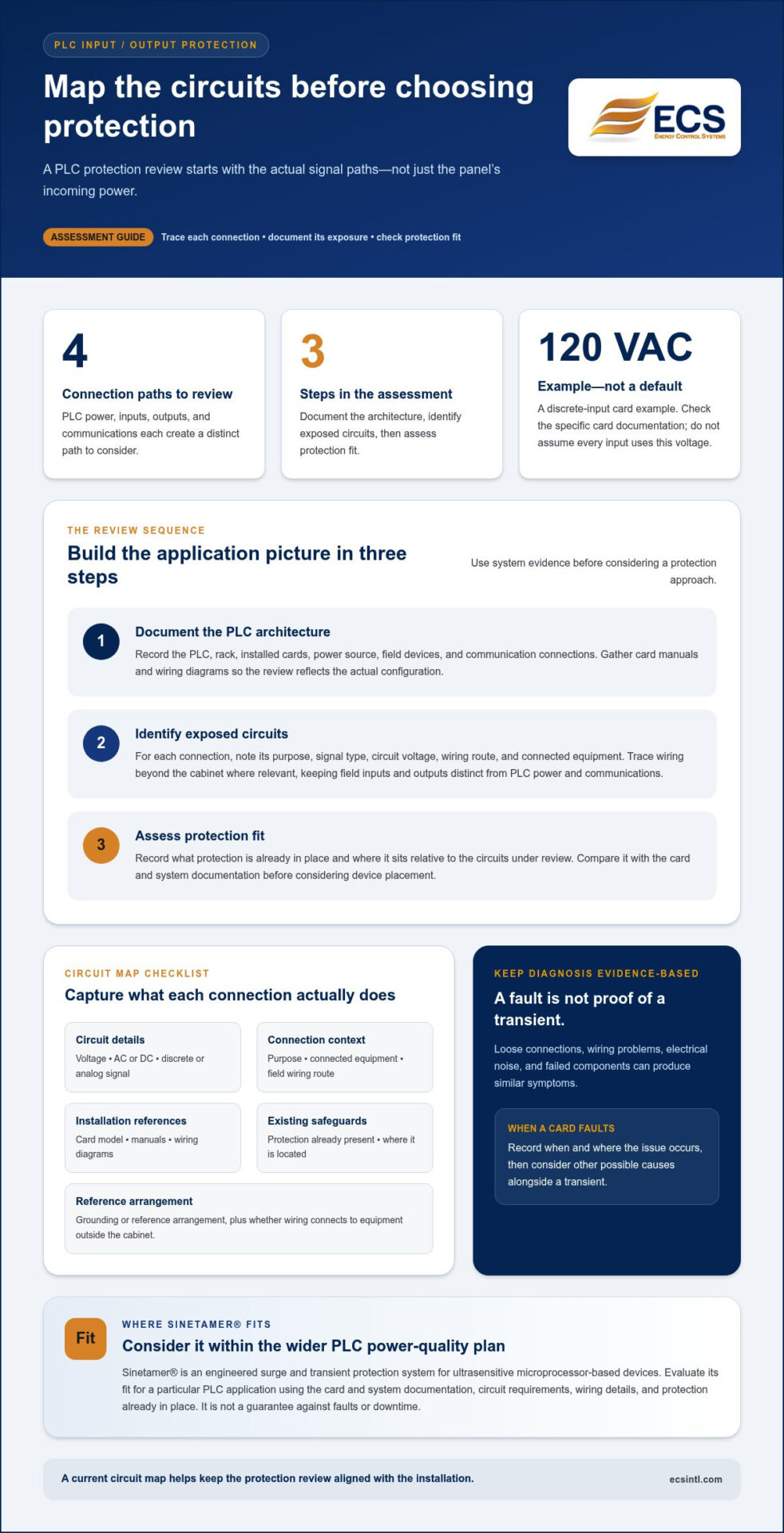
Start by mapping the PLC’s power, input, output, and communication connections. For each one, note what it serves, where its wiring runs, and whether it connects to equipment outside the control cabinet. This circuit map keeps the review focused on the installation’s actual connections instead of assuming every card or system has the same exposure.
A 120 VAC discrete-input card is a useful example, not a universal card specification. Check the card documentation for its input type and circuit details, then trace the connected wiring and note any existing protection. If a card faults, record when and where the issue occurs and consider other possible causes alongside a transient. These steps help identify which circuits warrant closer assessment without jumping to a diagnosis.
How to Evaluate Surge Protection for PLC Input/Output Cards
A useful protection decision begins with evidence, not a product choice. For surge protection for PLC input/output cards, work through the system in sequence: document the PLC architecture, identify exposed circuits, and assess whether a protection approach fits those circuits and the installation.
- Document the architecture. Record the PLC, rack, installed cards, power source, field devices, and communication connections. Gather card manuals and wiring diagrams so the review reflects the actual configuration.
- Identify exposed circuits. For each connection, note its purpose, signal type, circuit voltage, wiring route, and connected equipment. Trace paths beyond the cabinet where relevant, and distinguish field inputs and outputs from PLC power and communications.
- Assess protection fit. Record what protection is already in place and where it sits relative to the circuits under review. Compare that information with the card and system documentation before considering device placement.
What information helps match protection to a PLC I/O application?
Capture the specific card model and its documented circuit characteristics. Don’t assume every input is 120 VAC or every signal uses the same format. Relevant details include circuit voltage, AC or DC supply, discrete or analog signal type, connected equipment, wiring route, grounding or reference arrangement, and existing protection. The industrial surge protective device guide offers broader context for considering SPD approaches within an industrial power-quality plan.
Organizing these details helps focus an application-specific review on the circuits that matter instead of relying on a generic panel assumption. Energy Control Systems also provides professional Harmonic Analysis to identify electrical disturbances and support a broader power-quality assessment. For more background, explore Energy Control Systems’ power-quality resources.
Where Sinetamer® Fits in a PLC I/O Protection Plan
A circuit map gives the protection discussion a practical starting point. Sinetamer® is an engineered surge and transient protection system for ultrasensitive microprocessor-based devices. That makes it relevant to power-quality planning for PLC systems. To evaluate its fit for a particular application, use the card and system documentation to understand the circuit requirements and installation.
Document which PLC power, input, output, and communication connections are involved, what each circuit serves, how it is wired, and what protection is already in place. This keeps the discussion grounded in your system rather than assumptions about typical card voltages or signal types. Consider surge protection as part of a broader power-quality plan, not as a guarantee against faults or downtime.
Turn the circuit assessment into a practical next step
Bring together the PLC and card documentation, circuit characteristics, wiring routes, connected equipment, and existing protection approach. This creates a clear basis for evaluating where a solution fits and which application details need attention. ECS International has operated since 1987, and its technicians have an average of 15 years in the Power Quality industry.
For additional context on the SineTamer LA Series and industrial infrastructure, explore the SineTamer LA Series infrastructure guide. Then explore ECS power-quality solutions to see how Sinetamer® and other power-quality offerings can support a more informed protection plan and greater Peace of Mind.
Keep Your PLC Protection Plan Ready for What Changes
Keep your circuit map as a working reference, not a one-time exercise. When controls are updated, field devices change, or wiring routes are revised, revisit the protection plan so it reflects the installation you operate. A current assessment also gives maintenance and engineering teams a shared reference as systems evolve, helping them make informed decisions instead of reacting under pressure to unexplained card faults.
For surge protection for PLC input/output cards, the next step is an application-focused review grounded in your PLC documentation and circuit details. ECS International operates in more than 40 other countries. Explore ECS power-quality solutions to consider how Sinetamer® fits within your broader plan. Take a confident next step toward greater Peace of Mind.
Frequently Asked Questions
Can surge protection prevent every PLC input/output card failure?
No. Surge protection for PLC input/output cards addresses electrical disturbances within the protection approach’s application, but it can’t guarantee that failures will stop or explain every fault. If a channel drops out, compare its diagnostic status with controller logs and the connected device’s behavior. A damaged card, wiring issue, or another fault may need investigation before you attribute the problem to a transient.
How can I tell whether electrical transients are causing repeated PLC card problems?
Repeated faults alone aren’t proof that transients are responsible. Look for patterns in timestamped controller or process records, such as faults occurring around a documented electrical event. Note whether one channel, several cards, or the whole controller is affected. Compare these observations with circuit conditions and available power-quality records. Use them to guide further assessment, not as a diagnosis or a promise that a protection device will fix the issue.
Does surge protection replace a UPS for PLC equipment?
No. Surge and transient protection and a UPS address different power concerns, so one shouldn’t be treated as a substitute for the other. Assess the PLC’s continuity needs separately from its surge-protection requirements, including what the process needs during a power interruption. ECS’s UPS/Battery Service Department covers single-phase and 3-phase UPS technology.

Article by
Jeff Edwards
Founder of ECS International Inc. Edwards travels and speaks extensively in Latin America, Asia and Africa on the subject of power quality; transients and mitigating their impact on profitability. After graduating from Texas Tech University in Lubbock Texas, Edwards spent 9 years in the Telecommunications sector prior to founding Energy Control Systems in 1987 as a Texas based corporation selling surge suppression and UPS systems. The company has evolved into a global power quality products and energy efficiency concern with operations spanning South America, Asia, Europe and Africa.
Disclaimer
Some of the above information may be the opinion of the author.