

A brief voltage fluctuation or rising harmonic distortion may be worth investigating before it disrupts a shift. Electrical disturbances can be difficult to spot until equipment behaves unpredictably, and reactive repairs can throw planned work into disarray. Proactive power quality management turns observations into deliberate maintenance priorities, giving your team a clearer path from warning sign to response.
This article explains how planned maintenance differs from reactive repair, how to prioritize power-quality findings, and why a prompt response still matters when a fault occurs. It also covers how site surveys, evaluation visits, UPS maintenance, and engineered surge and transient protection can support a considered approach. No single measure can prevent every interruption, but a clear process can help your team make informed decisions.
Key Takeaways
- Proactive power quality management turns recurring observations into planned decisions, while leaving room for reactive repairs when faults occur.
- Use a simple workflow to record symptoms, identify affected equipment, review available power-quality information, prioritize follow-up, and document the action.
- Treat symptoms as prompts for investigation, not proof of a specific disturbance. Site evidence helps guide maintenance priorities.
- Understand how site surveys, evaluation visits, UPS/Battery Service Department maintenance, and Sinetamer® engineered surge and transient protection each fit into a broader plan.
What Proactive Power Quality Management Changes Before a Failure
A machine fault can seem sudden even when small warning signs appeared beforehand. A control reset, unexplained equipment behavior, or recurring process interruption may be worth recording and investigating. Proactive power quality management uses observations and available power-quality information to guide planned decisions before a disruption forces the issue. It doesn’t eliminate failures. It gives the maintenance team an opportunity to assess concerns and decide what deserves attention.
Power quality covers characteristics of electrical power that affect how equipment operates. The Electric Power Quality overview describes common issues such as voltage disturbances and harmonics. Recognizing a symptom is a starting point, not a diagnosis. The same equipment behavior can have different causes, so site evidence matters.
How planned maintenance differs from reactive repair
Monitoring gathers information; management interprets it and chooses a response; planned maintenance schedules that response before an urgent failure requires repair. Monitoring alone doesn’t set priorities. The team still needs to review observations, consider operational impact, and determine whether to investigate, maintain, or take another action.
| Planned maintenance | Reactive repair |
|---|---|
| Trigger: A trend, observation, or scheduled review prompts investigation. | Trigger: A detected fault or reported equipment problem demands attention. |
| Timing: The team assesses and schedules work around operational needs where possible. | Timing: Work begins in response to the problem, often with less control over timing. |
| Disruption: Planning can help teams prepare for the work and coordinate its impact. | Disruption: Unplanned troubleshooting or repair can interrupt established work. |
Reactive repair still has a role. Some faults need prompt attention, and a plan can’t anticipate every event. The practical difference is having a process to learn from observations instead of waiting for every concern to become an equipment problem. This helps teams set clearer priorities without treating monitoring data as an automatic instruction.
How to Turn Power Quality Signals into a Maintenance Plan
A useful maintenance plan starts with a clear record, not a quick guess. A control reset, for example, is an observed symptom. It doesn’t identify the electrical cause on its own. Context matters: equipment behavior, operating conditions, and timing help teams decide which signals merit investigation.
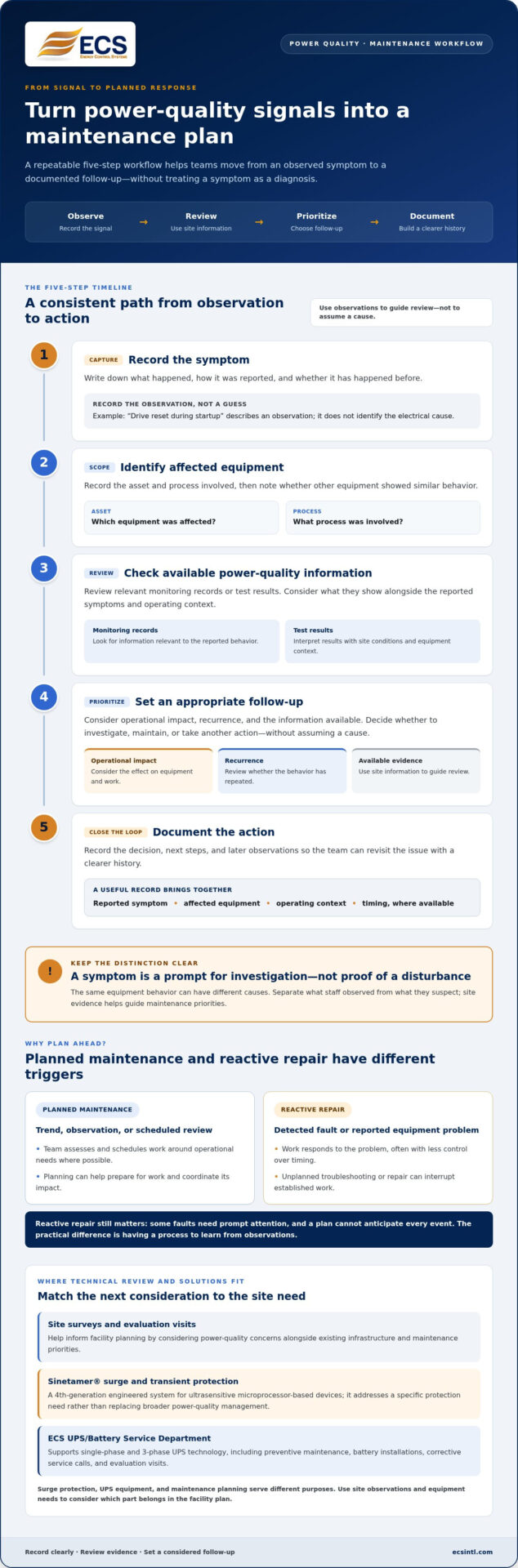
Use this repeatable workflow to turn observations into next steps:
- Record the symptom. Note what happened, how it was reported, and whether it has occurred before.
- Identify affected equipment. Record the asset and process involved, and whether other equipment showed similar behavior.
- Review available power-quality information. Look at relevant monitoring records or test results. Consider what the information shows alongside the reported symptoms and operating context.
- Prioritize review. Consider operational impact, recurrence, and the information available. Set an appropriate follow-up rather than assuming a cause.
- Document the action. Record the decision, next steps, and later observations so the team can revisit the issue with a clearer history.
What to record before prioritizing a power-quality issue
Capture the reported symptom, affected equipment, operating context, and timing where available. Separate what staff observed from what they suspect: “drive reset during startup” is an observation, while a specific electrical disturbance remains a hypothesis until supported by site evidence. For background on harmonic concerns, the guide Harmonic Analysis: The Key to Power Stability offers related context.
A disciplined record gives maintenance teams a stronger basis for deciding what to investigate and when. For facility planning informed by ECS power-quality solutions, connect documented observations with a technical review that considers site conditions and equipment needs.
Where ECS Solutions Fit in a Proactive Power Quality Plan
A maintenance plan becomes more useful when facility observations lead to the right kind of review or equipment consideration. ECS provides site surveys and evaluation visits to inform facility planning, helping teams consider power-quality concerns alongside existing infrastructure and maintenance priorities. These visits add context for planning and support informed decisions about next steps.
Match the response to the infrastructure need
Different needs call for different solutions. Sinetamer® is a 4th-generation engineered surge and transient protection system for ultrasensitive microprocessor-based devices. It addresses a specific protection need, rather than replacing a broader power-quality management program. The ECS UPS/Battery Service Department supports single-phase and 3-phase UPS technology, including preventive maintenance, battery installations, corrective service calls, and evaluation visits. Keeping these roles distinct helps teams align a concern with the relevant part of their plan.
For category background, the guides What is a Surge Protective Device? and Uninterruptible Power Supply can help clarify the different purposes of surge protection and UPS equipment. Use that context alongside site observations and equipment needs, rather than treating one solution as a substitute for all maintenance planning.
- For surge and transient protection: Consider whether engineered protection for sensitive microprocessor-based devices belongs in the facility plan.
- For UPS maintenance: Include the relevant single-phase or 3-phase UPS technology in maintenance discussions. ECS’s UPS/Battery Service Department provides maintenance and battery services for these systems.
Proactive power quality management is a process of observation, informed review, and planned action. ECS has worked in power quality since 1987, bringing experience to planning conversations without promising uninterrupted operation or avoided losses. Explore ECS power-quality solutions to consider how site evaluation, protection, and UPS maintenance may fit your facility’s priorities.
Give Your Maintenance Plan a Clear Next Step
Make the next step practical: choose one unresolved power-quality concern, assign someone to review it, and agree when the team will revisit the finding. That structure can turn scattered observations into a maintenance conversation your operations and facilities teams can act on. Proactive power quality management isn’t about predicting every fault or removing uncertainty. It’s about building a steadier basis for decisions, so urgent repairs aren’t the only way issues receive attention. Reactive repair will still have a role when problems arise.
ECS technicians average 15 years in the Power Quality industry and can help you explore solutions that fit your facility’s priorities. Take a considered next step toward greater peace of mind: explore ECS power-quality solutions. Clear, informed maintenance decisions help your team move forward with more confidence.
Frequently Asked Questions
Is proactive power quality management only useful after repeated equipment problems?
No. Proactive power quality management can help teams consider potential concerns before a pattern of failures emerges. After adding equipment or changing a process, for example, review whether existing observations and power-quality information still reflect how the facility operates. This creates an opportunity to notice and investigate changes rather than waiting for repeated faults to make the issue impossible to ignore.
Can power quality monitoring replace a maintenance plan?
No. Monitoring can provide records or measurements, but it doesn’t decide what matters to operations or assign follow-up work. A maintenance plan can establish who reviews information, how findings are recorded, and when decisions are revisited. For instance, a team might schedule a review after a new equipment installation, then document whether follow-up is needed. The data supports the plan; it can’t replace it.
What is the difference between surge protection and proactive power quality management?
Surge protection addresses a specific protection need, while proactive power quality management is the broader process of reviewing facility information and planning responses. A surge protective device may be one consideration in that plan, but it doesn’t replace equipment maintenance, review of other power-quality concerns, or decisions based on site conditions. The right approach depends on the issue being addressed and the evidence available.
Does a proactive maintenance approach guarantee less downtime?
No. Planning can’t prevent every electrical disturbance, equipment fault, or interruption, so it shouldn’t be treated as a guarantee of reduced downtime. Its value is in helping teams prepare, make considered maintenance decisions, and learn from operational observations. Keep a reactive response in the plan, too: if equipment reports a fault, address the immediate issue while preserving information that may help guide future reviews.

Article by
Jeff Edwards
Founder of ECS International Inc. Edwards travels and speaks extensively in Latin America, Asia and Africa on the subject of power quality; transients and mitigating their impact on profitability. After graduating from Texas Tech University in Lubbock Texas, Edwards spent 9 years in the Telecommunications sector prior to founding Energy Control Systems in 1987 as a Texas based corporation selling surge suppression and UPS systems. The company has evolved into a global power quality products and energy efficiency concern with operations spanning South America, Asia, Europe and Africa.
Disclaimer
Some of the above information may be the opinion of the author.