

What if the SPD with the higher In rating isn’t automatically the better fit for your facility?
If you’re looking for nominal discharge current (In) explained without the datasheet fog, start here: In is a standardized test rating, not a measure of everyday current or a guarantee of field protection. In IEC terminology, it describes a Type 2 SPD’s performance against an 8/20 μs current waveform. That context matters when you compare devices and plan protection against disruptive transients.
This article explains what In tells you, how the test waveform fits into the picture, and what the rating leaves out. You’ll also learn how to compare other specifications and consider surge exposure, installation location, and coordination across your facility. One number can inform your decision, but it shouldn’t make it for you.
Key Takeaways
- Nominal discharge current (In) is a standardized Type 2 SPD test rating, not a promise about every surge the device may encounter.
- The 8/20 μs waveform describes the test current and helps put an In value in context.
- Compare In with ratings such as Imax, Uc, and Up to understand more of an SPD’s characteristics.
- Consider the electrical system, installation location, surge exposure, and coordination needs when assessing whether an SPD suits your facility.
What Does Nominal Discharge Current (In) Mean on an SPD?
Nominal discharge current, written as In, is a standardized test rating used for Type 2 surge protective devices (SPDs) under IEC terminology. It indicates the peak current used in a defined test sequence, not the current an SPD encounters during ordinary operation or a guarantee of how it will handle every real-world surge. Here, “nominal” means designated for the test, not normal.
For example, a Type 2 SPD rated at 10 kA In is assessed using a 10 kA test impulse under the applicable procedure. IEC testing applies a defined sequence of impulses, with requirements depending on the standard edition and test classification. The rating describes performance in that test, not unlimited field capability. In is a rated test current, not an unrestricted maximum discharge current the SPD can safely conduct in any installation or surge event.
A Surge Protector is designed to limit transient overvoltage, but its In value alone doesn’t describe every aspect of its protection.
What does the 8/20 μs waveform represent?
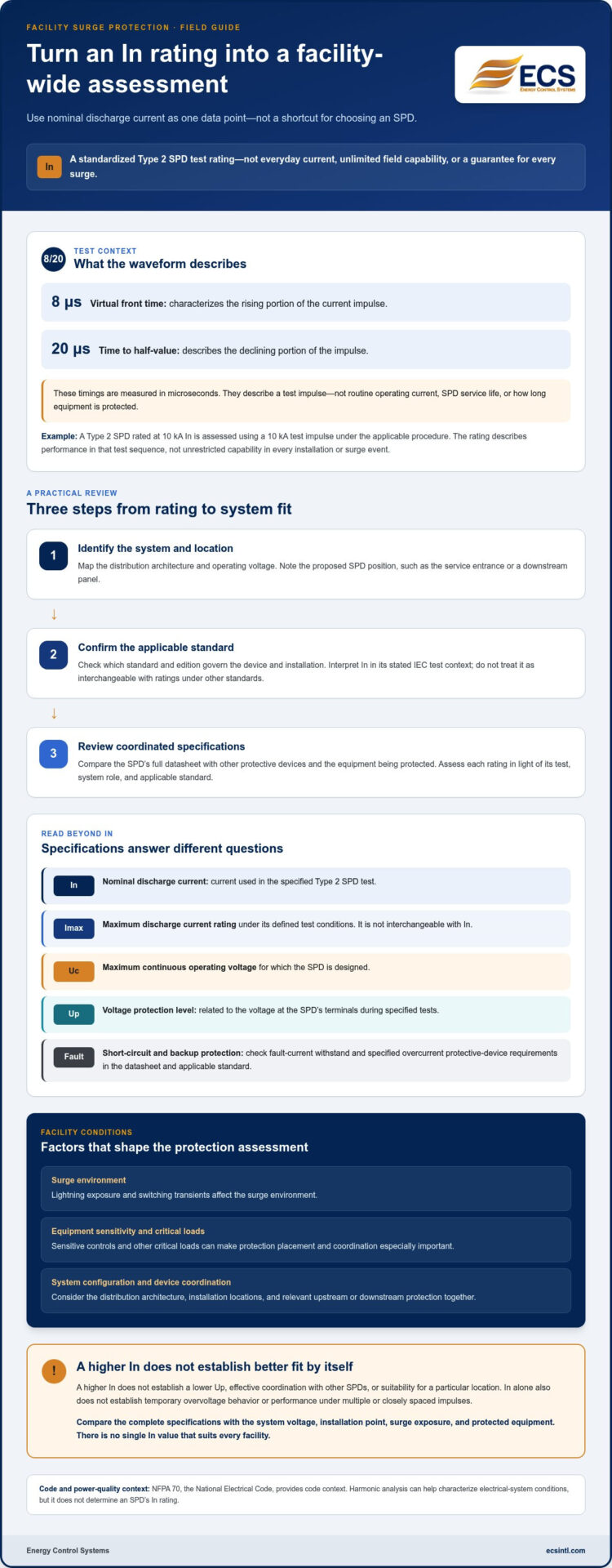
The 8/20 μs notation describes the shape and timing of a standardized current impulse. The 8 μs figure is the virtual front time, which characterizes the rising portion of the waveform. The 20 μs figure is the time to half-value on its declining portion. These timings are measured in microseconds. They don’t describe the SPD’s service life or how long it will protect equipment.
The impulse is a test condition, not routine operating current. Because the exact test sequence and terminology depend on the applicable standard and edition, interpret In within the stated IEC test context. Don’t treat it as interchangeable with ratings used under other standards. This gives you a clearer starting point for reading a datasheet.
How Should You Interpret In Alongside Other SPD Ratings?
Read In alongside the specifications that describe voltage limits, surge performance, and installation conditions. Under IEC terminology, these ratings answer different questions. A high value in one column can’t substitute for information in another.
| Rating or data | What it indicates |
|---|---|
| In | Nominal discharge current used in the specified Type 2 SPD test. |
| Imax | Maximum discharge current rating under its defined test conditions. Don’t assume it is interchangeable with In. |
| Uc | Maximum continuous operating voltage for which the SPD is designed. |
| Up | Voltage protection level, a measure related to the voltage at the SPD’s terminals during its specified tests. |
| Short-circuit and backup protection | Fault-current withstand and any specified overcurrent protective-device requirements. Follow the applicable datasheet and standard. |
Interpret each SPD rating in light of its defined test, system role, and applicable standard. The NFPA 70 National Electrical Code provides code context. Read device ratings and protection requirements in the relevant standard and product documentation.
Does a higher nominal discharge current mean better protection?
Not by itself. A higher In doesn’t establish a lower Up, effective coordination with other SPDs, or suitability for a particular location. Compare the complete specifications with the system voltage, installation point, and protected equipment. That’s the practical takeaway of nominal discharge current (In) explained: one test rating cannot replace a complete protection assessment.
Temporary overvoltage (TOV) behavior and performance under multiple or closely spaced impulses are separate considerations. In alone doesn’t establish them, so don’t infer them from its value. For broader context on how surge protection fits into facility power quality, What is a Surge Protective Device? The Industrial Leader’s Guide to Total Power Quality explores the device’s role. You can also review industrial surge protection solutions as part of a wider protection plan.
How Does In Fit Into a Facility’s Surge Protection Plan?
Use In as one data point in a facility-wide assessment, not as a shortcut to choosing an SPD. A practical review follows three steps:
- Identify the system and location. Map the distribution architecture, operating voltage, and proposed SPD position, such as the service entrance or a downstream panel.
- Confirm the applicable standard. Check which standard and edition govern the device and installation so you interpret its ratings in the right testing context.
- Review coordinated specifications. Compare the SPD’s full datasheet with other protective devices and the equipment being protected.
Next, account for facility conditions. Lightning exposure and switching transients affect the surge environment. Sensitive controls and other critical loads may make the placement of protection and coordination between devices especially important. System configuration matters too. There’s no single In value that suits every facility.
What information belongs in a coordinated SPD assessment?
Review the distribution architecture, each device’s installation location, equipment sensitivity, and relevant upstream or downstream protection together. This helps you assess whether a rating fits the device’s role instead of relying on an isolated comparison. That’s the practical value of nominal discharge current (In) explained: it gives you a test rating to interpret within the system, not a universal selection rule.
Harmonic analysis can add power-quality context by helping characterize conditions on the electrical system. It doesn’t determine an SPD’s In rating, but it can support a broader, evidence-led understanding of facility power quality.
For a closer look at one surge-protection product family, explore The Ultimate Guide to SineTamer LA Series. Energy Control Systems provides SineTamer surge protection and professional harmonic analysis to help facilities assess protection and power quality together.
Turn the Rating Into a Clearer Protection Plan
Make your next step practical: bring SPD datasheets, facility distribution information, and critical-load priorities into one review. This gives your team a shared basis for discussing protection choices and identifying where more power-quality insight may help. The goal isn’t to chase the largest number. It’s to make decisions that fit the system and support dependable operations.
To move from nominal discharge current (In) explained to a broader protection perspective, consider how surge protection and power-quality analysis fit into your facility’s needs. Energy Control Systems provides SineTamer surge protection devices and professional harmonic analysis.
Explore Energy Control Systems’ surge protection and power-quality solutions to plan your next steps with the right context.
Frequently Asked Questions
What is nominal discharge current (In) in surge protection?
Nominal discharge current is a standardized test rating for a Type 2 SPD under IEC terminology. It identifies the peak current used in a defined test, not a universal measure of how much surge current the device can handle in every installation. When reviewing a datasheet, read In alongside the named standard and the device’s other ratings.
What does an 8/20 μs current waveform mean?
An 8/20 μs waveform is a test impulse whose current rises and falls over microsecond timescales. The 8 μs value describes its virtual front time; 20 μs marks the time to half-value on the descending part. This notation distinguishes a brief test impulse from a sustained current. It doesn’t describe how long an SPD remains in service.
Does a higher In rating mean an SPD provides better protection?
No. A higher In value alone doesn’t establish that an SPD will better protect a specific load. For example, a device may have a higher In yet still need to be assessed against the system voltage, its protection level, and its position relative to sensitive equipment. Consider the ratings together to determine whether the device suits its intended role, rather than ranking SPDs by In alone.
Is nominal discharge current the same as maximum discharge current?
No. Under IEC terminology, In and Imax are distinct Type 2 SPD ratings associated with different specified test conditions. Imax indicates a maximum discharge-current rating under its defined test. It isn’t another name for In or an unrestricted measure of field capability. Compare the values only within the relevant standard and datasheet, since test requirements can differ by standard and edition.

Article by
Jeff Edwards
Founder of ECS International Inc. Edwards travels and speaks extensively in Latin America, Asia and Africa on the subject of power quality; transients and mitigating their impact on profitability. After graduating from Texas Tech University in Lubbock Texas, Edwards spent 9 years in the Telecommunications sector prior to founding Energy Control Systems in 1987 as a Texas based corporation selling surge suppression and UPS systems. The company has evolved into a global power quality products and energy efficiency concern with operations spanning South America, Asia, Europe and Africa.
Disclaimer
Some of the above information may be the opinion of the author.