

A lower SPD rating may look like a straightforward promise of safer equipment, but it’s only part of the picture. If you’re asking “what is let-through voltage in a spd,” the plain-language answer is the transient voltage that can remain on the protected circuit while the device limits a surge. It isn’t the same as the SPD’s nominal system voltage, and it doesn’t guarantee the exact voltage every connected component will experience.
It’s reasonable to want one number that tells you whether sensitive controls or other industrial equipment are protected. This guide explains how to read the UL 1449 Voltage Protection Rating (VPR), how it differs from related ratings, and why a lower value alone doesn’t settle the question. You’ll also see how equipment withstand capability, system conditions, and installation details affect protection, so you can interpret an SPD rating with greater confidence.
Key Takeaways
- Understand what is let-through voltage in a spd and why it describes surge-limiting behavior, not a promise of zero voltage at the load.
- Recognize that UL 1449 VPR and IEC 61643 Up use different standards, so their values shouldn’t be treated as directly equivalent.
- Compare the SPD’s relevant protection rating with the equipment’s impulse withstand capability, rather than relying on either figure alone.
- Account for lead length, placement, grounding and bonding, and surge exposure when assessing protection at equipment terminals.
What Is Let-Through Voltage in an SPD?
Let-through voltage is the transient voltage that remains on an SPD-protected circuit while the device limits a surge. If you’re asking what is let-through voltage in a spd, think of it as the surge-related voltage that connected equipment may still be exposed to, not a promise that voltage drops to zero. “Clamping voltage” is sometimes used informally for a related concept; the Surge protector overview explains this term.
This differs from an SPD’s nominal system voltage, which describes the electrical system it’s designed to connect to, and from normal operating voltage, the everyday supply under ordinary conditions. Let-through voltage concerns a brief transient, such as a surge. These figures answer different questions, so don’t compare them as if they were interchangeable.
What happens electrically when an SPD limits a surge?
An SPD responds when a transient raises voltage above the device’s operating threshold. Depending on its design, it provides a path that diverts surge current away from protected equipment or otherwise limits voltage across the circuit. The transient is reduced, not erased. The voltage remaining on the protected circuit depends on the surge’s characteristics, the SPD’s electrical behavior, and the installation.
An SPD limits a transient overvoltage by diverting surge current or restricting voltage; it does not eliminate the transient or guarantee zero voltage at the load. That distinction matters in industrial settings, where a control system may be sensitive to voltage stress even after a surge has been substantially limited. Let-through voltage is a useful protection indicator, but the number alone can’t describe every surge or installation.
How to Read an SPD’s Let-Through Voltage Rating
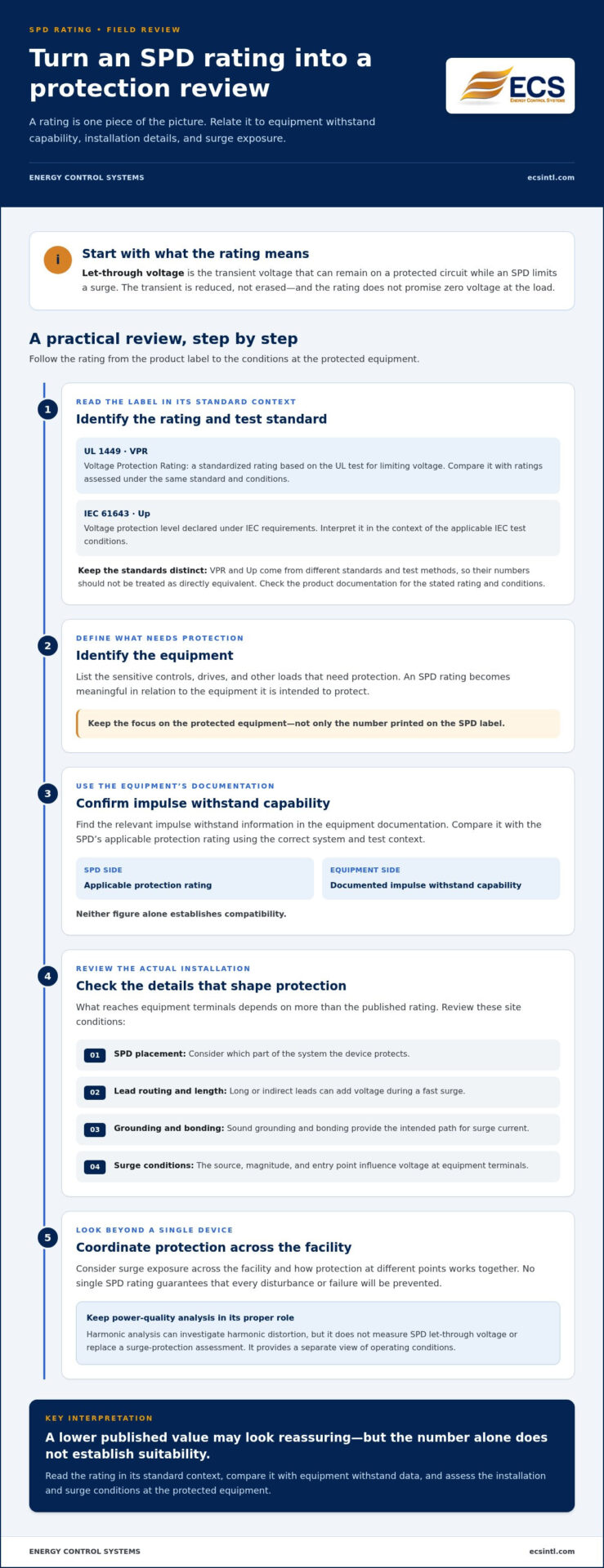
“Let-through voltage” is a useful plain-language description, but a product label may use a standard-specific term. In North America, UL 1449 uses the Voltage Protection Rating (VPR). IEC 61643 uses voltage protection level (Up). Both describe aspects of an SPD’s voltage-limiting performance, but they’re established under different standards and test methods.
| Label term | What it represents | How to interpret it |
|---|---|---|
| UL 1449 VPR | A standardized rating based on the UL test for limiting voltage. | Compare with ratings assessed under the same standard and conditions. |
| IEC 61643 Up | The declared voltage protection level under IEC requirements. | Read in the context of the applicable IEC test conditions. |
| Let-through or clamping voltage | Common language for voltage that remains during surge limitation. | Check which test standard and rating the specification refers to. |
Is let-through voltage the same as VPR or voltage protection level?
Not exactly. These terms are related, but they aren’t interchangeable labels for one universal measurement. A VPR and an Up value come from different standards, so comparing the numbers directly can give a misleading impression of which SPD limits voltage better. Check the standard, test conditions, and rating stated in the product documentation. The broader surge protective device guide explains how SPDs fit into power-quality protection.
A lower published value may look reassuring, but it doesn’t establish suitability by itself. The test conditions, system characteristics, and installation details all affect what protection means at the equipment. So, what is let-through voltage in a spd rating telling you? It’s one piece of evidence, not a complete protection assessment. ECS provides professional harmonic analysis and technical site analysis to help assess power-quality conditions alongside SPD ratings. Learn more about coordinated power-quality analysis.
What Let-Through Voltage Means for the Equipment You Need to Protect
An SPD rating becomes meaningful in relation to the equipment it’s meant to protect. Compare the applicable protection rating with the equipment’s documented impulse withstand capability, using the correct system and test context. A single number can’t establish compatibility: actual exposure also depends on how the SPD is installed and how a surge reaches the load.
Connection details matter. Long or indirect leads between an SPD and the electrical system can add voltage during a fast surge. Placement affects which part of the system the device protects, while sound grounding and bonding provide the intended path for surge current. The surge source, magnitude, and entry point also influence voltage at equipment terminals. The practical question isn’t only “what is let-through voltage in a spd?” It’s how the SPD rating relates to conditions at the protected equipment.
How should engineers apply the rating to a real installation?
Use a short, site-specific review:
- Identify the equipment: List the sensitive controls, drives, and other loads that need protection.
- Confirm withstand data: Find the relevant impulse withstand information in the equipment documentation.
- Assess installation: Review SPD location, lead routing and length, grounding, and bonding.
- Coordinate protection: Consider surge exposure across the facility and how protection at different points works together.
Industrial systems can face several power-quality issues. Harmonic analysis can help investigate harmonic distortion, but it doesn’t measure SPD let-through voltage or replace a surge-protection assessment. It provides a separate view of operating conditions, useful when one rating can’t explain the whole site. For context on how surge protection fits industrial infrastructure, explore the SineTamer LA Series infrastructure guide. No single SPD rating guarantees that every disturbance or failure will be prevented.
Turn the Rating Into a Protection Plan
Make your next step a site-specific review, not a search for the lowest number on a label. Start with the equipment most critical to safe, reliable operation. Then consider its withstand data alongside the SPD’s rating, placement, and connection details. This gives your team a clearer basis for evaluating protection across the facility.
If you’re still asking “what is let-through voltage in a spd,” remember that understanding the term is the start of better power-quality decisions, not a guarantee against every disruption. Energy Control Systems specializes in power-quality management, with SineTamer surge protection devices and professional harmonic analysis among its solutions. Explore ECS power-quality solutions to take the next step toward a more informed protection strategy.
Frequently Asked Questions
What is let-through voltage in a surge protective device?
It’s the residual transient voltage on the protected circuit during a surge. Put simply, what is let-through voltage in a spd? It describes the voltage stress that connected equipment may still need to withstand. For example, a control panel’s power supply may tolerate brief transients differently from a sensor or communication interface, so consider the vulnerable components, not just the equipment’s main input rating.
Is a lower let-through voltage always better?
No. A lower figure isn’t automatically the right choice if the rating comes from different test conditions or the SPD isn’t suitable for the system. Check that the device’s continuous operating voltage and configuration suit the electrical supply, then interpret its protection rating under the stated standard. A rating comparison is meaningful only when the devices and test bases are comparable.
What is the difference between VPR and voltage protection level Up?
VPR is the Voltage Protection Rating used under UL 1449, while Up is the voltage protection level used under IEC 61643. Each belongs to its own standard and testing framework. If a facility’s specifications use one system and a product document uses the other, don’t compare the printed values as if they were measured under identical conditions; review the supporting documentation.
Can an SPD’s let-through voltage damage sensitive equipment?
It can contribute to damage if the voltage stress at a device’s terminals exceeds what that device can withstand. Risk also depends on the surge’s characteristics, the equipment’s input design, and the condition of the protection system. For instance, a sensitive communications port may need attention even if a machine’s main power input is protected. Consider protection for connected signal and control circuits as well as power feeds.

Article by
Jeff Edwards
Founder of ECS International Inc. Edwards travels and speaks extensively in Latin America, Asia and Africa on the subject of power quality; transients and mitigating their impact on profitability. After graduating from Texas Tech University in Lubbock Texas, Edwards spent 9 years in the Telecommunications sector prior to founding Energy Control Systems in 1987 as a Texas based corporation selling surge suppression and UPS systems. The company has evolved into a global power quality products and energy efficiency concern with operations spanning South America, Asia, Europe and Africa.
Disclaimer
Some of the above information may be the opinion of the author.