

Every second your industrial facility sits idle, you are losing approximately $280. That is more than just a financial metric; it is the heavy weight of missed deadlines and the frustration of explaining avoidable equipment failure to your team. You have invested in elite protection, yet the anxiety of a potential wiring mistake keeps you on edge. We understand that burden. This SineTamer LA Series installation guide is built to replace that technical confusion with absolute certainty. You deserve a power grid that remains stable, protecting your reputation and your equipment simultaneously.
Precision in installation is the only way to transform a piece of hardware into a permanent guardian for your facility. We promise that by following these steps, you’ll master the specific parameters required to eliminate downtime and meet the updated 2026 NEC surge protection standards. We will detail the critical “law of lead length” to explain why keeping your wires between 6 and 8 inches is vital for performance. You will also learn the exact grounding and bonding requirements needed to create a “set and forget” system. It is time to restore your personal agency and bring lasting tranquility to your electrical infrastructure.
Key Takeaways
- Ensure your facility meets the latest 2026 NEC standards by mastering the critical grounding and bonding requirements that prevent mysterious system errors.
- Learn why the “Law of Lead Length” is non-negotiable, requiring precise 6-8 inch connections to ensure your surge protection performs when it matters most.
- This SineTamer LA Series installation guide empowers you to move beyond reactive repairs and establish a proactive shield for your most sensitive industrial assets.
- Discover how to verify a successful installation instantly using the unit’s LED indicators, giving you immediate peace of mind and operational clarity.
- Transform technical maintenance into a strategic victory by documenting your installation to validate your commitment to world-class power quality and facility stability.
Pre-Installation: Assessing Site Readiness and Grounding
You cannot build a fortress on sand. A successful installation begins long before you mount the hardware. It starts with a rigorous audit of your facility’s electrical foundation. We’ve seen many professionals rush this stage, only to face “ghost” errors or equipment failure later. This SineTamer LA Series installation guide is designed to prevent those frustrations by ensuring your site is truly ready for protection. We want you to feel confident that your infrastructure is prepared to handle the high stakes of industrial power management.
Start with safety. De-energize the panel completely. Use a multimeter to verify zero voltage before touching anything. This isn’t just about following code; it’s about creating a stress-free work environment for yourself and your team. Ensure your neutral and ground wires meet the latest 2026 NEC standards. If your bonding is weak, even the best technology cannot drain transients effectively. A solid connection is the only way to guarantee the relief you’re looking for.
Auditing Your Panel’s Foundation
Check every connection point. Loose buss bars create resistance that undermines your Surge Protective Device (SPD). You need a clear, low-impedance path to the grounding electrode system to provide a reliable exit for transients. If your facility uses a generator, verify the feed wires are stable. Unstable feeds often trigger false alarms that disrupt your operations and your focus. Grab the supplied plastic conduit and fittings from your kit now. Having these ready as part of your SineTamer LA Series installation guide workflow ensures a clean, professional path for your wiring.
Selecting the Optimal Mounting Location
Position is everything. To maintain the 6-8 inch lead length requirement, mount the unit as close as possible to the breaker or buss bar. A straight path is a fast path for surge energy. You should also consider the human element of maintenance. Install the unit where your staff can easily monitor the LED status lights during routine walk-throughs. Placing your surge protective device in a visible spot turns it into a proactive shield, giving you instant validation that your grid is stable and your assets are safe.
Step-by-Step Installation: The Law of Lead Length
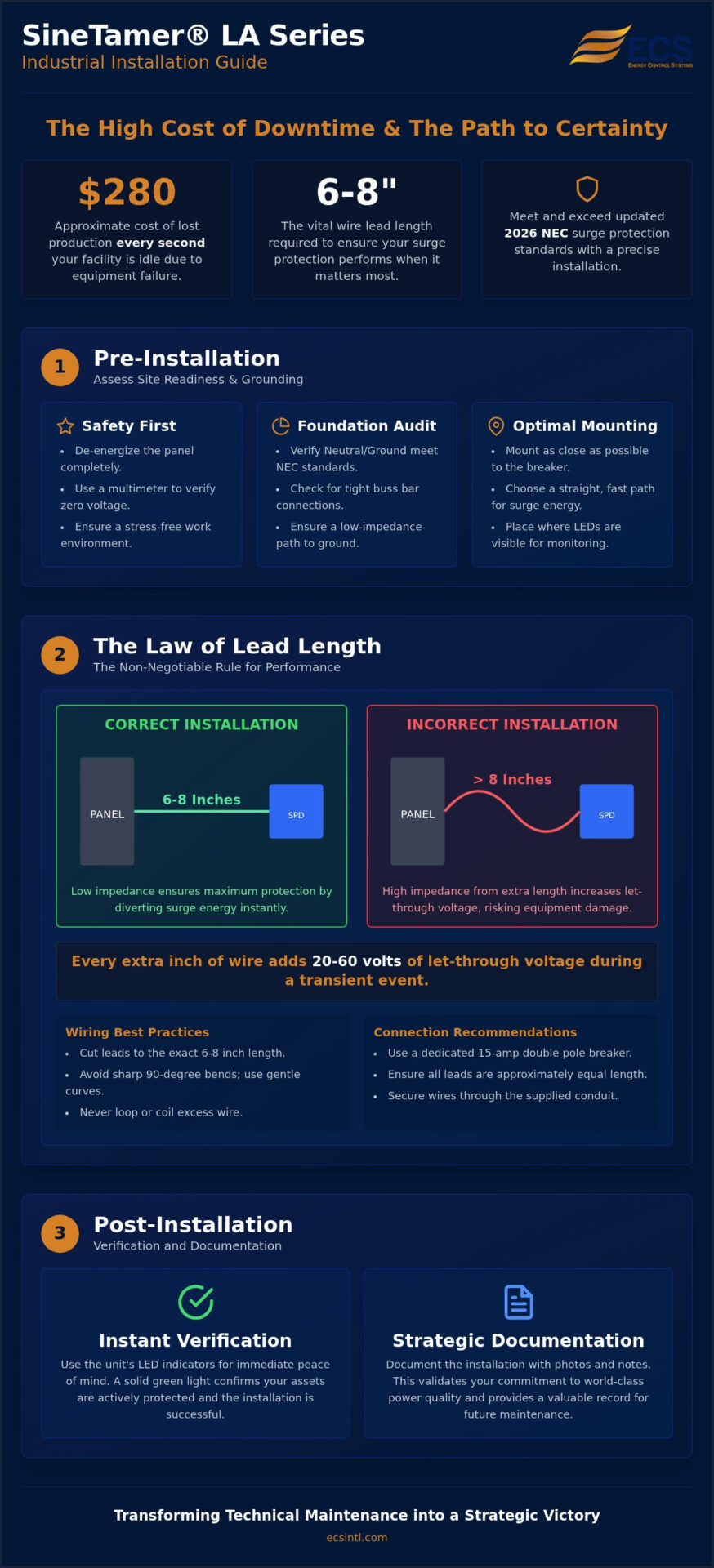
The physical installation is where your strategy meets reality. If the leads are too long, the protection vanishes. This SineTamer LA Series installation guide emphasizes one rule above all else: keep it short. You must mount the unit as close to the connection point as possible. Aim for a lead length of 6 to 8 inches. This isn’t just a suggestion. It is the boundary between a protected facility and a vulnerable one. When you minimize this distance, you’re ensuring that surge energy finds the suppressor before it finds your equipment.
Precision matters during this phase. Cut your leads to the exact length required for a tight, professional fit. Never loop excess wire or allow it to sag in the cabinet. You should also avoid severe 90-degree bends, as these create impedance that slows down the response time of the unit. While the SineTamer LA Series features internal thermal fusing for direct buss bar connection, we recommend using a 15-amp double pole breaker. This makes future maintenance easier and provides a clear point of isolation for your staff.
Why the 6-8 Inch Rule is Non-Negotiable
Physics does not negotiate with your panel layout. Every extra inch of wire adds significant impedance, which forces let-through voltage higher during a transient event. Specifically, 20 to 60 volts of let-through can be added for every inch of lead length beyond the recommended 8 inches. That extra voltage is exactly what damages sensitive microprocessors and causes the downtime you’re working so hard to avoid. By keeping leads short, you ensure the Frequency Protection Circuitry can react instantly to the smallest power fluctuations.
Wiring for Maximum Stability
Ensure all leads are approximately the same length to balance the protection across all modes. This symmetry is vital for long-term stability. You should also avoid “daisy-chaining” or sharing breakers with other high-draw equipment. A dedicated path is essential for this SineTamer LA Series installation guide to be effective. Secure all leads through the supplied conduit to protect the wires and maintain a clean cabinet. Double-check that you’ve met proper grounding requirements to provide the surge energy a clear exit. When the wiring is balanced and the path is straight, you’ve restored stability to your grid. If you need assistance with complex panel layouts, the experts at ECS can provide the technical clarity you need.
Post-Installation: Verification and Restoring Agency
The final turn of the breaker handle is more than a technical step. It is the moment you reclaim control over your facility’s chaotic electrical environment. Once you re-energize the panel, look for the two small LED signal lights on the face of the unit. When they glow, you have immediate, visual confirmation that your proactive shield is active. This is the “power-up” moment where the anxiety of potential failure begins to fade, replaced by the quiet confidence of a battle-tested protector.
Documentation is your next strategic victory. Don’t just close the cabinet and walk away. Record the installation date and the final lead lengths in your maintenance log. This proves you’ve followed every precision requirement in this SineTamer LA Series installation guide. When management asks about your uptime strategy, you’ll have the data to show you’ve met manufacturer standards and 2026 NEC requirements. It transforms a routine task into a professional milestone that earns respect within your organization.
Interpreting Status Indicators
The LEDs are your window into the unit’s health. Active lights confirm that the internal thermal fusing is intact and every protection mode is operational. If the lights are off, don’t panic. First, check the 15-amp breaker you installed. If the breaker hasn’t tripped but the lights remain dark, it may indicate the unit has sacrificed itself to save your equipment from a catastrophic event. This clear signaling eliminates the guesswork that usually defines industrial troubleshooting, restoring your personal agency during high-stakes moments.
Integrating with the Broader Power Strategy
Your SineTamer LA unit is a powerful ally, but it’s often part of a larger team. For total uptime, many facilities pair this protection with an uninterruptible power supply to bridge the gap during total outages. Think of this installation as your new baseline for efficiency. From here, you can perform a detailed harmonic analysis to identify other hidden stressors in your grid. By establishing a daily monitoring rhythm where staff check the LEDs during walk-throughs, you ensure that the tranquility you’ve restored today remains a permanent feature of your facility’s future.
Secure Your Facility’s Future with Precision Protection
You have now moved from technical uncertainty to operational mastery. By prioritizing the 6-8 inch lead length rule and verifying your site’s grounding foundation, you’ve done more than just install hardware. You have established a proactive shield that utilizes over 30 years of global industrial power expertise. This SineTamer LA Series installation guide is your roadmap to a stress-free work environment where equipment failure is no longer a daily anxiety. Your facility now benefits from internal thermal fusing as a standard, ensuring that stability is built into every mode of your electrical grid.
True tranquility comes from knowing your work meets the highest manufacturer and safety standards. If you encounter complex site configurations or require deeper analysis, our global technical support team is ready to assist you with battle-tested insights. Take the final step in documenting your success and ensuring your team has the resources they need to maintain this stability. Download the Full SineTamer LA Technical Install Sheet today to keep this vital information at your fingertips. You’ve earned the right to a reliable, quiet power grid. It is time to enjoy the professional success and recognition that comes with total power quality.
Frequently Asked Questions
Can the SineTamer LA Series be installed on a live panel?
You should never install the unit on a live panel. Safety is the foundation of a successful project, and de-energizing the panel ensures a stress-free environment for you and your electrical team. Always verify zero voltage with a multimeter before beginning any work. This protective approach prevents accidents and ensures your focus remains entirely on wiring precision.
What happens if my lead lengths are longer than 8 inches?
Excess lead length significantly reduces the device’s ability to clamp high-voltage transients. Every extra inch of wire adds unnecessary impedance, which forces more surge energy into your sensitive electronics instead of the suppressor. This SineTamer LA Series installation guide stresses short leads because they are the difference between total protection and equipment failure. Short, straight leads ensure the Frequency Protection Circuitry reacts instantly to power fluctuations.
Does the SineTamer LA require a dedicated breaker for operation?
The unit doesn’t have a load draw, so it doesn’t strictly require a dedicated breaker to function. However, we strongly recommend using a 15-amp double-pole breaker for easier maintenance and isolation. This setup allows you to service the unit or check connections without shutting down the entire panel. It’s a practical choice that gives you more agency over your facility’s ongoing uptime strategy.
Why should I avoid 90-degree bends in the suppressor wiring?
Sharp bends increase the wire’s impedance, which creates a roadblock for high-frequency surge energy. Transients travel at incredible speeds, and they need the straightest path possible to reach the suppressor quickly. Avoiding severe angles ensures that the surge energy is diverted away from your microprocessors before it can cause damage. A smooth, direct path is essential for maintaining maximum grid stability.
How do I know if my SineTamer unit has sacrificed itself to save my equipment?
You’ll know the unit has completed its protective mission if the two green LED indicators are no longer illuminated. Because the SineTamer LA includes internal thermal fusing on all modes, it’s designed to disconnect safely during a catastrophic event rather than allowing a fire hazard. If the breaker is on but the lights are dark, the unit has successfully shielded your infrastructure from a major threat.
Is the SineTamer LA suitable for outdoor AC panel applications?
Yes, the SineTamer LA is designed to protect both indoor and outdoor AC panels when mounted in an appropriate NEMA-rated enclosure. For 2026 NEC compliance, ensure you’re using a Type 1 or Type 2 device for service equipment. Following this SineTamer LA Series installation guide for your outdoor panels provides a proactive shield against lightning and external grid transients, protecting your reputation for facility reliability.

Article by
Jeff Edwards
Founder of ECS International Inc. Edwards travels and speaks extensively in Latin America, Asia and Africa on the subject of power quality; transients and mitigating their impact on profitability. After graduating from Texas Tech University in Lubbock Texas, Edwards spent 9 years in the Telecommunications sector prior to founding Energy Control Systems in 1987 as a Texas based corporation selling surge suppression and UPS systems. The company has evolved into a global power quality products and energy efficiency concern with operations spanning South America, Asia, Europe and Africa.
Disclaimer
Some of the above information may be the opinion of the author.