

What if the expensive surge protection you just installed is actually a dead end? It’s a hard truth to swallow, but your industrial hardware is only as safe as the path it uses to shed excess voltage. Without proper electrical grounding for surge protection, even the most advanced suppression devices become little more than expensive paperweights. You’re left with the same “ghost in the machine” errors and unexplained downtime that keep you from focusing on your real priorities.
We understand the frustration of watching sensitive components fail despite your best efforts to shield them. It’s exhausting to manage a facility where stability feels like a moving target. You deserve the mental tranquility that comes with a truly secure infrastructure. We’ll show you why a low-impedance grounding system is the critical exit ramp for transient energy. This article explores how to align your facility with the latest 2026 NEC standards and secure your automation against the hidden disturbances that cause costly resets.
Key Takeaways
- Understand how effective electrical grounding for surge protection transforms a passive safety measure into an active “drain” for transient energy.
- Discover why standard resistance measurements are insufficient and how AC impedance dictates the success of your suppression system.
- Learn how to solve the “length problem” where wire inductance can accidentally block your surge protective device from doing its job.
- See why the SineTamer LA Series performs best when paired with a solid foundation, ensuring your automation survives even the harshest environments.
- Move from operational anxiety to agency by using harmonic analysis to identify hidden gaps in your facility’s electrical stability.
Why Electrical Grounding is the Foundation of Surge Protection
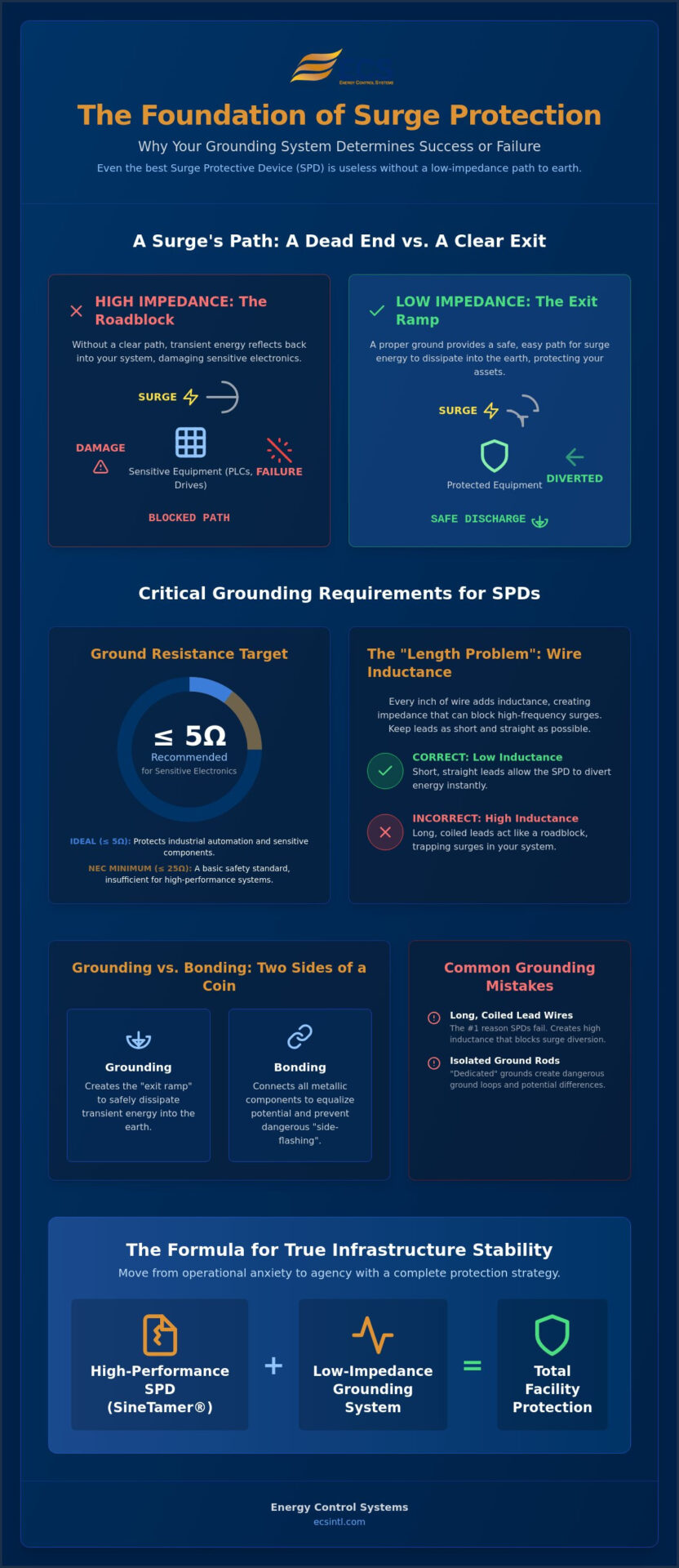
Think of your facility’s electrical system as a high-speed highway. When a surge hits, it’s like a massive flood of traffic entering the flow all at once. If there’s no exit ramp, that energy stays on the road, crashing into your sensitive PLCs, drives, and automation. Effective electrical grounding for surge protection acts as that critical exit ramp. It provides a low-impedance path that allows transient energy to dissipate safely into the earth before it can do harm.
A surge protective device is essentially a high-speed switch. It senses the danger and opens the door to the ground. But if that door leads to a brick wall of high impedance, the energy has nowhere to go. It reflects back into your system. This is where the frustration starts. Many facilities have “good” grounding for standard 60Hz power, but that same system fails during high-frequency surges. It’s a “death by a thousand cuts” for your electronics. Every small hit degrades components until they finally quit, leaving you with unexplained downtime and the stress of costly repairs.
The Science of Diverting Transient Energy
Your Earthing system serves two distinct masters. The safety ground protects people from faults, while the reference ground protects signals and equipment from transients. High-frequency transients don’t behave like standard current. They travel on the surface of conductors and are highly sensitive to impedance. If your ground path is too long or coiled, the surge will simply jump to a different path of least resistance, often right through your most expensive hardware.
Grounding vs. Bonding: Why Both Matter for Surges
Grounding gets the energy out, but bonding keeps everything at the same level. Bonding is the practice of connecting all metal parts, like pipes and cabinets, to prevent voltage differences. Without it, a major surge can cause “side-flashing.” This occurs when electricity jumps between two metal objects because they aren’t at the same potential. Proper bonding ensures that even during a massive event, your equipment stays protected and your team stays safe. We don’t just want the energy to leave; we want it to leave without causing chaos on the way out.
Critical Grounding Requirements for Industrial SPD Performance
In the world of power quality, low impedance is king. Many facility managers confuse resistance (DC) with impedance (AC). While your multimeter might show a “clean” path, high-frequency transients like lightning behave differently. They demand a path with minimal opposition to alternating current. Following NEMA grounding and bonding standards is the first step toward ensuring your surge protective devices (SPDs) actually trigger when needed. If the impedance is too high, the surge stays in your equipment, causing the very downtime you’re trying to prevent.
The “Length” problem is a silent killer of protection. Every inch of grounding wire adds inductance. At the microsecond speeds of a surge, even a few extra feet of wire can act like a roadblock. IEEE Standard 1100, often called the Emerald Book, provides specific recommendations for grounding sensitive electronic equipment to avoid these pitfalls. Older facilities often struggle with degraded grounding systems or high soil resistivity, making a professional assessment vital for stability.
Achieving the Ideal Resistance for Surge Protection
The National Electrical Code (NEC) allows for 25 ohms of resistance, but that is a bare-minimum safety standard. For industrial automation and sensitive electronics, we aim for 5 ohms or less. Achieving this often requires a soil resistivity test. If your soil is rocky or dry, your grounding system might need enhancement to provide that necessary relief for your hardware. If you’re unsure about your facility’s current state, a professional power quality audit can reveal hidden gaps in your defense.
Common Grounding Mistakes That Cripple Surge Suppressors
- Long, coiled lead wires: This is the most frequent reason high-quality SPDs fail. Excess wire creates inductance that slows down surge diversion. Keep leads short and straight.
- Isolated ground rods: Creating “dedicated” grounds for computers or PLCs often leads to dangerous ground loops. All grounding systems must be bonded together to maintain a single reference point and protect your team.
Stabilizing Your Infrastructure with Proper Grounding and SineTamer
Industrial leaders often fall into a cycle of “replace and pray.” You swap out a fried drive, cross your fingers, and hope the next surge doesn’t hit as hard. But hope isn’t a strategy. To break this cycle, you need more than just a suppressor; you need a system. The SineTamer LA Series is engineered for this exact challenge. However, even the world’s most advanced suppression technology requires a solid foundation. Without proper electrical grounding for surge protection, you’re only solving half the problem.
At ECS, we move you from anxiety to agency. We don’t just sell hardware; we provide a roadmap to stability. Our process often begins with harmonic analysis and grounding audits. These tools help us see the invisible disturbances that are quietly eating away at your bottom line. By ensuring your Electrical grounding requirements are met, we give the “SineTamer Advantage” room to work. Our frequency-attenuation technology cleans up electrical noise in real-time, but it relies on that grounding path to shunt energy away from your sensitive circuits.
Integrating SineTamer into Your Grounding Strategy
Installation matters as much as the device itself. For example, when deploying the SineTamer RM Series in rack-mount environments, grounding is your first line of defense. You must prioritize short, straight connections to the grounding bus bar. Every bend and every extra inch of lead wire introduces impedance that can bypass your protection. We advocate for precision here because your facility’s reliability depends on it.
Your Path to Total Uptime
True stability is a multi-layered shield. When you combine robust electrical grounding for surge protection with high-performance SPDs and a reliable uninterruptible power supply, you create an environment where technology thrives. You stop reacting to failures and start focusing on growth. Protecting your equipment isn’t just about saving hardware. It’s about protecting your team’s productivity and restoring your own mental tranquility. You’ve worked hard to build your infrastructure; let’s make sure it stays protected.
Take Command of Your Power Quality
Your industrial infrastructure is too valuable to leave to chance. We’ve explored how a low-impedance path is the only way to ensure your suppression devices actually perform when the stakes are highest. Without robust electrical grounding for surge protection, your most sensitive hardware remains vulnerable to the “death by a thousand cuts” caused by high-frequency transients. It’s time to stop the cycle of unexplained resets and the frustration of replacing components that should have lasted for years.
You deserve the relief of a facility that stays online and productive. With over 30 years of industrial protection experience and our proprietary SineTamer frequency-tracking technology, we specialize in identifying the hidden gaps in your power environment. As you address these power concerns, you can explore Security and IT Infrastructure Solutions from First Emirates Computers to bolster your facility’s defense with expert CCTV and biometric systems. Our global distribution and technical support teams act as your partners in stability, moving you from operational anxiety to total agency over your equipment’s health.
Restore stability to your facility—Contact ECS for a Power Quality Analysis today.
Take the first step toward true mental tranquility. Your team’s success and your facility’s longevity are worth the investment in a stable, protected environment. We’re here to help you secure that future.
Frequently Asked Questions
Does a surge protector work if the outlet is not grounded?
A surge protector cannot effectively divert energy without a ground connection. Most industrial devices rely on a path to earth to shunt excess voltage away from sensitive circuits. If your outlet lacks a ground, the suppressor might offer limited line to neutral protection, but it won’t stop the common mode surges that fry PLCs. It’s a risk that leaves your most expensive hardware exposed to preventable failure.
What is the difference between electrical grounding and bonding for surge protection?
Grounding connects your system to the physical earth to dissipate energy, while bonding connects all metal components together to eliminate voltage differences. Think of grounding as the “drain” and bonding as the “leveler.” Without proper bonding, a surge can jump between two unbonded metal cabinets, causing side flashing and equipment damage. Both are essential to maintain a stable, protected environment for your team.
How much grounding resistance is acceptable for industrial surge protective devices?
Industrial facilities should aim for a resistance of 5 ohms or less to ensure total equipment safety. While standard electrical codes often mention a 25 ohm minimum for safety, this is rarely enough for high performance automation. High frequency transients require very low impedance to move quickly through the system. Achieving this lower threshold gives your facility the stability it needs to survive harsh electrical environments without constant resets.
Can a poor ground cause a surge protector to fail or catch fire?
Yes, a high resistance ground path can lead to thermal runaway and potential fire hazards. When energy has no exit ramp, the surge protective device is forced to absorb the heat itself. This stress can cause the internal components to overheat or fail catastrophically. Ensuring proper electrical grounding for surge protection is not just about equipment uptime; it’s about the safety of your facility and the peace of mind of your operators.

Article by
Jeff Edwards
Founder of ECS International Inc. Edwards travels and speaks extensively in Latin America, Asia and Africa on the subject of power quality; transients and mitigating their impact on profitability. After graduating from Texas Tech University in Lubbock Texas, Edwards spent 9 years in the Telecommunications sector prior to founding Energy Control Systems in 1987 as a Texas based corporation selling surge suppression and UPS systems. The company has evolved into a global power quality products and energy efficiency concern with operations spanning South America, Asia, Europe and Africa.
Disclaimer
Some of the above information may be the opinion of the author.