

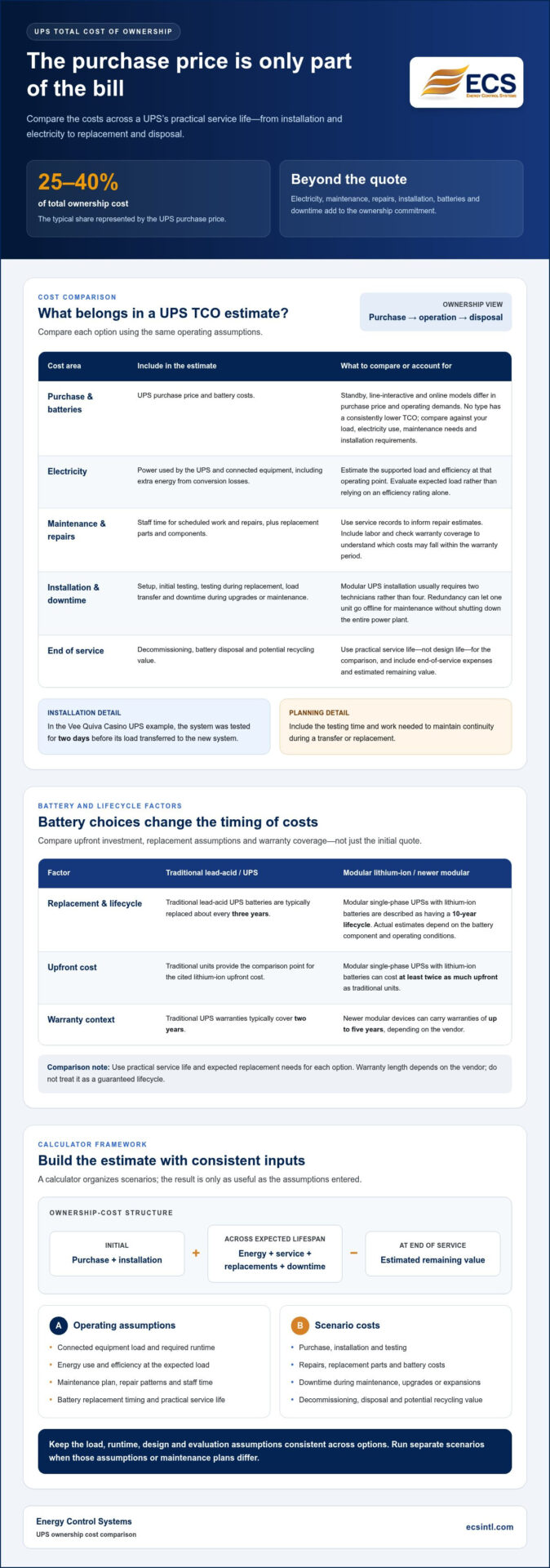
The purchase price is only part of the bill: it typically accounts for about 25-40% of a UPS system’s total cost of ownership. Calculating the total cost of ownership for a UPS means adding its purchase cost to the operating and maintenance expenses expected across its useful life.
When budgets are tight, it is easy to focus on the upfront price. But energy use, battery replacements, maintenance, installation, and downtime all contribute to what a UPS costs to own and operate.
This guide explains which costs to include in a UPS TCO estimate and how a calculator can organize them. Account for purchase, operating, and maintenance costs, as well as often-overlooked expenses, to compare options with a clearer view of the long-term commitment.
Key Takeaways
- Compare UPS options across their useful life, not by purchase price alone.
- Include energy use, maintenance, battery replacement, installation, and downtime in your cost picture.
- Account for battery technology and replacement timing when estimating long-term operating expenses.
- Use a calculator to organize assumptions, compare scenarios, and spot costs that are easy to overlook.
Purchase, operating, and maintenance costs
A UPS purchase price typically represents about 25-40% of total ownership cost. The rest accumulates through electricity, maintenance, repairs, installation, and downtime.
Model Type and Purchase Costs
Standby, line-interactive, and online models differ in purchase price and operating demands. No model type has a consistently lower TCO: compare each option against your load, electricity use, maintenance needs, and installation requirements. Include purchase and battery costs, then estimate expenses across the system’s practical service life. This prevents a lower initial quote from hiding higher ongoing costs.
Electricity Use and Conversion Losses
A UPS uses electricity to power connected equipment, and conversion losses require additional energy. To estimate consumption, consider the supported load and the UPS’s efficiency at that operating point. A less efficient UPS wastes more power, increasing electricity use and operating costs. Evaluate expected load rather than relying on an efficiency rating in isolation.
Installation and Maintenance Labor
Installation and maintenance labor includes staff time for setup, initial testing, scheduled work, and repairs. Include those hours in the TCO, along with downtime costs during upgrades or maintenance. Modular UPS installation usually requires two technicians rather than four. Redundancy can also allow one unit to go offline for maintenance without shutting down the entire power plant, helping maintain uptime while workers transfer the load.
Efficiency, Lifespan, Warranty, and Disposal
Efficiency, practical service life, warranty coverage, and end-of-service expenses all affect ownership costs. Traditional lead-acid UPS batteries are typically replaced about every three years. Traditional UPS warranties typically cover two years, while newer modular devices can carry warranties of up to five years, depending on the vendor. Include battery replacement, decommissioning, and disposal in your estimate. Also account for potential recycling value, and compare options using practical service life rather than design life.
What Is Total Cost of Ownership?
Total cost of ownership (TCO) covers an asset’s expenses from purchase through disposal. The UK Government describes TCO as the complete cost across that lifecycle, including direct and indirect costs.
Battery Technologies and Replacement Frequency
Battery technology affects purchase cost, service life, and the timing of future replacements. Modular single-phase UPSs with lithium-ion batteries can cost at least twice as much upfront as traditional units, while their lifecycle is described as 10 years. Compare that higher initial investment with expected replacement needs across the practical use life. The right estimate depends on the battery component and the system’s actual operating conditions.
Repairs and Replacement Parts
Repairs and replacement parts add to costs when a UPS component wears out, fails, or no longer supports the required power supply. Estimate likely component needs and the labor involved rather than treating the purchase price as the full commitment. Service records help make projections more accurate by showing repair patterns over time. Warranty coverage also determines which costs fall within the warranty period.
Replacing a UPS involves more than buying new equipment. The Vee Quiva Casino UPS system was tested for two days before its load transferred to the new system. Include testing time and the work needed to maintain continuity during the transfer when estimating replacement costs. This example shows why installation planning belongs in a TCO comparison.
For a complete estimate, include operating costs throughout the system’s practical service life and expenses at end of service. Decommissioning, battery disposal, and potential recycling value can change the final comparison. Considering these factors helps distinguish a lower initial price from a lower overall commitment.
Reviewing UPS options alongside battery technology and lifecycle assumptions can help frame a more complete ownership estimate.
UPS total cost of ownership calculators
A useful UPS TCO calculator compares expenses across the expected lifespan, not just the upfront purchase. Its results depend on realistic inputs for load, runtime, energy, maintenance, and downtime. Calculating total cost of ownership for a UPS is more useful when every estimate uses the same operating assumptions.
Using a UPS TCO Calculator
A UPS TCO calculator organizes initial and ongoing expenses into comparable scenarios. Enter purchase and installation costs, energy use, maintenance, repairs, battery replacement, and end-of-service expenses. Compare options using the same assumptions, including design, specification, and evaluation costs, plus staff time for testing. Service records can improve estimates by showing repair patterns and past operating costs.
Load and runtime determine equipment size and related costs. Start with the connected equipment’s power demand, then set the runtime needed to support it. A higher load or longer runtime changes the required capacity, affecting both the purchase estimate and energy use. Keep assumptions consistent across options so the calculator compares equivalent power protection.
Calculating Costs Over the Expected Lifespan
Calculating total cost of ownership for a UPS means adding the initial cost to projected expenses over its expected lifespan, then subtracting estimated remaining value. Include energy, maintenance, repairs, replacement components, installation, and disposal. Account for downtime during upgrades or expansions, too.
Run separate scenarios for different loads, runtimes, efficiency levels, and maintenance plans. Record each assumption, then review which expenses drive the result. A calculator supports decisions, but it’s only as useful as its inputs. Discuss UPS power requirements to connect your load and runtime needs with a suitable power supply.
Energy Control Systems: Uninterruptible Power Supplies (UPS)
Energy Control Systems offers Uninterruptible Power Supplies (UPS) to help organizations protect critical equipment from power interruptions. If your TCO comparison leaves questions about selecting a system for your load, runtime needs, and operating environment, discuss your requirements with the team. Clarifying those needs helps you evaluate options beyond their initial purchase cost.
Power quality can also affect the equipment a UPS protects. Harmonic Analysis can identify distortion in an electrical system, providing useful context when assessing power needs and infrastructure. These considerations help you make a more informed decision about the role of a UPS in your operation.
Contact Energy Control Systems to discuss your UPS requirements.
Turn Your UPS Cost Estimate Into a Clear Decision
Use your TCO estimate as a planning tool, not just a purchasing comparison. Revisit the assumptions as operating conditions or critical loads change. This keeps future decisions grounded in the needs of your equipment and the people who rely on it. A careful approach to calculating total cost of ownership for a UPS also helps explain your recommendation to colleagues.
For power-quality assessment and surge protection, Energy Control Systems offers comprehensive harmonic analysis and advanced transient voltage surge suppression solutions. These professional solutions can inform a broader assessment of your facility’s electrical infrastructure and overall power needs.
Contact Energy Control Systems to discuss your UPS and power quality requirements. A well-informed next step can help you move forward with greater clarity.
Frequently Asked Questions
What Resources Are Available to Help Determine TCO?
Use a spreadsheet or calculator alongside utility bills, equipment records, and maintenance logs. Utility bills help establish the energy baseline; service records reveal past repairs and replacement patterns. Add the UPS load profile, required runtime, battery details, and expected end-of-service handling. Comparing estimates with actual energy bills, for example, can show whether projected operating expenses reflect how the system is used.
What costs should be included in a UPS total cost of ownership calculation?
Include direct expenses such as purchase, installation, energy, maintenance, repairs, replacement parts, and disposal. Also consider indirect effects, including staff time for testing, downtime during upgrades, and the impact of power interruptions on operations. Keep estimated resale or recycling value separate from gross costs, then subtract it in the final calculation to avoid overlooking costs or double-counting credits.
How much does UPS installation and electrical work cost?
Estimate installation and electrical work based on UPS capacity, site layout, wiring changes, testing needs, and required labor. A project involving expanded or redundant wiring differs from a straightforward equipment setup. List equipment installation, distribution changes, commissioning tests, and staff time as separate items. This makes assumptions clear and helps explain differences in project totals.
What are typical UPS battery replacement costs and intervals?
Battery replacement costs depend on battery type, quantity, access, labor, and disposal requirements. Traditional lead-acid UPS batteries are typically replaced about every three years; other battery technologies have different lifecycle expectations. Record each system’s battery chemistry and replacement date. This gives your estimate a practical schedule rather than treating every battery bank as if it ages the same way.
What are UPS maintenance, monitoring, and service contract costs?
Maintenance costs depend on the tasks, monitoring scope, response arrangements, parts coverage, and number of UPS units included. Compare service plans by what they cover, not just their headline amount. List scheduled inspections, testing, repair labor, and replacement parts separately. Remote monitoring can inform battery maintenance and upgrade planning, helping you build a more complete operating-cost estimate.

Article by
Jeff Edwards
Founder of ECS International Inc. Edwards travels and speaks extensively in Latin America, Asia and Africa on the subject of power quality; transients and mitigating their impact on profitability. After graduating from Texas Tech University in Lubbock Texas, Edwards spent 9 years in the Telecommunications sector prior to founding Energy Control Systems in 1987 as a Texas based corporation selling surge suppression and UPS systems. The company has evolved into a global power quality products and energy efficiency concern with operations spanning South America, Asia, Europe and Africa.
Disclaimer
Some of the above information may be the opinion of the author.