

AC and DC lines need different surge protection, so protecting PLCs from power surges starts with safeguarding each power path and its connected signals. AC protection addresses disturbances on the incoming supply; DC protection focuses on the PLC’s power supply and sensitive I/O circuits. Electrical fast transient bursts can continue for many milliseconds as energy from an inductive load dissipates.
A PLC can appear to have a power problem when a transient enters through a signal line or affects grounding between components. That makes the protection approach important. This article explains how AC and DC protection differ, how ESD and EFT transients can affect PLCs, and the roles of grounding, isolation, and staged surge protection. You’ll have a clearer framework for identifying where a transient can enter and how layered protection can help safeguard your control system.
Key Takeaways
- AC and DC lines need protection suited to their different power paths, with attention to PLC supplies and connected signal circuits.
- The United States experiences about 25 million lightning strikes annually, according to the National Oceanic and Atmospheric Administration; surges can also enter through signal wiring and grounding.
- ESD and EFT can disrupt sensitive PLC electronics. Understanding where each transient enters helps you assess which protection measures matter most.
- Match an SPD to the PLC’s voltage and grounding arrangement, and consider UPS backup when stable power is part of your protection needs.
AC and DC power protection
Protecting PLCs from power surges means matching protection to AC and DC circuits and their connected wiring. The United States experiences about 25 million lightning strikes each year, according to the National Oceanic and Atmospheric Administration.
Surge Protector Types and Standards
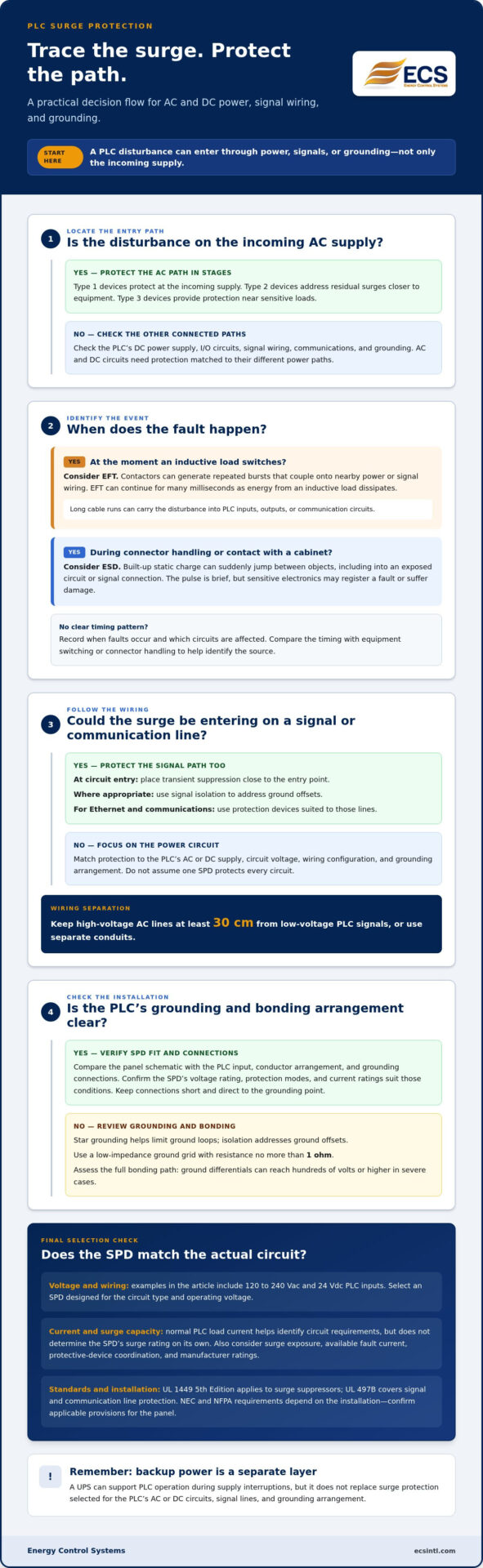
Type 1 devices protect at the incoming supply, Type 2 devices address residual surges closer to equipment, and Type 3 devices provide protection near sensitive loads. UL 1449 5th Edition applies to surge suppressors, while UL 497B covers signal and communication line protection. NEC and NFPA requirements depend on the installation; confirm applicable provisions for the panel.
Sizing and Installing SPDs
Match the SPD to circuit voltage, wiring configuration, and grounding. Examples include 120 to 240 Vac and 24 Vdc PLC inputs. Install protection at the incoming supply and near PLC power supplies and I/O modules. Equipment and installation costs depend on panel design, circuit needs, and site work; pricing is provided after a quote request.
Protecting PLC Power and Signal Lines
A complete plan for protecting PLCs from power surges covers power and signal paths. Place transient suppression close to circuit entry points, and use signal isolation where appropriate. Protect Ethernet and communications with devices suited to those lines. Keep high-voltage AC lines at least 30 centimeters from low-voltage PLC signals, or use separate conduits.
Grounding and Bonding Practices
Star grounding helps limit ground loops; isolation addresses ground offsets. Use a low-impedance ground grid with resistance no more than 1 ohm. Keep SPD connections short, inspect wear indicators because MOVs can degrade, and replace worn devices. Common mistakes include neglecting signal lines, poor bonding, and assuming one SPD protects every circuit.
ESD and EFT surge sources
ESD and EFT are fast electrical disturbances, but they arise differently and can reach PLCs through separate paths. Recognizing the source helps explain why a controller resets, reports false inputs, or loses communication when nearby equipment is operating.
Electrostatic discharge (ESD) occurs when built-up static charge suddenly jumps between objects. For example, a person touching a cabinet connector can discharge into an exposed circuit or signal connection. The pulse is brief, but sensitive electronics may register it as a fault or suffer damage. Enclosures, connector design, and protection at circuit entry points can help limit exposure.
Electrical fast transients (EFT) commonly arise when inductive loads switch. A contactor opening or closing can generate repeated bursts that couple onto nearby power or signal wiring. Unlike a single static discharge, an EFT burst can continue for many milliseconds as energy in an inductive load dissipates. Long cable runs can carry the disturbance into PLC inputs, outputs, or communication circuits.
IEC 61000-4-4 specifies transient levels equipment must withstand on cabling entering a chassis. Testing connections with transients of 4000 V can reveal vulnerabilities in those paths. The test level describes an immunity test, not a promise that every installation will resist every field event. The actual effect depends on the transient path, wiring layout, grounding, and the PLC’s connected equipment.
For recurring faults, record when they occur and which circuits are affected. A contactor switching at the same moment as an input error points toward a different source than a discharge during connector handling. These details give a power-quality review a practical starting point.
How do you size an SPD for PLC voltage, current, and system grounding?
Start with the PLC supply’s rated voltage, wiring configuration, and grounding method. For example, listed PLC systems include 120 to 240 Vac with a 2W+G configuration, and 24 Vdc with a 2W+G configuration. Select an SPD designed for the circuit type and operating voltage, not simply one that fits the cabinet.
Distinguish load current from surge capacity. The PLC’s normal current draw helps identify circuit requirements, but it does not determine the SPD’s surge rating on its own. Consider surge exposure, available fault current, protective-device coordination, and the manufacturer’s ratings. An SPD mismatched to the supply or grounding arrangement may not clamp the disturbance effectively.
Grounding can change the voltage an SPD must manage. Ground differentials between equipment can reach hundreds of volts or higher in severe cases, so assess the entire bonding path, not only the PLC terminal. A low-impedance ground grid with resistance no more than 1 ohm and star grounding can help limit ground loops and provide a defined path for surge current.
Before selecting a device, compare the panel schematic with the PLC’s AC or DC input, conductor arrangement, and grounding connections. Then verify that the SPD’s voltage rating, protection modes, and current ratings suit those conditions. Confirm short, direct connections to the grounding point; long leads add impedance and can weaken protection. Sizing depends on the whole installation, not one nameplate value. For help assessing electrical conditions, request a power-quality review.
Energy Control Systems: Uninterruptible Power Supplies (UPS)
Energy Control Systems offers Uninterruptible Power Supplies (UPS) for facilities that need backup power to support PLC operation during supply interruptions. A UPS can be part of a broader protection plan, but it does not replace surge protection selected for the PLC’s AC or DC circuits, signal lines, and grounding arrangement.
Consider a UPS when brief interruptions or an unstable supply threaten control continuity. If unexplained equipment behavior points to power-quality issues, Harmonic Analysis can help assess the electrical conditions affecting your system. These solutions address different needs: backup power supports continuity, while surge protection limits transient effects.
Contact Energy Control Systems to discuss UPS options for your PLC power needs.
Make Your PLC Protection Plan Work as One System
Protecting PLCs from power surges is an ongoing design decision, not a one-time component choice. As equipment, wiring, and operating conditions change, revisit how protection fits the control system and its power-quality needs. This helps your team connect maintenance decisions to reliable operation.
Energy Control Systems offers the SineTamer LA Series, SineTamer RM Series, and SineTamer ST-PCMF Series. Discuss which protection options suit your PLC application and power concerns. A focused conversation can help turn a complex electrical issue into a clearer plan for your facility.
Contact Energy Control Systems to discuss your PLC power-protection needs and move forward with confidence.
Frequently Asked Questions
What types of power surges can damage PLCs?
Lightning, switching events, and electrostatic discharge can all disrupt PLC operation. For example, a motor or contactor switching can create a transient that couples into nearby wiring, while a static discharge may affect exposed connectors during maintenance. Depending on its entry path and the circuits it reaches, a disturbance can cause faulty readings, communication dropouts, unexpected resets, or component damage.
How do you protect a PLC from lightning and electrical surges?
Coordinate protection across the incoming supply, PLC power, and connected signal circuits. A facility’s protection plan should account for the paths a surge can take, including Ethernet and other communication cables entering the control cabinet. Grounding and bonding also matter because they shape the path surge current follows. A UPS can support continuity during power interruptions, but it serves a different role from surge suppression.
What surge protective device (SPD) is recommended for a PLC control panel?
Choose an SPD whose voltage, configuration, and protection modes match the panel’s supply and grounding arrangement. Energy Control Systems offers SineTamer surge protection solutions engineered for microprocessor-based devices, including the SineTamer LA Series, SineTamer RM Series, and SineTamer ST-PCMF Series. The right fit depends on the PLC circuits being protected and the device’s place in the facility’s coordinated protection plan.
Which NEC, UL, and NFPA standards apply to surge protection for PLCs?
UL 1449 5th Edition applies to surge suppressors, and UL 497B covers signal and communication line protection. NEC and NFPA requirements depend on the installation, so confirm the applicable provisions for the panel.

Article by
Jeff Edwards
Founder of ECS International Inc. Edwards travels and speaks extensively in Latin America, Asia and Africa on the subject of power quality; transients and mitigating their impact on profitability. After graduating from Texas Tech University in Lubbock Texas, Edwards spent 9 years in the Telecommunications sector prior to founding Energy Control Systems in 1987 as a Texas based corporation selling surge suppression and UPS systems. The company has evolved into a global power quality products and energy efficiency concern with operations spanning South America, Asia, Europe and Africa.
Disclaimer
Some of the above information may be the opinion of the author.