

What if a failed SPD is warning you about more than the device itself? The common modes of spd failure include MOV degradation from repeated surges or sustained temporary overvoltage, but the underlying cause may involve wiring, grounding, or broader power-quality conditions. If protection is reduced, critical equipment may be exposed before anyone realizes the SPD is no longer doing its job.
It’s understandable to wonder whether an SPD is still functioning, especially when a transient could disrupt operations and the symptoms might point to an upstream issue. This guide explains common failure mechanisms and warning signs, including status indicators and visible damage. It also shows how installation and electrical conditions can contribute, and what to record to help distinguish a device problem from a system-level concern.
Key Takeaways
- Learn how common modes of spd failure, including MOV degradation and thermal disconnection, can reduce intended protection.
- Use status indicators and alarm records as clues, not definitive proof that the wider system is protected.
- Track which equipment or circuits are affected to help distinguish an SPD issue from a broader electrical disturbance.
- When failures recur, review application, exposure, and installation conditions before treating replacement as the only answer.
Common Modes of SPD Failure: What Breaks and Why
Surge protective device (SPD) failure means the device can no longer provide its intended level of protection, or that protection has been reduced. Equipment damage alone doesn’t prove an SPD has failed: a transient may exceed the protection available, or the cause may lie elsewhere in the electrical system. Understanding the common modes of spd failure helps separate a device problem from a wider power-quality issue. A Surge Protector Overview explains the general role and types of surge protectors.
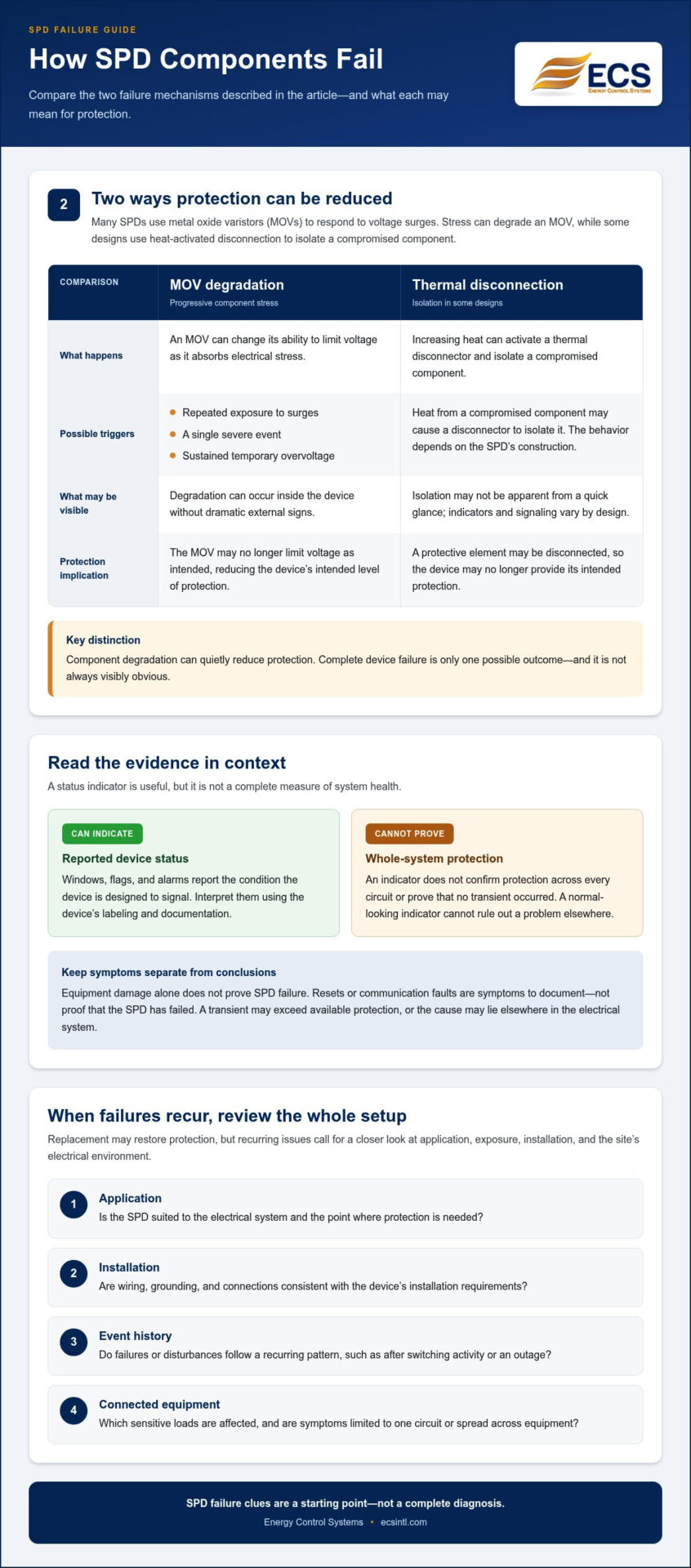
Many SPDs use metal oxide varistors (MOVs) to respond to voltage surges. Repeated exposure, a severe event, or sustained temporary overvoltage can stress an MOV and change its ability to limit voltage. This degradation can occur inside the device, without dramatic external signs. A single severe event may also compromise a device, so the absence of a history of repeated surges doesn’t rule out damage.
How SPD components can degrade or disconnect
An MOV can degrade progressively as it absorbs electrical stress. In some designs, increasing heat activates a thermal disconnector that isolates a compromised component, reducing the risk of continued overheating. The result depends on the SPD’s construction: isolation may leave a protective element disconnected, and the device may no longer provide its intended protection.
“Component degradation can quietly reduce protection; complete device failure is only one possible, and not always visibly obvious, outcome.”
Indicators and failure behavior vary by design. Some devices provide a status window or flag; others use different signaling, and a damaged component may not be apparent from a quick glance. Treat visible damage or an abnormal indicator as a clear reason for review, but don’t assume every SPD shows failure the same way. The key question is whether its protective components remain able to perform their intended role.
How to Recognize SPD Failure Without Misreading the Evidence
A warning light can be useful, but it’s only one piece of evidence. An SPD indicator reflects the status the device is designed to report; it doesn’t confirm protection across every circuit or prove that no transient occurred. As the Understanding Electrical Surges resource explains, surges can have different origins, so symptoms elsewhere in the system also deserve attention.
What an SPD indicator can, and cannot, tell you
Indicator windows, flags, and alarms vary by manufacturer and device design. Follow the device’s labeling and documentation to interpret a reported end-of-life condition. Don’t treat unexplained equipment resets or communication faults as proof that the SPD has failed. They are symptoms to document and assess alongside the device’s status.
“An SPD indicator reports device status, not the complete health of an electrical system.”
Use this sequence to build a useful record:
- Observe the status indicator and note its exact position, color, or displayed message. Don’t open or handle electrical equipment to inspect it.
- Record any alarm, including when it appeared and whether it repeats.
- List affected equipment and circuits. Note whether the issue is isolated or appears across multiple loads.
- Write down the timing and any recent electrical events, such as an outage, switching event, or nearby storm.
These notes give a technical assessment a clearer starting point for distinguishing a reported SPD condition from a broader power-quality concern. If disturbances recur, professional harmonic analysis from Energy Control Systems can help investigate electrical conditions affecting sensitive equipment. The common modes of spd failure may be part of the picture, but a normal-looking indicator alone can’t rule out a problem elsewhere in the protection system.
Reduce Repeat SPD Failures by Reviewing the Whole Protection System
Replacing a failed device may restore protection, but it won’t address the cause if the failure reflects a mismatch or a problem elsewhere. Device-level wear is only one part of the picture. Application mismatch, electrical exposure, wiring, grounding, and other installation conditions can all affect how an SPD performs. A useful surge protective device guide can help clarify an SPD’s role within a broader power-quality plan.
Recurring issues call for a closer look at the protection arrangement and the site’s electrical environment, rather than automatic replacement alone. The SineTamer LA Series guide provides product context, but no single device detail should be treated as a diagnosis. The common modes of spd failure are clues to investigate, not a complete explanation of what happened.
Turn failure observations into a practical protection review
Organize the review around four questions. This gives a technical assessment a clearer starting point:
- Application: Is the SPD suited to the electrical system and the point where protection is needed?
- Installation: Are wiring, grounding, and connections consistent with the device’s installation requirements?
- Event history: Do failures or disturbances follow a recurring pattern, such as after switching activity or an outage?
- Connected equipment: Which sensitive loads are affected, and are symptoms limited to one circuit or spread across equipment?
If disturbances recur or affect multiple loads, harmonic analysis can help investigate broader power-quality concerns. It is one part of an assessment, not a diagnosis for every SPD failure. Energy Control Systems provides professional harmonic analysis and technical site analysis, along with SineTamer surge protection and UPS systems, to support a broader review of power quality.
Turn Protection Insights Into a Stronger Plan
Use what you’ve learned about the common modes of spd failure as a starting point for a documented power-quality plan. Assign ownership for reviewing event records, note changes in critical loads, and revisit protection needs as systems evolve. Keeping these observations together helps your team make decisions with evidence rather than waiting for the next disruption.
Energy Control Systems supports industrial and commercial power-quality needs with SineTamer SPD series, uninterruptible power supplies, and professional harmonic analysis. These offerings can inform a broader review of how your facility manages power disturbances and protects sensitive infrastructure.
Explore ECS power-quality solutions to find SineTamer protection, UPS systems, and harmonic analysis for your facility’s needs.
Frequently Asked Questions
Can an SPD fail without causing an immediate equipment outage?
Yes. An SPD can lose or reduce protection without interrupting power to connected loads, so operations may continue while protection is compromised. For example, a controller might experience an intermittent reset while nearby equipment stays online. Treat the disturbance as a reliability clue, not proof of SPD failure. Compare its timing with the device’s status and available system event logs.
What are the most common signs that an SPD may need attention?
A device-specific end-of-life indication, alarm, or visible damage can signal that the SPD needs review. Recurring equipment faults may also warrant investigation, but they can have other causes. Read the device documentation to interpret its indicators, and follow site safety procedures. Don’t open an energized enclosure or rely on a single symptom to identify the cause.
Can a surge protective device fail after one surge?
Yes, a sufficiently severe surge may compromise an SPD in a single event, while repeated exposure can contribute to degradation over time. There’s no universal surge count that predicts failure. The outcome depends on the event and the device’s application. If a disturbance coincides with a major event, preserve available event records and review the SPD’s status afterward.
Should I replace an SPD every time protected equipment has a fault?
No. A fault in one device doesn’t establish that its SPD has failed. For example, if one machine reports an error while other loads operate normally, the issue may be isolated to that equipment or circuit. Check the SPD’s status and the equipment’s own fault information. Replacement decisions should follow evidence of a protection issue, not an equipment fault alone.

Article by
Jeff Edwards
Founder of ECS International Inc. Edwards travels and speaks extensively in Latin America, Asia and Africa on the subject of power quality; transients and mitigating their impact on profitability. After graduating from Texas Tech University in Lubbock Texas, Edwards spent 9 years in the Telecommunications sector prior to founding Energy Control Systems in 1987 as a Texas based corporation selling surge suppression and UPS systems. The company has evolved into a global power quality products and energy efficiency concern with operations spanning South America, Asia, Europe and Africa.
Disclaimer
Some of the above information may be the opinion of the author.