

More surge protective devices don’t automatically mean more protection. If you’re unsure whether devices will work together or whether sensitive equipment is still exposed, look beyond individual ratings. SPD coordination for maximum protection is a system-level design task: each protective stage needs to suit the electrical environment and the other devices in the path.
This guide explains how coordinated SPDs protect different points in a facility and what to review when selecting devices, including system specifications, upstream overcurrent protection, placement, and installation details. You’ll also learn how to turn those checks into a practical plan based on your facility’s loads and existing equipment. The goal is to help you identify the next steps toward stronger power quality and operational resilience.
Key Takeaways
- SPD coordination for maximum protection depends on how devices work together across the electrical system, not on one surge rating alone.
- Map facility loads and circuits, then gather system data to identify where protection stages are needed.
- Review manufacturer coordination guidance alongside overcurrent protection and available fault-current information.
- Prioritize protection based on equipment criticality, while treating SPDs, UPS support, and harmonic analysis as distinct parts of a power-quality plan.
SPD Coordination for Maximum Protection: Why One Device Rating Is Not Enough
A surge protective device (SPD) rating describes one aspect of its performance, not how it will work with other devices or protect every load in your facility. Effective spd coordination for maximum protection means designing protection stages to suit the electrical system, so devices work together rather than operate as unrelated components.
A high surge-current rating alone doesn’t tell you whether an SPD is suitable for the system voltage and configuration, whether its protection level suits connected equipment, or whether it is coordinated with upstream devices. Selection also depends on device type, installation location, and manufacturer guidance. The rating matters, but it is only one part of the decision.
Adding SPDs without checking how they interact can create a false sense of security. More devices don’t automatically close protection gaps; poorly matched stages may not share surge energy as intended. For background on device types and basic principles, see Understanding Surge Protectors.
What does coordinated surge protection mean in practice?
In a layered design, a service-entry SPD may address incoming surges, distribution-level devices may protect downstream circuits, and equipment-level protection may serve sensitive loads such as control systems. The role of each device depends on the installation. Device type, system configuration, placement, and manufacturer coordination guidance all affect whether the stages can work together.
Coordinated surge protection is a planned set of compatible devices that protects the path from service entrance to critical equipment, rather than simply adding SPDs at multiple points. Instead of asking only how many devices are installed, ask whether each stage suits the electrical system and the next point of protection.
How to Review SPD Coordination: A Practical Engineering Sequence
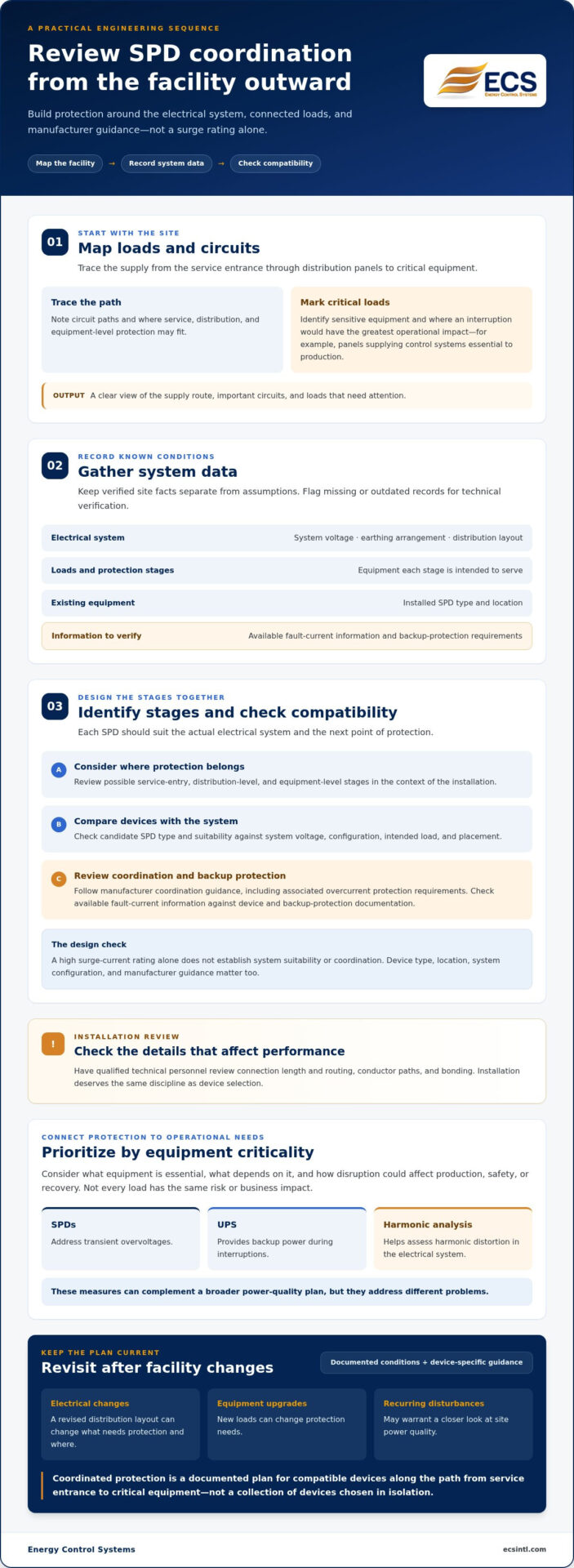
A repeatable review starts with the facility, not a product catalogue. Work through the system in order, recording known conditions and flagging information that needs technical verification before selecting devices.
- Map loads and circuits. Trace the supply from the service entrance through distribution panels to critical equipment. Note circuit paths, sensitive loads, and where an interruption would have the greatest operational impact. For example, identify which panels supply control systems or other equipment essential to production.
- Gather system data. Record system voltage, earthing arrangement, distribution layout, and the equipment each protective stage is intended to serve. Gather available fault-current information and details of existing SPDs, including their type and location.
- Identify stages and check compatibility. Consider where service, distribution, and equipment-level protection may fit. Compare candidate SPDs with the actual system and review the manufacturer’s coordination guidance, including requirements for associated overcurrent protection. Check that available fault-current information aligns with the device and backup-protection documentation.
Which information should engineers collect before selecting coordinated SPDs?
Keep site facts separate from assumptions. Verify missing or outdated records before finalizing a design. Uncertainty about system configuration or protective-device requirements can undermine an otherwise careful selection.
Checklist: Record known voltage, earthing, distribution, loads, and installed devices. Flag unknown fault-current values, SPD compatibility, and backup-protection requirements for verification against manufacturer documentation.
Installation deserves the same discipline. Have qualified technical personnel review connection length and routing, conductor paths, and bonding, since installation details affect how protection performs in practice. Energy Control Systems’ technical site analysis can help inform power-quality planning with a clearer picture of facility conditions.
Turn SPD Coordination into a Facility-Wide Power-Quality Plan
Connect protection choices to operational consequences. Identify which equipment is essential, what depends on it, and how a disruption could affect production, safety, or recovery. This helps prioritize where coordinated surge protection deserves attention without assuming every load has the same risk or business impact.
Keep related power-quality tools in their proper roles. SPDs address transient overvoltages. An uninterruptible power supply (UPS) provides backup power during interruptions, while harmonic analysis helps assess harmonic distortion in the electrical system. These measures can complement a broader plan, but they address different problems. Energy Control Systems offers SineTamer LA, RM, and ST-PCMF series surge protection products, UPS systems, harmonic analysis, and technical site analysis to support facility-level decisions.
When should a facility revisit its surge-protection strategy?
Reassess after electrical-system changes, recurring disturbances, or equipment upgrades. A new load or revised distribution layout can change what needs protection and where. Recurring issues may also warrant a closer look at site power quality. For additional background, explore this industrial surge protection guide and surge protective device guide.
Use technical site analysis to ground decisions in actual facility conditions, then align protection priorities with equipment criticality and operational needs. That’s the practical path to spd coordination for maximum protection: a documented plan rather than a collection of devices chosen in isolation.
Coordination depends on documented system conditions and device-specific manufacturer guidance. Keep those records current as the facility changes, so future reviews can build on known conditions instead of guesswork.
Make Your Next Power-Quality Decision with Confidence
Long-term resilience begins with a clear picture of how power conditions affect the equipment and processes your facility depends on. Use your coordination review to guide decisions based on site conditions and operational priorities, rather than treating protection as a one-time device purchase. That’s how spd coordination for maximum protection can support planning as your operation changes.
Energy Control Systems offers technical site analysis and professional harmonic analysis, along with SineTamer LA, RM, and ST series surge protection products. These solutions can help you move from questions about system conditions toward a more informed power-quality plan.
Explore Energy Control Systems power-quality solutions to take the next step toward a more resilient facility.
Frequently Asked Questions
Is a higher SPD surge-current rating enough to ensure maximum protection?
No. A higher surge-current rating alone doesn’t establish spd coordination for maximum protection. It won’t tell you whether the device suits the system or whether its voltage protection level is appropriate for connected equipment. For example, choosing a device for a main panel does not, based on its rating alone, establish the protection needed for a sensitive control circuit farther downstream. Consider the full application.
Can multiple SPDs be installed in the same electrical system?
Yes, multiple SPDs can be used in one system when their selection and placement are planned together. A facility might have protection at its service entrance and additional devices serving separate distribution panels. Before adding another SPD, review the system layout and existing devices so the new installation fits the protection design rather than creating an unassessed overlap. Keep device and location records current.
How do you choose an MCB for an SPD?
Use the SPD manufacturer’s documentation to identify the required or permitted backup overcurrent protection. Don’t choose an MCB by current rating alone. Check the specified breaker series, rating, and trip curve, then compare its breaking capacity with the available prospective fault current at the installation point. If the manufacturer’s instructions and site information don’t align, pause selection for qualified engineering review.
What happens if SPDs are not coordinated?
Protection stages may not share surge energy as intended. A downstream SPD could respond prematurely or fail before an upstream device acts, potentially leaving connected equipment exposed. The precise outcome depends on the devices and installation, so an uncoordinated arrangement doesn’t mean failure is certain, but it does create avoidable uncertainty. Review device-specific guidance and the actual system before relying on multiple SPDs.

Article by
Jeff Edwards
Founder of ECS International Inc. Edwards travels and speaks extensively in Latin America, Asia and Africa on the subject of power quality; transients and mitigating their impact on profitability. After graduating from Texas Tech University in Lubbock Texas, Edwards spent 9 years in the Telecommunications sector prior to founding Energy Control Systems in 1987 as a Texas based corporation selling surge suppression and UPS systems. The company has evolved into a global power quality products and energy efficiency concern with operations spanning South America, Asia, Europe and Africa.
Disclaimer
Some of the above information may be the opinion of the author.