

The UPS with the biggest battery may still be the wrong choice for your site. Heat, dust, moisture, corrosive exposure, and unstable power can all affect equipment performance. Selecting a UPS for a harsh environment starts with understanding those conditions, not just comparing product specifications.
An unexpected power failure can put critical equipment and operations under pressure. A practical selection process helps you protect essential loads while accounting for runtime, installation constraints, and maintenance. Start by documenting site exposure and identifying the equipment that needs backup. Then compare UPS capabilities and consider how surge protection and harmonic analysis fit into the wider power-quality plan.
Key Takeaways
- Document temperature, dust, moisture, vibration, altitude, and access constraints to understand what your installation must withstand.
- When selecting a ups for a harsh environment, define critical loads and required runtime before comparing system capacity.
- Compare operating conditions, battery access, and monitoring to account for maintenance as well as power needs.
- Distinguish UPS backup from surge protection, and consider whether harmonic analysis can inform your power-quality plan.
Start UPS selection for a harsh environment with the site, not the product list
An unsuitable power system can leave critical equipment vulnerable when conditions are challenging. Before comparing UPS options, document the environment where the equipment will operate. Selecting a ups for a harsh environment begins with the site: heat, contamination, or difficult service access can undermine an otherwise suitable power plan.
Environmental suitability concerns whether the UPS can operate under the conditions at its installation location. It is different from capacity, the electrical load it can support, and runtime, how long it can provide backup power. For an overview of UPS operation and system types, see this article on the Uninterruptible Power Supply (UPS).
- Temperature: Record typical conditions and short-duration highs or lows.
- Dust: Note airborne particles and nearby processes that generate debris.
- Moisture: Identify humidity, drips, washdown, or weather exposure.
- Vibration: Check for equipment or vehicle movement near the installation.
- Altitude: Document the site elevation for application review.
- Access: Consider the space needed for inspection and battery service.
Which site conditions should shape an industrial UPS specification?
Separate normal operating conditions from brief extremes, and specify whether the UPS will be indoors or outdoors. Record the precise location, ventilation, nearby processes, and any exposure that could affect operation or service. A unit beside a hot process or in a washdown area faces different demands from one in a ventilated control room.
Match required environmental ratings to documented site conditions rather than assumptions based on a product label. Include access for routine inspection and battery service in the installation plan. A clear site record gives the selection process a practical basis and helps prevent avoidable operating and maintenance issues.
Compare harsh-environment UPS options by load, runtime, and serviceability
Once you have documented site conditions, identify the connected load and the backup duration your operation requires. UPS sizing depends on the connected load and the required backup duration. A nominal capacity figure alone does not show whether a system can support your equipment for the time needed.
Use the same criteria for each option so environmental fit and maintenance needs stay in view. Massachusetts’ site suitability guidance provides broader context on energy infrastructure siting. It is not a UPS rating or specification.
| Compare | What to document |
|---|---|
| Load | Connected equipment and its operating demand |
| Required runtime | Backup duration needed for safe shutdown or continued operation |
| Operating conditions | Site exposure and installation constraints from your assessment |
| Battery access | Space and practical access for inspection and replacement |
| Monitoring | What operators need to observe and how they will respond to alerts |
How can buyers compare specifications without overlooking site realities?
Compare the actual load and required runtime, not just nominal capacity. Then consider installation space, service access, battery replacement planning, and monitoring alongside the documented site conditions. A system that fits electrically but is difficult to inspect can make maintenance more challenging.
If power-quality conditions raise concerns, harmonic analysis can help identify issues that should inform the assessment. Energy Control Systems provides UPS systems and power-quality services, including professional harmonic analysis. Explore Energy Control Systems’ power-quality capabilities. When selecting a ups for a harsh environment, compare the complete operating requirement, not one headline specification.
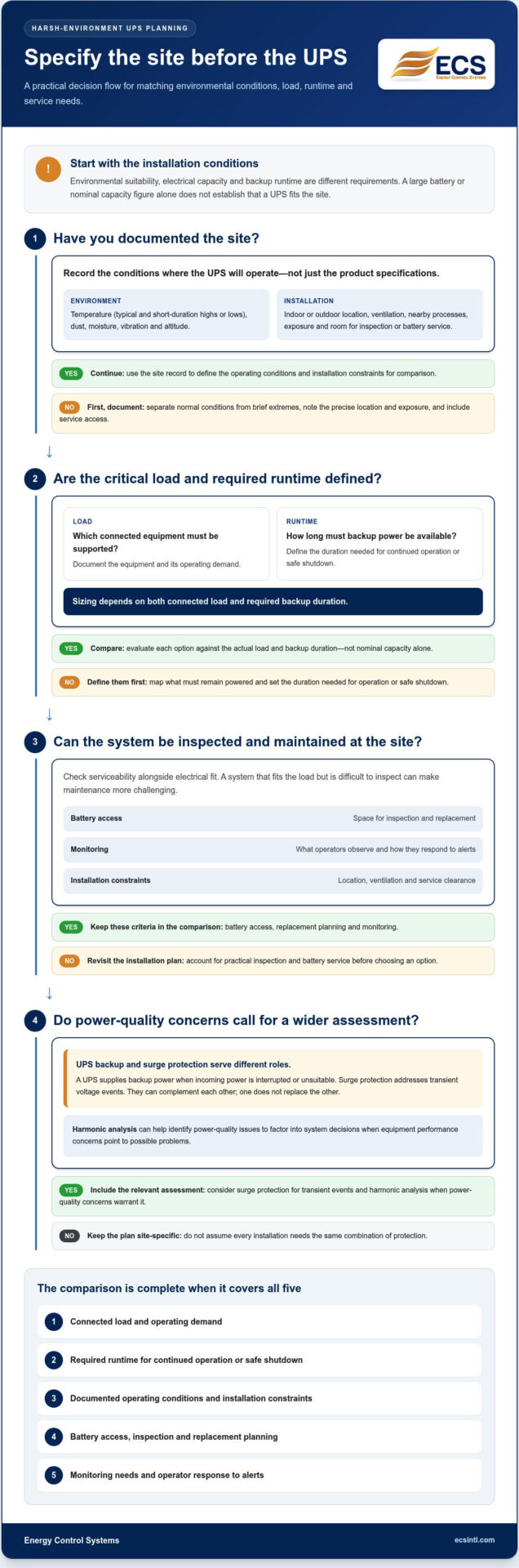
Plan the next step: align UPS protection with the wider power-quality strategy
Turn your site observations into practical requirements with a straightforward sequence:
- Document site conditions and installation constraints.
- Map critical loads and identify what must remain powered.
- Define the backup runtime needed for continued operation or safe shutdown.
- Compare UPS requirements against the load, runtime, environment, and maintenance plan.
This approach helps you evaluate the whole application instead of focusing on a single capacity figure. It also gives you a clearer basis for considering other power-quality concerns. IEEE 1159 describes recommended practices for monitoring power quality, which can provide useful context when shaping a wider power-quality strategy.
When should a UPS assessment include surge protection or harmonic analysis?
A UPS supports continuity by supplying backup power when incoming power is interrupted or unsuitable. Surge protection serves a different role by addressing transient voltage events. The two measures can complement each other, but one does not replace the other. Read the industrial UPS uptime guide and the SineTamer LA Series guide for more context on these parts of power protection.
If equipment performance concerns point to possible power-quality issues, harmonic analysis can help identify conditions to factor into system decisions. Using those findings helps keep your plan grounded in the site’s needs instead of assuming every installation requires the same combination of protection.
Energy Control Systems provides UPS systems, SineTamer surge protection, and professional harmonic analysis. Explore the company’s UPS solutions and power-quality resources to plan protection around your site conditions, loads, and service requirements.
Build a power plan you can rely on
Choosing a UPS for a demanding site starts with evidence, not guesswork. Document environmental conditions, identify critical loads, and set the runtime your operation needs before comparing systems. That sequence makes selecting a ups for a harsh environment more practical and keeps installation and maintenance realities in view.
Then consider how backup power fits alongside other power-quality measures. A UPS supports continuity during power interruptions, while surge protection addresses transient events. Harmonic analysis can help identify power-quality conditions that also deserve attention.
Energy Control Systems specializes in power-quality management, providing UPS systems, SineTamer surge protection, and professional harmonic analysis. Bring your site requirements into the next planning step. Explore ECS power-quality solutions to plan protection for your critical operations.
Frequently Asked Questions
What makes an environment harsh for a UPS?
A UPS faces a harsh environment when site conditions challenge its operating limits or service needs. Heat or cold, dust, moisture, vibration, altitude, outdoor exposure, poor ventilation, and restricted maintenance access can all matter. Selecting a ups for a harsh environment means documenting routine conditions and short-term extremes, then matching the requirements to the application.
How do I size a UPS for industrial equipment?
Identify the equipment that needs backup and determine its electrical load during operation. Then define how long the UPS must support that load, whether for continued operation or a controlled shutdown. Compare those requirements with system capacity and expected runtime under the application conditions. Do not rely on a headline capacity figure alone. The connected load and required backup duration guide sizing.
Can a UPS operate in high temperatures, dust, or moisture?
It can if the specific UPS and its installation are suited to the site conditions. Do not assume a standard unit can tolerate high temperatures, dust, or moisture. Compare its stated operating conditions and applicable enclosure information with routine exposure and short-term extremes. Placement, ventilation, and service access matter too. Environmental suitability depends on the complete application, not a general label.
Does a UPS protect equipment from surges and harmonic distortion?
A UPS provides backup power, but do not assume it replaces dedicated surge protection or resolves every harmonic distortion issue. Surge protection addresses transient voltage events, while harmonic analysis can help identify power-quality conditions that may affect equipment performance. These are distinct considerations in a protection plan. Energy Control Systems provides UPS systems, SineTamer surge protection, and professional harmonic analysis for power-quality needs.

Article by
Jeff Edwards
Founder of ECS International Inc. Edwards travels and speaks extensively in Latin America, Asia and Africa on the subject of power quality; transients and mitigating their impact on profitability. After graduating from Texas Tech University in Lubbock Texas, Edwards spent 9 years in the Telecommunications sector prior to founding Energy Control Systems in 1987 as a Texas based corporation selling surge suppression and UPS systems. The company has evolved into a global power quality products and energy efficiency concern with operations spanning South America, Asia, Europe and Africa.
Disclaimer
Some of the above information may be the opinion of the author.