

What if the strongest case for surge protection starts with losses you can document, not savings someone promises? For facility teams, the challenge isn’t recognizing that downtime and equipment failures are costly. It’s determining whether electrical disturbances contributed and what those events mean for an investment. A credible industrial surge protection ROI estimate should reflect your equipment, repair history, production impact, and the limits of what you can confidently attribute.
You don’t need inflated claims to build a useful business case. This article shows how to use downtime, repair, and operational data to compare a protection investment with plausible avoided losses, document assumptions, and identify missing evidence. You’ll also see how professional harmonic analysis can help investigate site power-quality conditions before you estimate potential benefits. The goal is a clearer decision, not a promised payback.
Key Takeaways
- Build a facility-specific baseline from incident logs, downtime records, repair reports, and affected production processes.
- Estimate industrial surge protection ROI with a clear analysis period, documented inputs, and assumptions that account for uncertainty.
- Compare potential avoided losses with the investment, then test how different scenarios change the result.
- Validate power-quality conditions and system requirements before choosing protection or forecasting financial outcomes.
Why industrial surge protection ROI starts with your facility’s actual losses
A credible industrial surge protection ROI case begins with what your facility can document, not a generic savings estimate. Compare the proposed investment with potential benefits, adjusted for uncertainty and the likelihood that protection could address the recorded risk. Start with incident logs, downtime records, repair reports, and the production processes affected. For each event, record when it happened, which equipment was involved, what was damaged, how long operations were disrupted, and what evidence points to the cause.
That last detail matters. A failed control, drive, or other electronic component doesn’t prove a surge caused the failure. Mechanical wear, heat, maintenance issues, and other electrical conditions may also be involved. Review maintenance history and available power-quality data before assigning losses to electrical disturbances. Professional harmonic analysis can help investigate site power-quality conditions, but its findings should be interpreted in context, not treated as automatic proof of a surge event. For a basic overview of the Surge Protection Device (SPD), see this reference.
Which operational costs belong in an industrial surge protection assessment?
Separate direct costs, such as documented repair or replacement expenses, from operational consequences, such as lost production time, restart work, or delayed orders. In equipment-heavy fields such as conventional energy development, where operators like Decimus Oil Corp. manage continuous production, downtime can quickly compound across interrelated systems. Use invoices, work orders, downtime logs, and production records where available. Include only amounts supported by facility records. If you estimate a cost, label it clearly, explain the assumption, and avoid counting the same impact twice. For example, don’t add a downtime cost to a lost-production estimate if both represent the same interruption.
Site-specific surge protection ROI compares the documented cost of protection with estimated, risk-adjusted benefits based on a facility’s evidence and stated assumptions.
This definition keeps the case transparent. It also makes clear that the estimate is not a promise of savings. A well-documented baseline gives your team a firmer starting point for deciding whether further technical assessment is warranted.
How to calculate industrial surge protection ROI with defensible assumptions
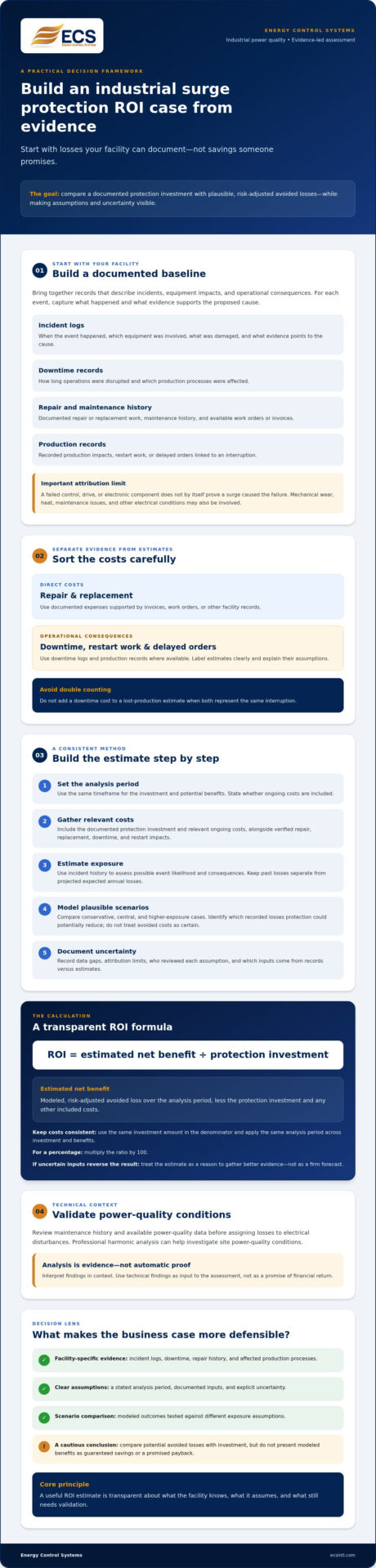
Use a consistent method so finance, maintenance, and operations can see how the estimate was built. Set an analysis period, include costs that fall within it, estimate exposure, and model plausible outcomes. Keep observed losses separate from assumptions about future events, and record where the evidence ends.
- Set the period: Choose a timeframe and apply it consistently to both the investment and potential benefits. State whether the estimate includes ongoing costs.
- Gather costs: Include the documented protection investment and relevant ongoing costs, alongside verified repair, replacement, downtime, and restart impacts.
- Estimate exposure: Use incident history to assess possible event likelihood and consequences. Keep observed past losses separate from expected annual loss estimates, and explain how you derived any projection.
- Model scenarios: Compare conservative, central, and higher-exposure cases. State which recorded losses protection could potentially reduce. Don’t treat avoided costs as certain.
- Document uncertainty: Record data gaps, attribution limits, and who reviewed each assumption. Note which inputs come from records and which are estimates.
A simple illustrative formula is ROI = estimated net benefit ÷ protection investment. Estimated net benefit is the modeled, risk-adjusted avoided loss over the analysis period, less the protection investment and any other included costs. Use the same investment amount in the denominator. If you express the result as a percentage, multiply the ratio by 100. Keep the analysis period and cost categories consistent. If small changes to uncertain inputs reverse the result, treat the estimate as a reason to gather better evidence, not as a firm forecast.
What data should finance and maintenance teams gather first?
Bring together event records, equipment repair histories, downtime duration, and documented production impacts. For each event, note the affected equipment and process, repair or replacement work, and the basis for linking the failure to an electrical disturbance. Ask maintenance, operations, and finance to review the inputs before sharing a result. Industrial surge protection ROI depends on the likelihood of relevant incidents, their operational consequences, and the protection investment.
If electrical conditions need closer investigation, ECS harmonic analysis may be a useful technical resource. Treat its findings as input to the assessment, not as a promise of financial return.
Turn the ROI estimate into a practical industrial surge protection decision
An ROI estimate is a decision aid, not a specification. Before forecasting financial outcomes or choosing equipment, validate the electrical conditions behind the assumed risk. Check whether event evidence supports the suspected cause, identify which systems and processes are exposed, and confirm relevant system requirements with qualified technical reviewers. If the evidence is incomplete, keep that uncertainty visible rather than treating a modeled benefit as a guaranteed saving.
Protection should follow the risks identified at your facility. The industrial SineTamer LA Series guide can help you explore that product series, while the surge protective device guide provides broader background. Energy Control Systems offers SineTamer LA, RM, and ST-PCMF series, as well as UPS systems. Any product selection still needs to be checked against site conditions and system requirements. A guide can inform the discussion, but it can’t replace a technical review of your installation.
When should a facility request power-quality analysis?
Consider further assessment when disturbances recur, equipment problems remain unexplained, or incident records are too weak to support a reliable estimate. Professional harmonic analysis is one available way to investigate power-quality conditions. Confirm its proposed scope and deliverables before relying on findings in a financial model. Analysis can inform the decision, but it doesn’t guarantee that a particular failure was caused by a surge or that protection will deliver a specific return.
With clearer evidence, your team can revisit the assumptions, refine the risk estimate, and make a more informed protection decision. If you’re exploring next steps, explore ECS power-quality solutions as a technical resource for your assessment.
Make your next protection decision with confidence
A defensible industrial surge protection ROI estimate starts with your facility’s records, not a generic savings promise. Separate documented losses from estimates, make uncertainty visible, and validate whether electrical conditions support the risks in your model. Then use that evidence, along with system requirements and qualified technical review, to guide protection decisions.
You don’t need perfect data to take a practical next step. You do need clear assumptions and a willingness to test them. Energy Control Systems focuses on power quality, offering SineTamer surge protection, uninterruptible power supplies, and harmonic analysis.
As you assess your facility’s needs, explore ECS power-quality solutions and discuss the technical considerations relevant to your site.
Frequently Asked Questions
How do you calculate industrial surge protection ROI?
Calculate industrial surge protection ROI by comparing modeled, risk-adjusted benefits with the protection investment over a defined period. One illustrative formula is estimated net benefit divided by investment. Estimate net benefit by subtracting the investment and included ongoing costs from potential avoided losses. Base assumptions on facility records, distinguish historical losses from projected exposure, and show uncertainty rather than treating potential savings as guaranteed.
Is industrial surge protection worth the investment?
It may be worthwhile if documented site risks and potential consequences justify the investment, but there’s no universal answer or guaranteed payback. Review equipment exposure, incident history, repair and downtime impacts, and the evidence linking failures to electrical disturbances. Then validate assumptions and system requirements with qualified technical review. A transparent estimate helps your team decide whether protection merits further evaluation.
What costs should an industrial surge protection ROI analysis include?
Include the protection investment and relevant ongoing costs, then compare them with documented losses the protection may help address. Those losses can include equipment repair or replacement, downtime, restart work, and supported production impacts. Use maintenance and finance records where available. Label estimates clearly, explain assumptions, and avoid counting the same consequence twice, such as overlapping lost production and downtime costs.
Can surge protection prevent all industrial downtime?
No. Surge protection is intended to address surge-related electrical risks, not every cause of an outage or equipment failure. Mechanical faults, maintenance issues, process interruptions, and other electrical problems can still cause downtime. That’s why event attribution matters: review incident records and electrical conditions before estimating potential benefits. A technical assessment can help clarify risks, but it can’t guarantee uninterrupted operations.

Article by
Jeff Edwards
Founder of ECS International Inc. Edwards travels and speaks extensively in Latin America, Asia and Africa on the subject of power quality; transients and mitigating their impact on profitability. After graduating from Texas Tech University in Lubbock Texas, Edwards spent 9 years in the Telecommunications sector prior to founding Energy Control Systems in 1987 as a Texas based corporation selling surge suppression and UPS systems. The company has evolved into a global power quality products and energy efficiency concern with operations spanning South America, Asia, Europe and Africa.
Disclaimer
Some of the above information may be the opinion of the author.