

The most rugged surge protective device in the world will fail if your connection has just six inches of excess lead wire. When high-energy transients strike, you don’t just face fried components; you face devastating downtime that threatens your entire operation. That is why learning how to install a type 1 surge protector correctly is about far more than tightening lugs. It is about safeguarding your facility’s heartbeat and reclaiming your operational peace of mind.
You already know the anxiety of balancing line-side NEC regulations against the physics of lead-length impedance. You deserve total confidence that your critical assets are truly protected. This industrial guide delivers the precise steps for code-compliant mounting, lead trimming, and line-side termination to slash let-through voltage. Let’s walk through the exact engineering practices your licensed electrician needs to lock down your electrical foundation.
Key Takeaways
- Understand NEC Article 242 and UL 1449 mandates to ensure your service entrance setup meets strict line-side compliance before work begins.
- Discover how to install a type 1 surge protector with ultra-short conductor leads to minimize impedance and prevent excessive let-through voltage.
- Equip your licensed electrical contractor with the precise enclosure mounting and phase termination protocols needed to safeguard downstream industrial controls.
- Establish baseline diagnostic records and phase voltage benchmarks during commissioning to secure long-term operational uptime and mental tranquility.
Pre-Installation Requirements and NEC Guidelines for Type 1 SPDs
Under NEC Article 242 and UL 1449 standards, an industrial Surge Protection Device (SPD) rated Type 1 is engineered for placement between the secondary transformer and the service entrance overcurrent disconnect. Knowing how to install a type 1 surge protector begins with an absolute safety boundary: you cannot compromise on human life. Never attempt live taps. NFPA 70E safety protocols demand complete de-energization, verified zero-energy states, and arc-rated PPE before opening enclosures. While Energy Control Systems engineers rugged solutions like the SineTamer LA Series to eliminate destructive spikes, qualified, licensed electrical personnel must execute the physical work.
Line-Side vs. Load-Side Mounting Configurations
A major point of industry confusion in how to install a type 1 surge protector centers on line-side versus load-side placement. Type 1 units offer the distinct advantage of mounting upstream of your main service overcurrent disconnect. This positioning intercepts violent utility-grid surges before they touch distribution breakers. However, upstream rating does not grant permission to tap inside sealed utility meter enclosures. Most utilities strictly prohibit third-party equipment inside their metering sections. Instead, your electrician should land leads inside a dedicated service panelboard or rated auxiliary gutter. Always coordinate with your utility provider to schedule an upstream service interruption before installation. It eliminates lethal arc-flash hazards, satisfies local code inspectors, and provides the baseline security your facility needs to maintain steady uptime.
Step-by-Step Installation: Wiring and Mounting Your Type 1 SPD
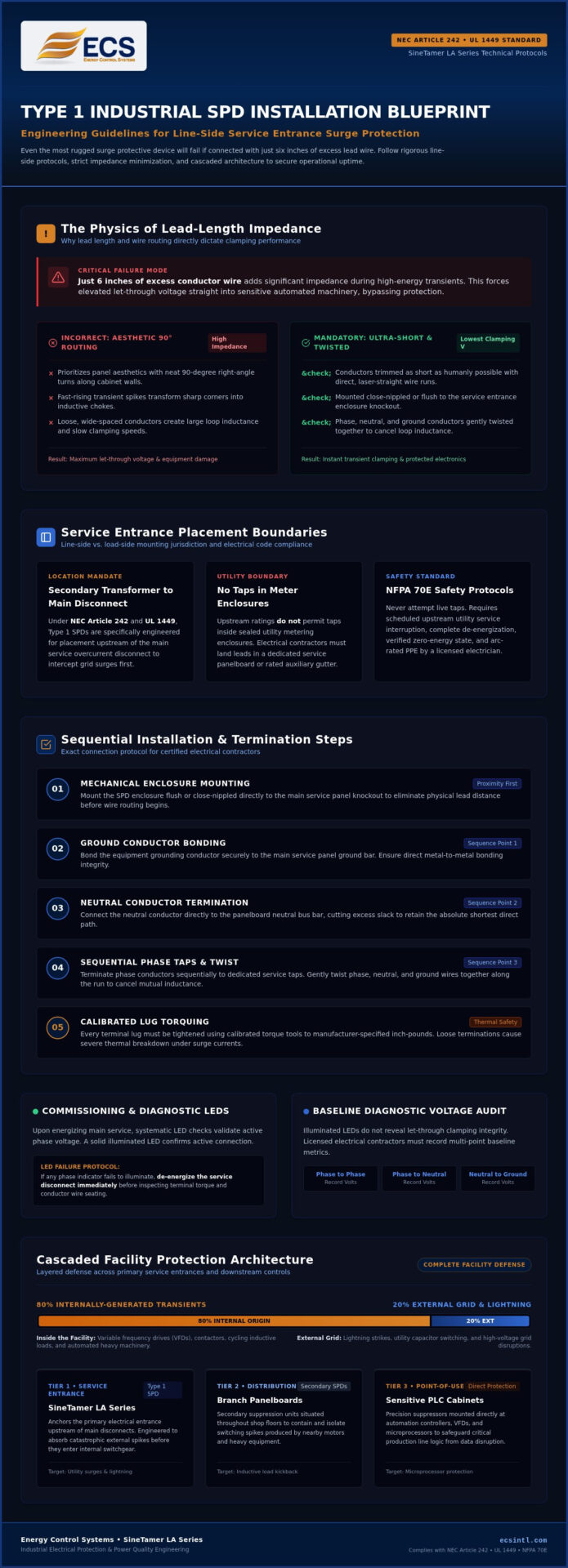
Physical proximity dictates electrical survival. Understanding how to install a type 1 surge protector correctly means mastering impedance from the start. Mount the SPD enclosure directly flush or close-nippled to the main service panel knockout. Ensure your licensed electrical contractor follows these essential connection sequences:
- Bond the equipment grounding conductor securely to the panel ground bar.
- Connect the neutral conductor directly to the neutral bus.
- Terminate phase conductors sequentially to the dedicated service taps.
Every terminal lug must be tightened using calibrated torque tools to meet manufacturer specifications. Loose terminations invite severe thermal breakdown when destructive transients hit.
Minimizing Lead Length for Optimal Clamping Performance
Neatness often sabotages surge suppression. Standard electrical habits favor clean 90-degree wire bends along cabinet walls, but fast-rising spikes turn sharp corners into inductive chokes. Don’t prioritize panel aesthetics over clamping performance. Every extra inch of conductor adds significant impedance, forcing elevated let-through voltage directly into your automated machinery.
Instruct your technician to cut conductors as short as humanly possible, keeping runs laser-straight. Gently twist phase, neutral, and ground leads together before landing them on lugs. This cancels out loop inductance and ensures the device clamps transients instantly. For mission-critical infrastructure, consulting with the power engineering team at Energy Control Systems gives your team the certainty needed to safeguard long-term production.
Commissioning, Testing, and Layered Facility Protection Strategies
Once your electrician energizes the main service, commissioning validates your installation. A solid diagnostic LED confirms active phase voltage, but illuminated lights alone don’t reveal let-through clamping integrity. Check every indicator display systematically. If a phase indicator fails to illuminate, de-energize the service disconnect immediately before inspecting terminal torque and wire seating. Your licensed electrical contractor should measure and record baseline voltages across all phases, neutral, and ground to create a dependable benchmark for future preventative maintenance audits. For facilities seeking qualified professionals to manage complex panel setups, explore Electrical Contracting Services to ensure safe, code-compliant execution.
Integrating SineTamer LA Series into Cascaded Protection Architecture
A rugged service-entrance barrier is only your first line of defense. Understanding how to install a type 1 surge protector shields your facility against lightning strikes and utility capacitor switching. Still, roughly 80% of transient disturbances generate inside your building from variable frequency drives, contactors, and cycling inductive equipment.
Complete uptime demands a cascaded defense. Anchor your service entrance with the SineTamer LA Series to absorb catastrophic external surges. Then, apply downstream what is a surge protective device concepts by placing secondary suppressors at branch panelboards and sensitive PLC cabinets. Executing how to install a type 1 surge protector within a tiered strategy locks down automation reliability, stops production halts, and delivers true operational peace of mind.
Take Command of Your Facility’s Electrical Resilience
Mastering how to install a type 1 surge protector transforms vulnerable infrastructure into an impenetrable operational fortress. By enforcing line-side NEC compliance, slashing conductor lead lengths to eliminate impedance, and recording initial diagnostic baselines, you stop catastrophic electrical noise before it reaches delicate automated controls. You protect your machinery, your production targets, and your daily peace of mind.
True operational tranquility requires the right engineering ally in your corner. Backed by over 35 years engineering industrial power quality systems worldwide, our dedicated technical support teams assist global industrial infrastructure projects with proprietary frequency attenuation network technology built into SineTamer devices. While your licensed electrician handles physical panel connections, consult with Energy Control Systems to engineer custom transient suppression for your facility. Step onto your production floor tomorrow with total confidence in your power foundation.
Frequently Asked Questions
Does a Type 1 SPD require a dedicated circuit breaker?
No, a Type 1 SPD does not require a dedicated circuit breaker or external fused disconnect. Under UL 1449 and NEC standards, Type 1 devices incorporate internal overcurrent protection, permitting direct connection to service entrance conductors. However, your licensed electrical contractor may install an external disconnect switch if facility safety standards demand an isolated lockout point during routine maintenance.
Can I install a Type 1 surge protector on the load side?
Yes, you can install a Type 1 SPD on the load side of your main service disconnect. Type 1 devices are rated to operate anywhere between the utility transformer secondary and subpanels. When evaluating how to install a type 1 surge protector downstream, having your electrician connect to an adjacent branch breaker provides convenient servicing while maintaining robust transient suppression.
What wire gauge is required for Type 1 SPD installation?
Most Type 1 SPDs require conductor wiring between #10 AWG and #6 AWG copper. Always verify the manufacturer’s installation manual and NEC minimum grounding requirements before pulling wire. Using heavier stranded copper minimizes conductor resistance, but keeping the run as short and straight as possible matters far more than oversizing the gauge for high-frequency transient attenuation.
How much does lead wire length affect surge protector performance?
Conductor lead length degrades clamping performance by adding roughly 150 to 200 volts of let-through surge voltage per foot of wire. When mastering how to install a type 1 surge protector, high-frequency impedance is your biggest enemy. Long, looping conductors force destructive transient spikes past the suppressor and straight into sensitive automated electronics before clamping can occur.

Article by
Jeff Edwards
Founder of ECS International Inc. Edwards travels and speaks extensively in Latin America, Asia and Africa on the subject of power quality; transients and mitigating their impact on profitability. After graduating from Texas Tech University in Lubbock Texas, Edwards spent 9 years in the Telecommunications sector prior to founding Energy Control Systems in 1987 as a Texas based corporation selling surge suppression and UPS systems. The company has evolved into a global power quality products and energy efficiency concern with operations spanning South America, Asia, Europe and Africa.
Disclaimer
Some of the above information may be the opinion of the author.