

The biggest misconception in industrial surge protection is assuming a Type 1 device is simply a stronger version of a Type 2. In reality, evaluating a type 1 vs type 2 spd isn’t about raw suppression capacity; it’s about where the hardware physically and safely connects to defend your infrastructure. When automated machinery locks up and sensitive PLCs trip mid-cycle, the operational stress is immediate. You shouldn’t have to wrestle with dense regulatory codes just to keep your production line running reliably.
We’re here to bring clarity and control back to your facility. You’ll master the functional differences between Type 1 and Type 2 units, clarify line-side versus load-side installation rules, and discover how to stop chronic transient damage for good. Here is how to configure a cascaded defense across your switchgear and subpanels to protect your equipment and your peace of mind.
Key Takeaways
- Understanding the physical placement rules of a type 1 vs type 2 spd ensures you deploy line-side and load-side suppression correctly to remain code-compliant.
- High surge current ratings only tell half the story; focusing on Voltage Protection Rating (VPR) is what actually shields sensitive PLCs and drives from chronic ring-wave damage.
- A cascaded defense combines robust service-entrance protection with precision downstream filtering to stop both utility spikes and internal switching transients.
- Specifying the right engineered suppression restores stability to your electrical infrastructure, ending mysterious automation faults and costly production interruptions.
Decoding Type 1 vs Type 2 SPD Standards and Locations
Unplanned plant downtime burns thousands of dollars every minute, but the real cost is the unrelenting stress on maintenance teams scrambling to revive frozen production lines. Clearing up the confusion surrounding a type 1 vs type 2 spd gives your team the control it deserves. Under ANSI/UL 1449, an SPD’s physical installation location dictates its internal safety design, short-circuit ratings, and testing protocols.
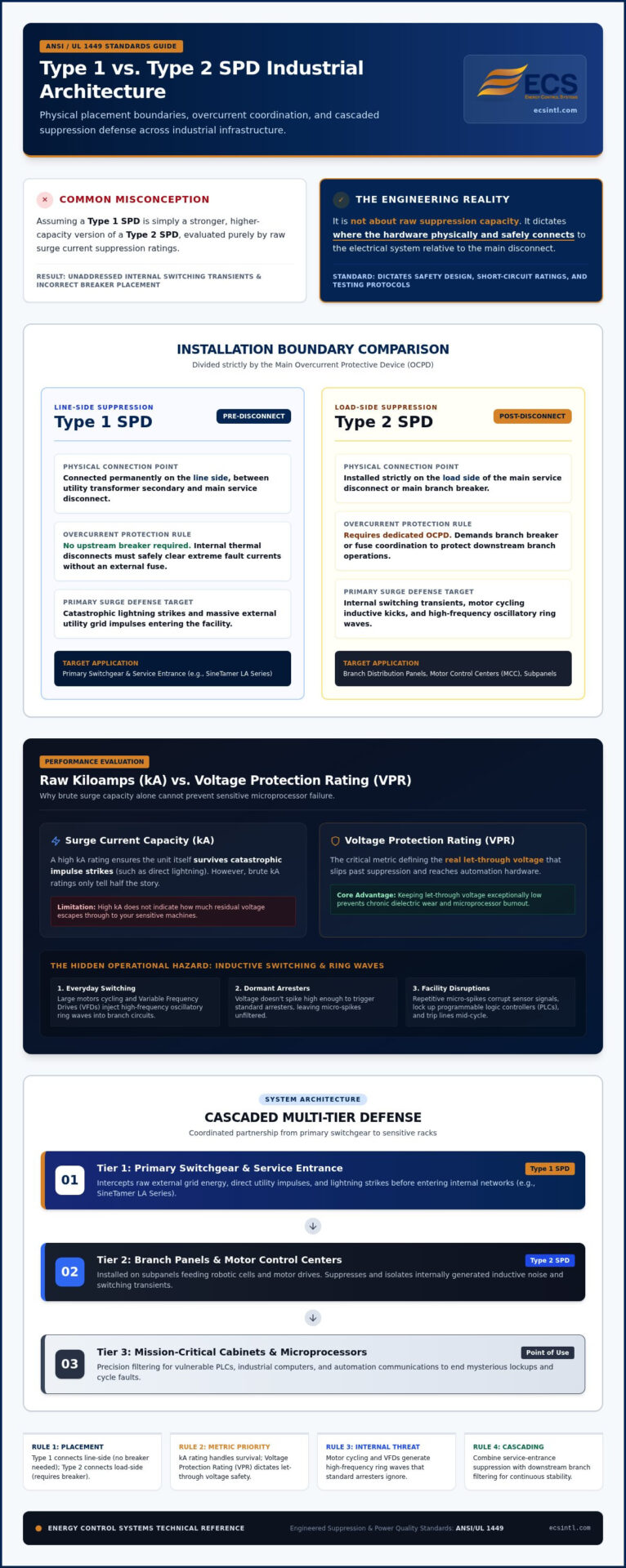
Type 1 devices handle direct, brutal lightning strikes and massive utility grid impulses entering before the main service disconnect. They form the initial shield against catastrophic external events, stopping destructive transients before they breach your primary switchgear.
Installation Boundaries: Service Entrances Versus Distribution Panels
The dividing line between these two devices comes down to the main overcurrent protective device (OCPD). Knowing where each belongs protects both your hardware and your operational peace of mind:
- Type 1 SPDs: Connect permanently on the line side, sitting between the utility transformer secondary and the main service disconnect. Because there is no upstream breaker to protect them, Type 1 units undergo rigorous UL testing to ensure their internal thermal disconnects clear extreme fault currents safely without an external fuse.
- Type 2 SPDs: Install strictly on the load side of the main disconnect, typically protecting branch panels, motor control centers, and critical subpanels. They require dedicated branch breaker or fuse coordination to safeguard downstream operations.
Placing each unit correctly ends the cycle of unexplained machinery failures and keeps your facility running smoothly.
Comparing Performance: Clamping Voltage and Internal Transient Defense
Massive kiloamp (kA) ratings look reassuring on a specification sheet, but brute surge capacity alone won’t stop silent equipment failure. While a high kA rating ensures a unit survives direct lightning impulses, the critical metric is the Voltage Protection Rating (VPR). VPR defines the real let-through voltage that slips past the suppressor and strikes your sensitive machinery. Keeping let-through voltage exceptionally low prevents the gradual dielectric wear that quietly destroys microprocessors from the inside out.
The Vulnerability of Variable Frequency Drives and Microprocessor Controls
Everyday industrial operations produce a persistent internal threat: inductive switching transients. Each time large motors cycle or variable frequency drives switch, they inject high-frequency oscillatory ring waves back into branch circuits. Standard arresters stay completely dormant during these micro-spikes because the voltage doesn’t spike high enough to activate standard thresholds. Still, those repetitive oscillations corrupt sensor signals, freeze programmable logic controllers, and trigger sudden production halts.
Evaluating a type 1 vs type 2 spd requires looking beyond raw clamping voltage; you need suppression engineered with real-time frequency attenuation to filter high-frequency ringing dynamically. If chronic automation lockups keep disrupting your production schedule, exploring advanced transient filtering at ecsintl.com can permanently restore control and reliability across your facility floor.
Building a Cascaded Defense with Industrial SineTamer Solutions
Treating industrial protection as a choice between one unit or another leaves critical gaps in your facility. Frame the type 1 vs type 2 spd debate not as an either-or decision, but as a coordinated partnership. A true cascaded architecture layers heavy service-entrance suppression with precision distribution protection. Deploying the SineTamer LA Series at your main electrical panels intercepts raw external grid energy before it penetrates internal plant networks. This engineered barrier protects sensitive hardware and eliminates the dreaded late-night emergency callouts that drain your team.
Layering Protection from Service Entrance Down to Mission-Critical Racks
True operational resilience requires systematic coverage across every tier of your electrical distribution:
- Primary Switchgear: Position heavy-duty Type 1 suppressors directly at the utility entrance to absorb catastrophic lightning currents and grid-switching spikes.
- Branch Distribution: Install a Type 2 surge protective device on subpanels feeding robotic cells, motor drives, and production lines to isolate internally generated noise.
- Mission-Critical Cabinets: Shield vulnerable PLCs, industrial computers, and communications using the SineTamer RM Series to guarantee clean power right at the point of use.
This multi-tiered defense turns vulnerable automation into a rock-solid operational asset, giving you total confidence in your plant’s daily performance.
Reclaim Operational Reliability Across Your Facility
Mastering the role of a type 1 vs type 2 spd isn’t just about passing electrical inspections; it’s about ending the chronic stress of sudden production halts. When you combine rugged line-side service entrance protection with precision load-side filtering, you eliminate the disruptive micro-spikes that quietly degrade automation systems. You take back control over your maintenance calendar instead of losing weekends to mystery equipment faults.
Since 1987, Energy Control Systems has delivered engineered surge solutions across mission-critical industrial facilities worldwide. SineTamer’s proprietary frequency attenuation network suppresses destructive high-speed ring waves that ordinary threshold devices miss entirely. Take the definitive step toward permanent plant stability today: Request an industrial power quality assessment from Energy Control Systems and secure the lasting peace of mind your team deserves.
Frequently Asked Questions
Can a Type 1 SPD replace a Type 2 SPD in an electrical panel?
Yes, a Type 1 SPD can safely replace a Type 2 SPD in an electrical panel. UL 1449 dual-rates Type 1 devices for both line-side and load-side locations because of their robust internal safety disconnects. However, replacing hardware downstream won’t solve automation lockups on its own unless the unit features active frequency attenuation to filter out internal motor switching noise.
What is the main difference between UL 1449 Type 1 and Type 2 devices?
The primary distinction in the type 1 vs type 2 spd evaluation is physical location relative to the main service disconnect. Type 1 devices connect on the line side before the main breaker, safely managing direct lightning strikes without external overcurrent protection. Type 2 devices mount on the load side of the main disconnect, shielding branch panels and downstream machinery.
Why do facilities require both Type 1 and Type 2 surge suppressors?
Industrial facilities require both to eliminate two completely different threats. Type 1 suppressors divert massive, external lightning impulses and utility grid surges right at your switchgear. Downstream Type 2 devices capture the daily internal switching transients generated by drives and contactors. Deploying both stops equipment damage at the perimeter while keeping your sensitive automated production lines stable and online.
Do Type 2 SPDs require a dedicated circuit breaker for installation?
Yes, standard Type 2 SPDs require connection through a dedicated circuit breaker or fused disconnect. This upstream overcurrent device provides short-circuit coordination and lets maintenance technicians service the suppressor without de-energizing the entire panel. For maximum protection, keep breaker lead lengths as short and straight as possible to avoid adding inductive let-through voltage to your sensitive drives.

Article by
Jeff Edwards
Founder of ECS International Inc. Edwards travels and speaks extensively in Latin America, Asia and Africa on the subject of power quality; transients and mitigating their impact on profitability. After graduating from Texas Tech University in Lubbock Texas, Edwards spent 9 years in the Telecommunications sector prior to founding Energy Control Systems in 1987 as a Texas based corporation selling surge suppression and UPS systems. The company has evolved into a global power quality products and energy efficiency concern with operations spanning South America, Asia, Europe and Africa.
Disclaimer
Some of the above information may be the opinion of the author.