

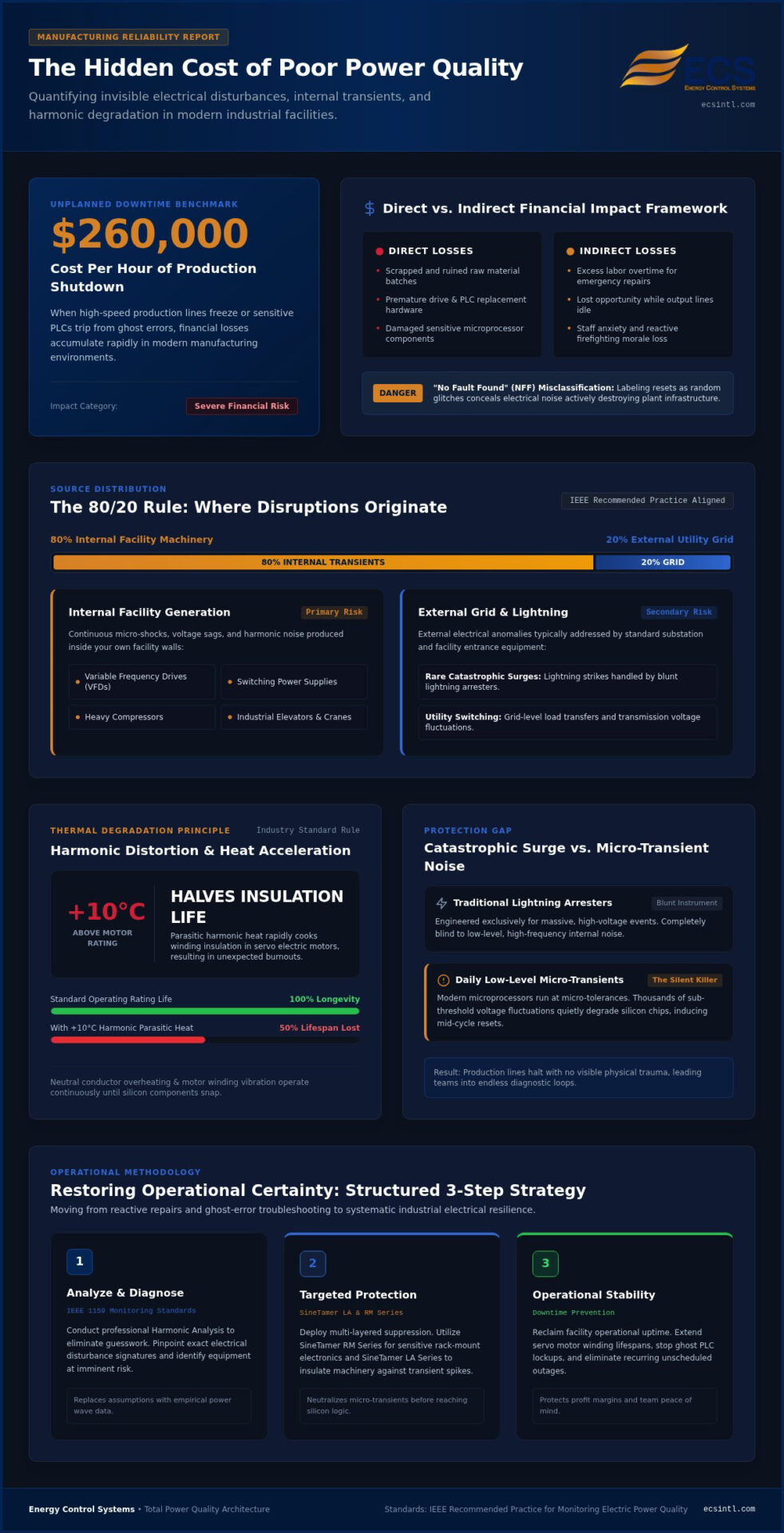
Did you know that the average unplanned production shutdown now costs a staggering $260,000 per hour? This hidden cost of poor power quality in manufacturing is a gut-wrenching reality for modern facilities. You’ve likely felt the sting of a high-speed line freezing due to a “ghost error” or a sensitive PLC tripping for no apparent reason. It’s exhausting to replace expensive components only to have them fail again weeks later. We know your reputation and your team’s peace of mind are on the line whenever power fluctuates.
You deserve stability, not electrical chaos. This article reveals how invisible disturbances like voltage sags and internal harmonics erode your profit margins. We’ll show you how to move from reactive repairs to total operational certainty. Discover the diagnostic steps and protection strategies needed to ensure your facility remains a reliable powerhouse, protecting your equipment and your professional success.
Key Takeaways
- Stop dismissing “no fault found” errors as random glitches. Learn how these invisible events inflate the cost of poor power quality in manufacturing by hiding the true pace of equipment degradation.
- Look inside your own walls for the primary source of instability. Discover why 80% of electrical disturbances are generated by your own heavy machinery rather than the external utility grid.
- Distinguish between rare lightning strikes and the constant, low-level transients that quietly erode sensitive electronics. Protecting against these daily micro-shocks is essential for extending your equipment’s lifespan.
- Move from reactive repairs to proactive stability. Implement a structured strategy using Harmonic Analysis and SineTamer LA Series protection to reclaim your facility’s operational uptime and peace of mind.
The Invisible Drain: Quantifying the Financial Impact of Poor Power Quality
Direct vs. Indirect Costs of Electrical Disturbances
Calculating the impact requires a clear framework. Direct costs include scrapped product batches and damaged components. Indirect costs are more insidious. Think about the labor overtime required for emergency repairs or the lost opportunity when a line sits idle. Harmonics are a major culprit here. They create parasitic heat that cooks the winding insulation in servo electric motors. According to industry rules of thumb, a 10°C rise above motor rating can halve insulation life. For sensitive electronics, the SineTamer RM Series offers a specialized shield for rack-mount environments, preventing these failures before they start.
Beyond the spreadsheets, there’s a heavy psychological toll. Your maintenance team shouldn’t live in a state of constant anxiety, chasing “ghost errors” that vanish upon inspection. This cycle of reactive firefighting drains morale and kills productivity. Poor power quality in 2026 is no longer a maintenance nuisance; it is a direct erosion of manufacturing competitiveness. We’re here to help you stop the drain and reclaim your electric power quality for long-term success.
Beyond the Surge: Identifying the Sources of Industrial Power Disturbances
You might look at the sky during a thunderstorm and worry about your facility’s safety. It’s a natural reaction. However, the most destructive forces often hide within your own four walls. This is the “80/20 Rule” of power quality. While utility grid issues matter, 80% of transients are actually generated internally by your own heavy machinery, compressors, and elevators. These internal disturbances significantly drive up the cost of poor power quality in manufacturing by causing subtle, repetitive damage that goes unnoticed until a critical failure occurs.
Lightning arresters are designed for catastrophic surges. They’re vital, but they’re blunt instruments. They often miss the low-level, high-frequency noise that plagues modern digital technology. Today’s sensitive microprocessors operate at incredibly tight tolerances. They don’t need a lightning strike to fail; a minor voltage fluctuation is enough to trigger a “ghost error” or a mid-cycle reset that ruins a production batch.
The Silent Killer: Internal Transients and Harmonic Distortion
Modern efficiency tools like Variable Frequency Drives (VFDs) and switching power supplies are double-edged swords. They save energy but introduce harmonic distortion that overheats neutral conductors and vibrates motor windings. This isn’t just a technical glitch. It’s a cumulative process. Thousands of daily micro-surges slowly degrade silicon components until they eventually snap. You’re left with expensive downtime and no clear explanation for the failure.
To protect your operations, you must move beyond guesswork. A professional harmonic analysis provides the visibility you need to see these hidden threats. By following the IEEE Recommended Practice for Monitoring Electric Power Quality, you can develop a data-driven defense. Understanding and identifying these internal sources is the only way to lower the cost of poor power quality in manufacturing and restore your facility’s operational stability.
Restoring Stability: Implementing a Comprehensive Power Quality Strategy
You don’t have to accept downtime as an inevitable part of doing business. Reclaiming your facility’s stability requires a structured, three-step path. First, you must Analyze. A professional Harmonic Analysis removes the guesswork by identifying the specific electrical signatures causing your equipment to fail. Next, you must Protect. We position the SineTamer LA Series as your primary shield. Finally, you must Secure. Integrating a high-quality uninterruptible power supply (UPS) ensures your systems bridge the gap during those brief, damaging voltage sags.
A common mistake is relying solely on service entrance protection. To truly lower the cost of poor power quality in manufacturing, you must place a surge protective device at the point of use. Protecting the main panel is good; protecting the individual machine is vital. This cascaded approach ensures that internally generated noise, which we discussed earlier, is suppressed before it reaches your most expensive components.
Protecting Automation: SCADA and PLC Safeguards
Communication errors between your SCADA system and PLCs are often power quality issues in disguise. These “ghost” interruptions occur when transients corrupt data packets. Transient Voltage Surge Suppression (TVSS) is the critical layer for sensitive electronics that filters this noise. Use this checklist to evaluate your current protection level:
- Are SPDs installed directly at the PLC cabinet?
- Is your control logic backed by a dedicated UPS?
- Have you performed a harmonic audit in the last 24 months?
Taking these steps restores your personal agency. It moves you from a state of constant anxiety to a position of professional success and recognition. You aren’t just fixing machines; you’re securing your company’s future and ensuring total operational uptime.
Reclaiming Your Operational Agency
You’ve seen how invisible transients and “ghost errors” eat away at your bottom line. By recognizing that 80% of these disturbances start inside your walls, you can finally stop guessing. Reducing the cost of poor power quality in manufacturing requires a shift from reactive repairs to proactive protection. It’s about restoring the stability your team needs to thrive every single day.
Since 1987, we’ve provided global technical support for complex industrial environments. Our SineTamer units feature Frequency Attenuation Network (FAN) technology; this specifically targets the high-frequency noise that standard devices miss. You don’t have to settle for electrical chaos. We’re here to help you secure your facility’s long-term health.
Step out of the cycle of emergency calls and into a future of total uptime. We’re ready to stand with you as your seasoned protector.
Frequently Asked Questions
How much does downtime really cost the average manufacturing plant?
Unplanned downtime currently averages $260,000 per hour across general manufacturing sectors, according to Aberdeen Research benchmarks. In high-stakes environments like automotive plants, this figure surges to $2.3 million per hour. These numbers show how the cost of poor power quality in manufacturing isn’t just a minor line item; it’s a massive financial leak that threatens your facility’s competitive edge and operational stability.
Can poor power quality cause PLC communication errors and resets?
Yes, low-level high-frequency transients frequently corrupt data packets, leading to unexplained PLC resets and communication dropouts. These “ghost errors” often result in “No Fault Found” labels because the hardware isn’t broken; it’s simply overwhelmed by electrical noise. Protecting your automation with point-of-use suppression restores your personal agency, allowing your team to focus on production rather than chasing invisible glitches that ruin your day.
Is a standard surge arrester enough to protect my industrial electronics?
No, a standard surge arrester is built for catastrophic events like lightning, but it misses the micro-surges that occur thousands of times daily. These internal transients account for 80% of disturbances. You need a dedicated solution like the SineTamer LA Series, which uses frequency attenuation to filter out the high-frequency noise that quietly degrades sensitive silicon components over time. It’s the difference between basic survival and total uptime.
What are the symptoms of harmonic distortion in a factory environment?
Symptoms include neutral conductors running hot, vibrating motors, and frequent failures of Variable Frequency Drives. You might also notice flickering lights or transformers that hum loudly. These issues indicate that non-linear loads are polluting your system. Performing a professional Harmonic Analysis is the first step to identifying these hidden signatures, ensuring you stop guessing and start protecting your equipment’s long-term health.

Article by
Jeff Edwards
Founder of ECS International Inc. Edwards travels and speaks extensively in Latin America, Asia and Africa on the subject of power quality; transients and mitigating their impact on profitability. After graduating from Texas Tech University in Lubbock Texas, Edwards spent 9 years in the Telecommunications sector prior to founding Energy Control Systems in 1987 as a Texas based corporation selling surge suppression and UPS systems. The company has evolved into a global power quality products and energy efficiency concern with operations spanning South America, Asia, Europe and Africa.
Disclaimer
Some of the above information may be the opinion of the author.