

What if the “mystery” failures in your PLCs and drives aren’t actually mysteries, but the predictable result of a main service entrance left wide open to external electrical chaos? You’ve likely felt that sinking feeling when a production line grinds to a halt without warning, leaving you to answer for the high cost of downtime. It’s frustrating to face these hurdles while navigating complex electrical ratings that feel more like a barrier than a solution. You deserve a workspace defined by stability rather than constant crisis management.
This type 1 spd selection guide for industrial facilities is designed to help you master the technical requirements to eliminate these disruptions and restore your operational stability. You’ll gain the equipment reliability and professional recognition that comes with solving chronic power quality issues once and for all. We’ll explore the critical selection criteria for 2026 and show you how the SineTamer LA Series provides the protection your facility needs to thrive.
Key Takeaways
- Identify why the high-energy 10/350µs waveform demands a specialized “first line of defense” at your main service entrance to prevent catastrophic infrastructure damage.
- Master the critical relationship between Impulse Current (Iimp) and Voltage Protection Level (Up) to ensure your hardware actually shields sensitive electronics from external surges.
- Follow this type 1 spd selection guide for industrial facilities to navigate complex 2026 safety standards and secure the professional recognition you deserve for solving power quality issues.
- Explore how the SineTamer LA Series uses advanced frequency attenuation to provide a level of operational stability that standard MOV-only devices simply cannot match.
The Role of Type 1 SPDs in Industrial Infrastructure
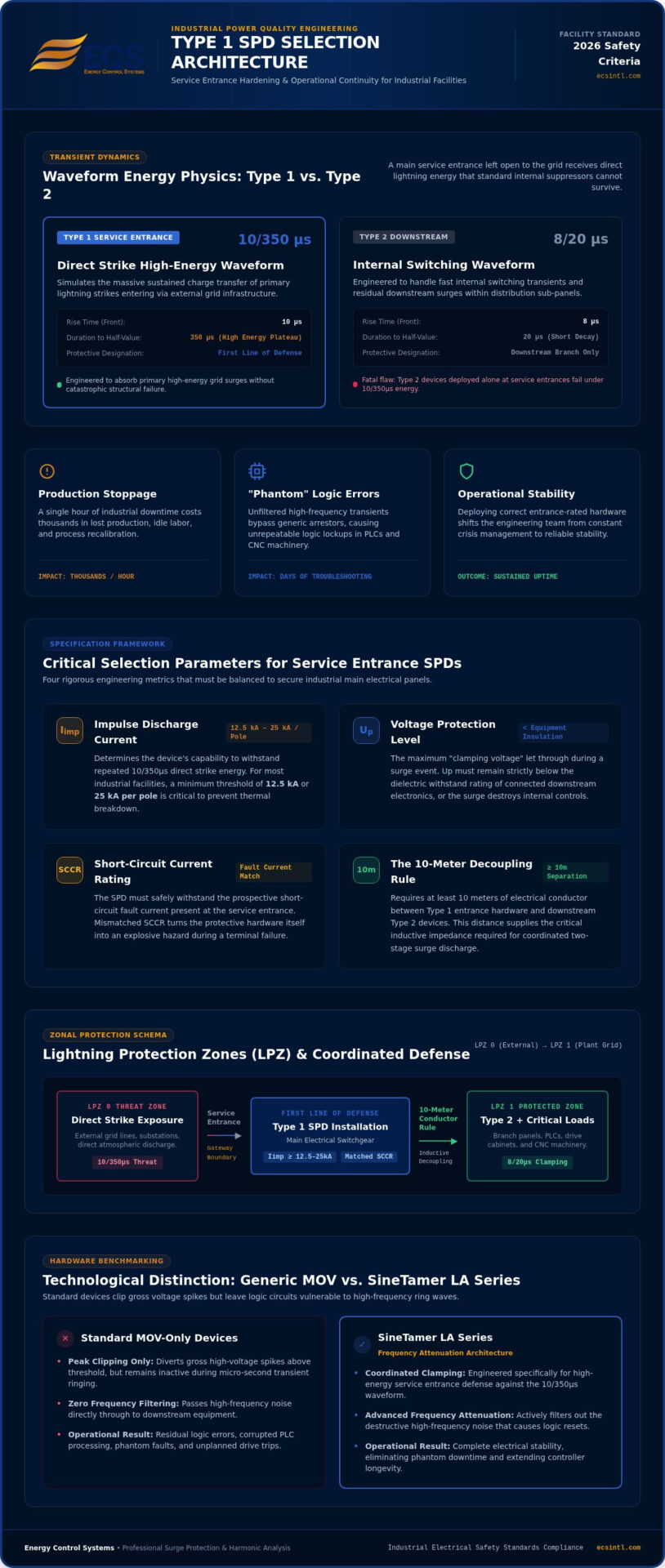
Think of your main electrical panel as the gateway to your entire operation. A Type 1 SPD serves as your facility’s first line of defense. It sits at the service entrance, standing between your sensitive machinery and the raw volatility of the external grid. This type 1 spd selection guide for industrial facilities is your roadmap to securing that boundary. Unlike Type 2 devices that handle internal switching surges, Type 1 surge protective devices are engineered for the 10/350µs waveform. This specific rating defines the massive energy of a direct lightning strike. You can’t stop the storm, but you can choose to be shielded from its consequences.
The distinction between Type 1 and Type 2 hardware is often where confusion begins. While Type 2 units manage the 8/20µs waveform of internal transients, they simply aren’t built to survive the high-energy surge of a primary strike at the entrance. Using the wrong class of protection leaves your infrastructure exposed. There is a profound psychological relief in knowing your facility is truly shielded. It’s the difference between reacting to every thunderclap with dread and walking into your plant with total confidence in your equipment’s resilience.
The Emotional and Financial Toll of Inadequate Protection
When the main entrance is vulnerable, the cost isn’t just a blown fuse; it’s the high price of silence on the factory floor. A single hour of industrial downtime can cost thousands in lost production and labor. Even worse are the “phantom errors” in PLCs and CNC machines that leave maintenance teams chasing ghosts for days. It’s exhausting to live in a state of constant technical anxiety. By selecting the right hardware, like the SineTamer LA Series, you aren’t just buying a component. You’re restoring order to a chaotic environment and earning the respect of your organization as the leader who finally solved the “unsolvable” power issues.
Technical Selection Criteria: Choosing the Right Protection
Choosing the right hardware isn’t just about checking boxes. It’s about ensuring your facility survives the unthinkable. When using a type 1 spd selection guide for industrial facilities, your first priority is Impulse Current (Iimp). For most industrial sites, a minimum of 12.5kA or 25kA per pole is critical. This rating determines if the device can actually withstand the massive energy of a direct strike without failing. You also need to match the Short-Circuit Current Rating (SCCR) to your service entrance’s available fault current. If these ratings don’t align, the protection itself can become a safety hazard during a failure.
Don’t overlook the Voltage Protection Level (Up). This “clamping voltage” must stay lower than your equipment’s insulation rating, or the surge will simply bypass the protector and fry your electronics. Achieving total reliability requires coordinated protection. A Type 1 device at the entrance must work in harmony with downstream Type 2 units to catch what remains. Following industrial electrical safety standards isn’t just about compliance; it’s about protecting your people and your peace of mind. If you’re feeling overwhelmed by these ratings, a professional harmonic analysis can provide the clarity you need to choose with confidence.
Matching SPD Ratings to Your Lightning Risk Zone
Your risk isn’t uniform across the plant. We categorize environments into Lightning Protection Zones (LPZ). Moving from LPZ 0, where equipment is exposed to direct strikes, to LPZ 1 requires hardware that can handle specific Iimp levels based on your geographic exposure. A facility on a flat plain faces different threats than one in a dense urban grid. To ensure these stages work together, the 10-meter rule requires at least 10 meters of conductor between Type 1 and Type 2 devices to provide the inductive decoupling necessary for coordinated operation.
Implementing the SineTamer LA Series for Total Uptime
You’ve identified the risks. Now, you need the tool that finally ends the cycle of equipment failure. The SineTamer LA Series is the definitive choice for service entrance protection. It doesn’t just meet industry standards; it redefines them. While generic devices rely solely on Metal Oxide Varistors (MOVs) to clip voltage peaks, SineTamer incorporates advanced frequency attenuation. This technology filters out the high-frequency noise that causes logic errors in sensitive electronics. It provides a level of stability that standard hardware can’t touch. Explore our SineTamer LA Series guide for a deep dive into these specifications.
True operational tranquility requires more than a single device. It requires a holistic view of your entire electrical system. Pairing your hardware with a professional harmonic analysis ensures that long-term stability isn’t just a goal, but a documented reality. This type 1 spd selection guide for industrial facilities is your path to moving from constant crisis management to total equipment reliability. By choosing the right hardware, you’re choosing to protect your facility and your peace of mind.
Steps to Restore Agency and Protect Your Legacy
Taking control of your power quality requires a structured approach. You don’t have to face technical complexity alone. Follow these steps to secure your infrastructure and your professional standing:
- Step 1: Conduct a thorough site risk assessment. Pinpoint every entry point where external volatility can breach your defenses.
- Step 2: Specify a SineTamer LA Series device. Match the Iimp ratings to your specific LPZ requirements to ensure maximum resilience against lightning.
- Step 3: Partner with ECS for a technical site analysis. We help ensure perfect coordination between your entrance protection and downstream devices.
By following this path, you aren’t just installing a component. You’re building a legacy of reliability and positioning yourself as the steady hand your organization needs to thrive.
Securing Your Operational Future
This type 1 spd selection guide for industrial facilities has highlighted the critical need for coordinated protection and the specific energy-handling capabilities of the SineTamer LA Series. You’ve learned how to match Iimp ratings to your risk zones and why frequency attenuation is the key to stopping phantom failures. Since 1987, we’ve provided over 35 years of industrial power quality expertise to manufacturing leaders worldwide. We don’t just sell hardware; we provide technical support that treats you as a partner in success.
It’s time to restore stability to your facility with SineTamer LA Series and claim the professional peace of mind you deserve. You have the tools to end the chaos of downtime and protect your legacy. Your facility is ready for a new standard of reliability. Let’s build that stability together.
Frequently Asked Questions
What is the main difference between a Type 1 and Type 2 SPD?
The primary difference lies in the energy waveform they are designed to manage. Type 1 devices protect against the 10/350µs waveform associated with direct lightning strikes, while Type 2 units handle the 8/20µs waveform of internal switching surges. This type 1 spd selection guide for industrial facilities emphasizes that while Type 2 protects equipment, Type 1 protects your entire infrastructure from external grid volatility.
Where should a Type 1 surge protective device be installed in a factory?
You should always install a Type 1 surge protective device at the main service entrance or the primary low-voltage switchboard. This location allows the device to intercept massive external surges before they enter your facility’s distribution network. By placing it at the boundary between the utility grid and your plant, you ensure that the high-energy “first wave” of a strike is neutralized before it reaches sensitive PLC controls.
Is a Type 1 SPD mandatory for industrial facilities under IEC standards?
While specific requirements depend on your local risk assessment and Lightning Protection Zone (LPZ), IEC 60364-4-44 often necessitates Type 1 protection for facilities with external lightning systems or overhead service lines. Beyond simple compliance, installing hardware like the SineTamer LA Series is a proactive step toward operational stability. It’s about more than following rules; it’s about securing your facility against the high cost of production downtime.
How do I know if my Type 1 SPD is still functioning correctly?
Most modern Type 1 devices feature visual status indicators, such as green LEDs, to show the protection is active. If these lights turn red or extinguish, the internal suppression components have likely reached their end-of-life after a major event. For total peace of mind, we recommend using units with remote monitoring contacts that alert your maintenance team immediately. This ensures you aren’t left vulnerable without knowing it.

Article by
Jeff Edwards
Founder of ECS International Inc. Edwards travels and speaks extensively in Latin America, Asia and Africa on the subject of power quality; transients and mitigating their impact on profitability. After graduating from Texas Tech University in Lubbock Texas, Edwards spent 9 years in the Telecommunications sector prior to founding Energy Control Systems in 1987 as a Texas based corporation selling surge suppression and UPS systems. The company has evolved into a global power quality products and energy efficiency concern with operations spanning South America, Asia, Europe and Africa.
Disclaimer
Some of the above information may be the opinion of the author.