

You’ve double-checked the wiring, verified the ground, and replaced the surge protector, yet the PLC still trips at 3:00 AM for no reason. These “ghost errors” are more than just technical glitches. They’re a direct threat to your operational peace and your professional reputation. It’s exhausting to face unexplained downtime when you’ve followed every standard protocol. You deserve a system that works as hard as you do.
The reality is that standard surge protection often leaves the back door wide open to invisible killers. Mastering the difference between common mode vs differential mode noise is the first step toward reclaiming your agency and protecting your sensitive infrastructure. In this guide, we’ll identify exactly how these electrical disturbances operate. You’ll learn how to spot the specific type of noise affecting your site so you can finally restore lasting stability to your environment.
Key Takeaways
- Understand the fundamental difference between common mode vs differential mode noise to pinpoint whether interference is traveling between conductors or bleeding into the ground.
- Identify the common culprits behind “ghost errors,” including VFDs and switching power supplies, to stop the cycle of unexplained equipment downtime.
- Discover why standard surge protection often misses low-level transients and how specialized frequency attenuation technology provides a more robust shield for your facility.
- Reclaim your personal agency and operational stability by moving beyond component-level filters toward a holistic solution that protects your professional reputation.
Understanding the Invisible Chaos: Defining Common vs. Differential Mode Noise
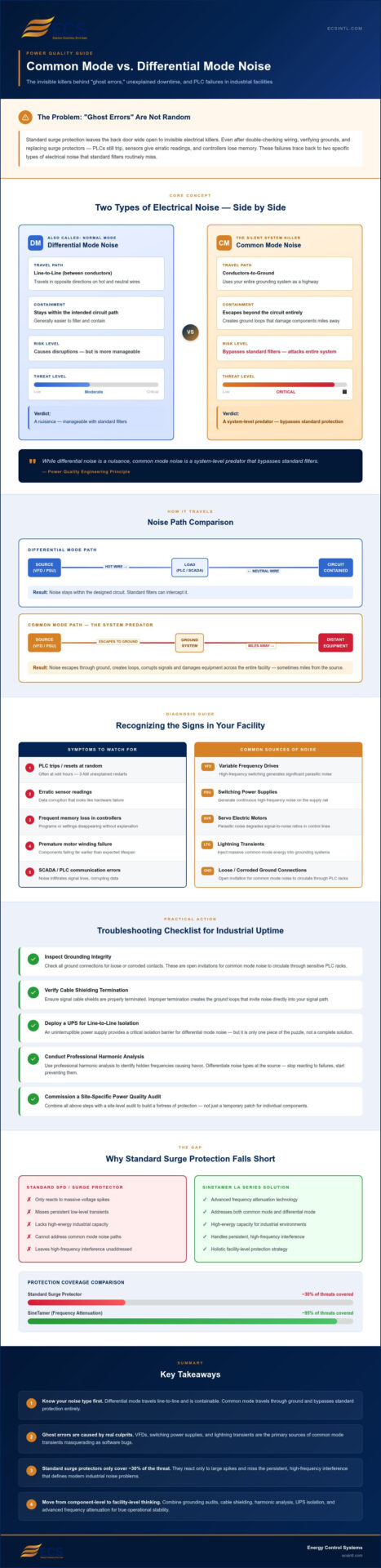
To solve the mystery of your failing equipment, you must first understand the two distinct ways electrical noise travels through your facility. Differential mode noise, often called normal mode, occurs between two conductors. It travels line-to-line, moving in the opposite direction on the hot and neutral wires. While it can cause disruptions, it’s generally easier to contain because it stays within the intended circuit path. However, understanding the specific interaction of common mode vs differential mode noise is essential for any facility manager who values long-term stability.
Common mode noise is far more aggressive. This interference appears between the conductors and the ground wire. Instead of staying within the circuit, it uses your entire grounding system as a highway. This creates ground loops that can damage components miles away from the source. “While differential noise is a nuisance, common mode noise is a system-level predator that bypasses standard filters.” It’s the primary reason your standard surge protectors aren’t stopping the chaos and why your team is constantly chasing ghost errors.
The Anatomy of Electrical Interference in Automation
Industrial environments are noisier than ever. The high-frequency switching used in servo electric motors and variable frequency drives generates significant parasitic noise. This isn’t just a technical variable; it’s a direct threat to your signal-to-noise ratios. When this noise infiltrates your SCADA and PLC communication lines, it creates data corruption that looks like a hardware failure. You shouldn’t have to guess which component will fail next. Analyzing common mode vs differential mode noise allows you to build a shield that restores your operational agency. You deserve a work environment where your technology supports your success rather than undermining it.
Diagnosing the Disturbance: Symptoms and Sources in Your Facility
Identifying the source of your facility’s instability shouldn’t feel like a guessing game. If your system resets for no apparent reason, you aren’t dealing with a software bug; you are likely dealing with common mode transients. These disruptions often stem from Variable Frequency Drives (VFDs), switching power supplies, and lightning transients. They manifest as erratic sensor readings, frequent memory loss in controllers, or premature motor winding failure. These aren’t just technical hiccups. They are the primary drivers of the exhaustion you feel when your production line grinds to a halt without warning.
To truly eliminate these invisible killers, you need precision. Professional harmonic analysis is the key to identifying the “hidden” frequencies causing havoc. By differentiating between common mode vs differential mode noise at the source, you can stop reacting to failures and finally reclaim your agency. You have the right to a facility that operates with predictable excellence. Understanding these power quality nuances is the first step toward a stress-free environment.
Practical Troubleshooting for Industrial Uptime
Start with the basics of grounding integrity. Loose or corroded ground connections are open invitations for common mode noise to circulate through your sensitive PLC racks. Check your cable shielding. It must be properly terminated to prevent the very ground loops that invite noise into your signal path. While an uninterruptible power supply (UPS) provides a critical barrier for isolating loads from line-to-line noise, it is only one piece of the puzzle. Combining these steps with a site-specific power quality audit ensures you are building a fortress, not just a temporary patch. If you’re tired of the mystery, we can help you diagnose these hidden disturbances before they lead to another failure.
Beyond Suppression: Protecting Your Infrastructure with SineTamer
Standard filters often fall short because they lack the high-energy capacity needed for industrial environments. They might handle minor spikes, but they can’t stop the persistent, high-frequency interference that defines common mode vs differential mode noise. This is where the SineTamer LA Series changes the game. Unlike standard surge protective devices that only react to massive voltage spikes, SineTamer utilizes advanced Frequency Attenuation technology. It targets the specific frequency spectrum where destructive noise resides, neutralizing it before it ever reaches your sensitive electronics.
SineTamer is the steady hand that restores order to your power grid, allowing you to focus on production, not troubleshooting. By shifting from a reactive “fixing” approach to a proactive “shielding” mindset, you eliminate the emotional weight of waiting for the next failure. You aren’t just buying hardware; you’re investing in the mental tranquility that comes with a stable facility. It’s time to stop chasing ghosts and start protecting your professional legacy.
Restoring Personal Agency and System Reliability
Implementing a SineTamer RM or ST series solution does more than protect machines. It elevates your status within the organization by ending the cycle of chronic downtime. When you become the leader who finally solved the “unsolvable” electrical issues, you reclaim your professional agency and respect. The path forward starts with a technical site analysis to map out a custom protection strategy. This process identifies exactly where common mode vs differential mode noise is leaking into your system. Don’t let invisible killers dictate your schedule or your stress levels any longer.
Reclaiming Your Operational Peace
You no longer have to accept “ghost errors” as a cost of doing business. By distinguishing between common mode vs differential mode noise, you’ve taken the first step toward a more stable, predictable facility. We’ve seen how standard protection misses the high-frequency transients that bleed into your ground system and crash your PLCs. You deserve a shield that actually stops the chaos.
With over 30 years of industrial power quality expertise and our proprietary SineTamer technology, we provide the frequency attenuation needed to protect your professional reputation. Our worldwide technical support team is ready to help you move from reactive repairs to proactive stability. It’s time to restore your agency and your mental tranquility. Restore stability to your facility with SineTamer; contact ECS for a Technical Site Analysis today. Your facility’s best days are just beginning.
Frequently Asked Questions
What is the most common cause of common mode noise in factories?
Variable Frequency Drives (VFDs) and high-frequency switching power supplies are the most frequent sources of common mode noise in modern industrial plants. These devices create rapid voltage changes that couple through parasitic capacitance into the grounding system. This unwanted energy then travels throughout your facility, disrupting sensitive electronics. Identifying these sources is a critical step in differentiating between common mode vs differential mode noise.
How can I tell if my communication errors are caused by differential mode noise?
You can identify differential mode noise by observing errors that occur strictly between two signal lines or power conductors. Unlike common mode issues that affect the entire system via the ground, differential noise is often localized to specific cabling runs. If your twisted-pair communication lines lack proper shielding or are routed too close to high-power cables, the resulting interference is likely line-to-line.
Will a standard surge protector stop common mode noise?
Standard surge protectors are designed to clamp massive voltage spikes, but they often ignore the low-level, high-frequency interference that characterizes common mode noise. These “ghost errors” slip past traditional devices because they don’t reach the high-voltage trigger threshold. To stop this invisible killer, you need specialized frequency attenuation technology like the SineTamer LA Series to provide a comprehensive shield for your facility.
Can improper grounding increase common mode interference?
Improper grounding is a primary catalyst for increased common mode interference. When your ground system has high impedance or multiple paths, it creates ground loops that invite noise to circulate freely. This lack of a clear, low-resistance path forces interference into your sensitive signal wires instead. Maintaining grounding integrity is essential to reclaiming your operational stability and protecting your professional reputation from the stress of unexplained downtime.

Article by
Jeff Edwards
Founder of ECS International Inc. Edwards travels and speaks extensively in Latin America, Asia and Africa on the subject of power quality; transients and mitigating their impact on profitability. After graduating from Texas Tech University in Lubbock Texas, Edwards spent 9 years in the Telecommunications sector prior to founding Energy Control Systems in 1987 as a Texas based corporation selling surge suppression and UPS systems. The company has evolved into a global power quality products and energy efficiency concern with operations spanning South America, Asia, Europe and Africa.
Disclaimer
Some of the above information may be the opinion of the author.