

It is 2:00 AM on a Tuesday when your phone vibrates with another “phantom” alarm from the plant floor. You know the drill. A high-end PLC has rebooted for no apparent reason, or an expensive VFD has finally surrendered to the invisible electrical noise that has been eating it alive for months. You should not have to live in a state of constant, low-level anxiety about your infrastructure. You deserve a facility that simply works, allowing you to focus on production rather than firefighting.
We will help you master the science of spd placement in industrial facilities to finally silence those alarms and reclaim your mental tranquility. By implementing a strategic, cascaded defense, you can transform your electrical environment from a source of stress into a stable foundation. This guide explores how to position protectors to safeguard your assets and ensure total uptime through 2026 and beyond.
Key Takeaways
- Learn how to establish a robust perimeter defense at the service entrance to neutralize external lightning surges before they penetrate your facility.
- Discover why effective spd placement in industrial facilities must account for internal transients generated by your own high-power machinery.
- Identify the critical “choke points” in your power distribution through a technical site analysis to safeguard sensitive PLCs and VFDs.
- Transition from high-stress reactive repairs to a state of mental tranquility by implementing a multi-layered, cascaded protection strategy.
The Cascaded Defense: Why SPD Placement Starts at the Service Entrance
Effective spd placement in industrial facilities begins at the boundary. Think of your facility as a series of concentric circles, or “Zones of Protection.” Per IEEE C62.41 standards, these are defined as Category C (the service entrance), Category B (distribution panels), and Category A (individual outlets). A Surge Protective Device (SPD) installed at the service entrance acts as your primary shield. It’s your first line of defense against external lightning strikes and utility switching. Without this perimeter wall, your internal electronics are sitting ducks for high-energy external events.
Securing the perimeter restores your personal agency. You can’t control what happens on the utility grid, but you can control what enters your building. However, entrance protection has a major limitation. Industry data indicates that roughly 80% of transients are actually born inside your facility. While Category C protection is non-negotiable, it’s only the first step in a cascaded defense strategy. You must look deeper into the infrastructure to find the real source of your downtime.
Type 1 Placement: Hardening the Facility Perimeter
Installing the SineTamer LA Series at the main disconnect provides the heavy-duty protection required for Category C environments. This hardware is your insurance policy against catastrophic external failure. To ensure maximum reliability and mental tranquility, prioritize these technical requirements:
- Keep lead lengths as short and straight as possible. Every extra inch of wire adds impedance, which delays the response time during a surge.
- Ensure a high-quality grounding system. The SPD is only as effective as the path it uses to shunt energy away from your equipment.
Strategic spd placement in industrial facilities at this level creates the “quiet” environment you need. Once the perimeter is secure, you can focus on the more nuanced internal threats that cause daily operational headaches.
Internal Transients: Strategic Placement Near Sensitive Industrial Loads
The perimeter defense discussed previously is vital, but it only solves 20% of your power quality issues. The 80/20 rule of electrical transients is a harsh reality for facility managers. It states that most “phantom” errors and hardware degradations are generated by your own equipment. Every time a heavy motor cycles or a VFD switches, it sends high-frequency noise back into your system. This is why spd placement in industrial facilities must move beyond the service entrance and into the heart of the plant floor.
Strategic placement at distribution panels serves as a critical buffer. These IEEE location categories, specifically Category B, are where you isolate heavy industrial loads from sensitive control logic. By installing protection here, you stop internal “pollution” from reaching the brains of your operation. It’s about restoring order to a chaotic environment. Proper spd placement in industrial facilities ensures no more unexplained 3 AM error codes. No more missed family dinners because a PLC decided to reset. You gain back your time and your mental tranquility.
Point-of-Use Protection for High-Value Assets
The final layer of defense happens at the point of use. We recommend deploying the SineTamer ST series directly at your control cabinets. This hardware filters the low-level, high-frequency noise that standard surge arresters ignore. This specific placement offers several advantages:
- Precision filtering: Protecting digital technology in server rooms with rack-mount units.
- Total stability: Linking SPDs with an uninterruptible power supply (UPS) for absolute uptime.
- Asset longevity: Preventing the premature failure of expensive PLCs and SCADA systems.
To see how these layers work together, you can request a technical site analysis today.
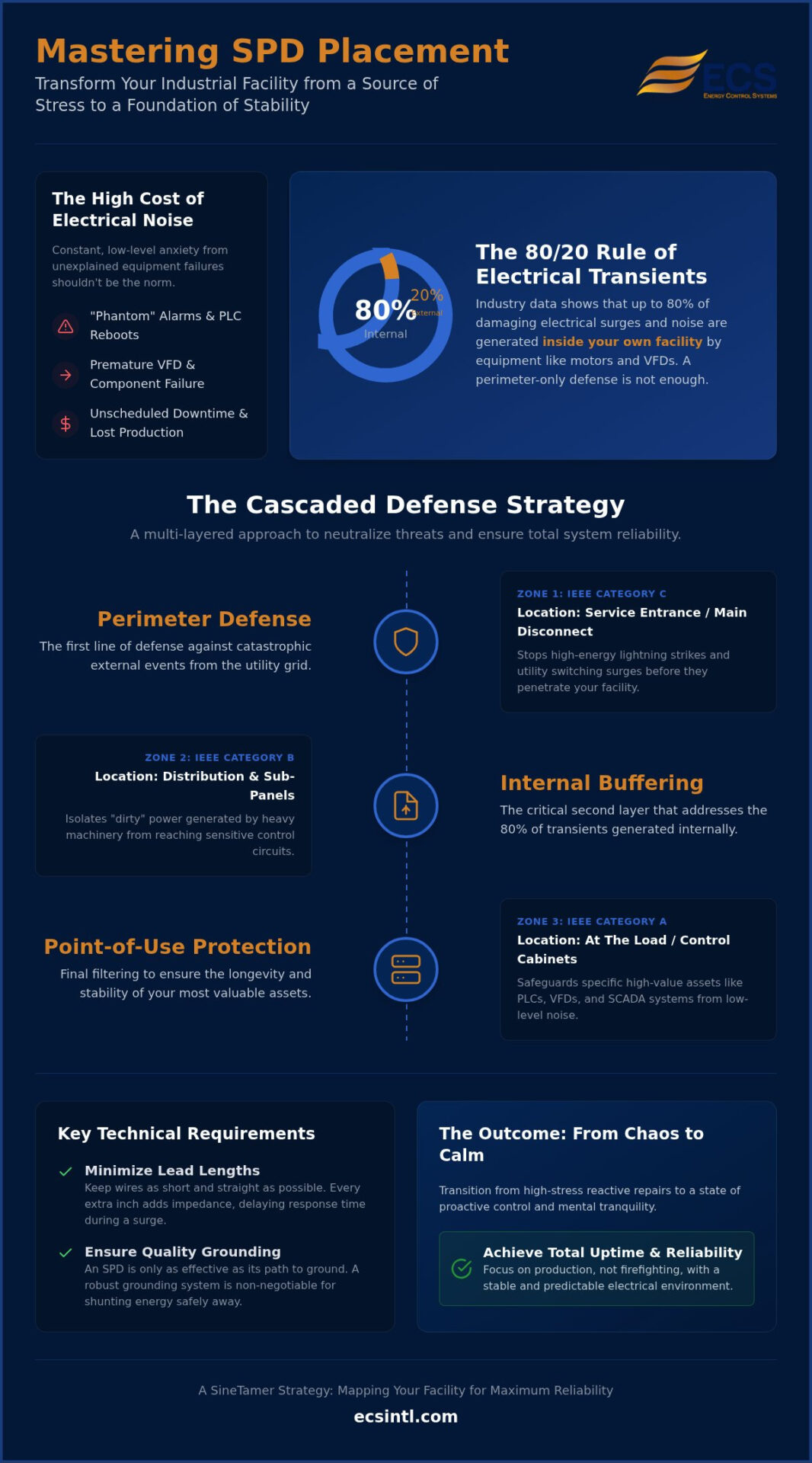
The SineTamer Strategy: Mapping Your Facility for Maximum Reliability
Building a resilient infrastructure requires more than just buying hardware. It requires a roadmap. You’ve already secured the perimeter and identified sensitive loads, but the final step is a comprehensive technical site analysis. This process identifies the hidden “choke points” in your power distribution where transients congregate. By mastering spd placement in industrial facilities through a structured map, you move from the chaos of reactive repairs to the calm of planned maintenance. You stop being the person who fixes problems and start being the one who prevents them.
Implementing the SineTamer Advantage means matching specific device specs to the unique transient profile of every zone. This isn’t a one size fits all approach. It’s a surgical application of technology designed to restore your personal agency. When your spd placement in industrial facilities is logically mapped, the constant threat of downtime vanishes. You gain the mental tranquility that comes from knowing your infrastructure is battle tested and secure. You become the hero of your organization by delivering the stability the board demands.
Designing Your Facility’s Surge Map
Effective mapping begins by separating your “Aggressor” loads from your “Victim” loads. Aggressors, like large motors and VFDs, are the sources of internal noise. Victims are the sensitive PLCs and SCADA systems that suffer the consequences. Frequency Attenuation is the key differentiator in SineTamer’s strategy, as it specifically targets and neutralizes the high-frequency ring waves that bypass standard units. To maintain this “quiet” environment, we recommend these steps:
- Integrate your surge protective device monitoring directly into your existing maintenance dashboard.
- Conduct annual reviews of your surge map to account for new machinery or facility expansions.
- Prioritize placement density around the most expensive “Victim” assets to maximize ROI.
This strategic layering ensures that every component of your facility is protected by a shield tailored to its specific needs.
Secure Your Infrastructure and Reclaim Your Peace of Mind
You now have the roadmap to move from constant firefighting to strategic stability. Effective spd placement in industrial facilities isn’t just about hardware; it’s about a multi-layered defense that guards the perimeter and neutralizes internal noise. By mapping your facility, you eliminate the “phantom” errors that drain your time and profit. You’ve seen how cascaded protection and internal transient suppression work together to create a quiet, reliable electrical environment.
Since 1987, SineTamer has protected facilities in over 45 countries. Our 37-year legacy of industrial protection is built on reducing maintenance costs through planned suppression. We provide global support to ensure multi-national manufacturing leaders achieve total uptime and mental tranquility. Stop the downtime headaches; request a Technical Site Analysis from ECS today.
You have the power to solve the downtime problem for good. We’re here to help you become the hero your facility deserves and finally enjoy the professional success you’ve earned.
Frequently Asked Questions
Where is the best place to install a surge protective device in a factory?
The most effective strategy involves a cascaded defense across three specific zones. You should install Type 1 devices at the service entrance to block external lightning and utility surges. Follow this with Type 2 protection at distribution panels and point-of-use suppressors near sensitive PLCs. This layered spd placement in industrial facilities ensures that no transient reaches your critical assets.
What is the difference between Type 1 and Type 2 SPD placement?
Type 1 SPDs are engineered to handle the massive energy of external events and are installed at the main service disconnect. Type 2 SPDs are placed at distribution or branch panels. While Type 1 guards the perimeter, Type 2 is your workhorse for internal transients. Proper placement of both types creates a quiet electrical environment that restores your personal agency.
Do I need an SPD on every sub-panel in my industrial facility?
Strategic placement is more effective than a blanket approach. You should focus on panels serving high-value “Victim” loads or those located downstream from “Aggressor” machinery. A technical site analysis identifies these critical zones. This targeted method ensures your most sensitive assets remain protected without unnecessary hardware costs, providing the stability your facility requires for total uptime through 2026.
How does proper SPD placement reduce industrial downtime?
Strategic placement stops the high-frequency transients that cause “phantom” PLC reboots and VFD failures. When you eliminate these invisible disruptions, you stop the bleeding of profit. Industrial facilities can lose approximately $280 for every second of idle time. Proper spd placement in industrial facilities transforms your infrastructure into a stable foundation, giving you the mental tranquility you deserve.

Article by
Jeff Edwards
Founder of ECS International Inc. Edwards travels and speaks extensively in Latin America, Asia and Africa on the subject of power quality; transients and mitigating their impact on profitability. After graduating from Texas Tech University in Lubbock Texas, Edwards spent 9 years in the Telecommunications sector prior to founding Energy Control Systems in 1987 as a Texas based corporation selling surge suppression and UPS systems. The company has evolved into a global power quality products and energy efficiency concern with operations spanning South America, Asia, Europe and Africa.
Disclaimer
Some of the above information may be the opinion of the author.