

What if the “phantom” equipment resets plaguing your facility aren’t actually mysteries, but the predictable result of a missing shield? You know the exhaustion of a PLC communication error halting production during a high-stakes run. It’s more than a technical glitch. It’s a direct hit to your team’s productivity and your own peace of mind. Integrating a high-quality type 1 spd for industrial control panels is the essential first line of defense to stop external transients before they enter your architecture.
We’re here to help you regain control. This guide explores how advanced frequency attenuation in the SineTamer LA Series protects sensitive electronics from the voltage spikes that cause modern hardware to fail. We’ll clarify the UL 508A 3rd Edition standards and show you how to build a foundation of “Total Uptime” for 2026. It’s time to replace technical anxiety with the confidence of a battle-tested power quality strategy.
Key Takeaways
- Understand why mounting a type 1 spd for industrial control panels on the line side is your most effective move for stopping external surges before they hit your panel.
- Simplify your compliance journey by learning how to match system configurations and discharge ratings to the latest UL 508A requirements.
- See how the SineTamer LA Series provides relief from PLC communication errors by filtering out the high-frequency noise that standard devices often miss.
- Secure your facility’s future and reclaim your time by implementing a protection strategy that prioritizes industrial uptime and equipment longevity.
Why Type 1 SPDs are Non-Negotiable for Industrial Control Panels
You’ve seen the smoke. You’ve felt the gut-punch of a fried VFD during peak production. It’s an avoidable tragedy that costs more than just hardware; it costs you time and reputation. A Surge protector isn’t just a technical checkbox. It’s the security guard for your entire operation. A type 1 spd for industrial control panels is specifically intended for installation between the secondary of the service transformer and the line side of the service equipment overcurrent device.
This “line-side” position is critical. It allows the device to intercept utility-generated transients before they ever touch your internal breakers. There’s a common misconception that Type 1 units are only for lightning strikes. That’s a dangerous myth. While they certainly handle massive external surges, they also shield your sensitive electronics from the daily reality of grid switching and capacitor bank discharges. Without this protection, these transients flood your panel architecture, degrading the life of your PLCs and causing the “phantom” resets that keep you at the plant late on a Friday night.
Type 1 vs. Type 2 SPDs: Understanding the Line-Side Advantage
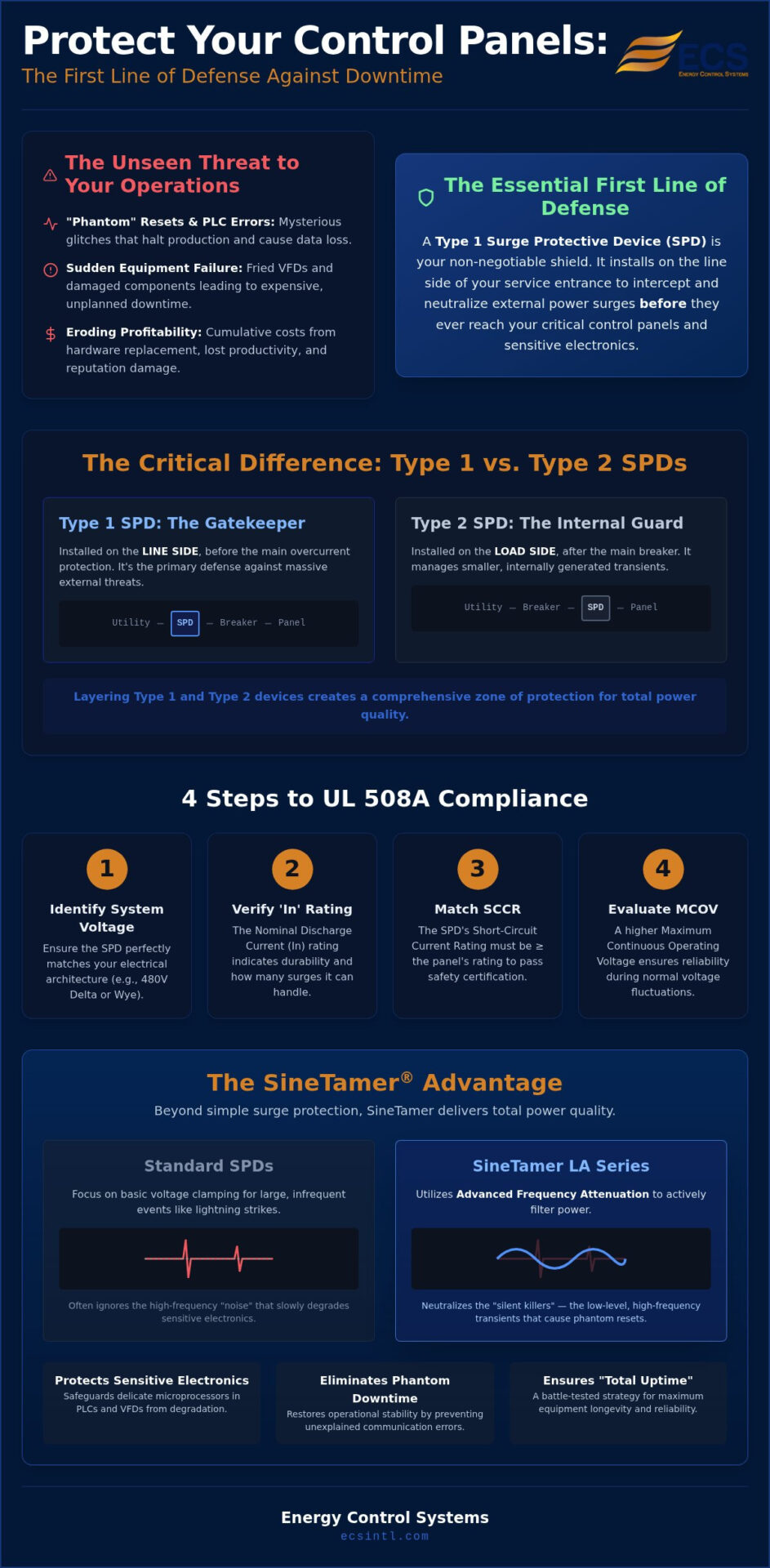
The core difference lies in the installation location. Type 1 devices sit on the line side, catching external threats before they pass through your main overcurrent protection. Type 2 devices reside on the load side. They work in a hierarchy. By layering these devices, you create a comprehensive zone of protection that filters out massive external jolts and smaller, frequent internal switching noise. A Type 1 SPD is the robust gatekeeper of industrial power quality.
UL 508A Standards and Selecting the Right Type 1 SPD
Choosing the right type 1 spd for industrial control panels is a high-stakes decision. You aren’t just buying hardware; you’re securing your facility’s future and your own peace of mind. The UL 508A standard provides the mandatory framework, but navigating it requires a clear, step-by-step strategy to avoid compliance bottlenecks.
- Step 1: Identify your system voltage and configuration. Whether it’s 480V Delta or Wye, the SPD must match the electrical architecture perfectly to function.
- Step 2: Verify the Nominal Discharge Current (In) rating. This tells you how many hits the device can take before it’s spent. Durability is the key to longevity.
- Step 3: Match the Short-Circuit Current Rating (SCCR). Your SPD’s SCCR must be equal to or greater than the panel’s overall rating. Don’t let a small component compromise your entire safety certification.
- Step 4: Evaluate the Maximum Continuous Operating Voltage (MCOV). A higher MCOV ensures the device handles natural voltage fluctuations without failing prematurely.
Key Specifications: MCOV, SCCR, and Voltage Protection Ratings
A high SCCR is vital because it prevents the SPD from becoming a weak link during rigorous safety inspections. Beyond compliance, you need to look at Voltage Protection Ratings (VPR). A low VPR is essential for safeguarding the delicate microprocessors in your PLCs from the “silent killers” of low-level transients. If you’re feeling overwhelmed by these technicalities, you can explore what is a surge protective device in our detailed guide. We’re here to help you restore operational agency and eliminate the stress of power quality issues.
The SineTamer Advantage: Beyond Standard Surge Protection
Most competitors offer basic voltage clamping. That’s fine for lightning, but it doesn’t solve your daily headaches. The SineTamer LA Series is a specialized type 1 spd for industrial control panels designed for the brutal realities of industrial infrastructure. It doesn’t just wait for a massive surge. This type 1 spd for industrial control panels actively addresses the high-frequency noise and low-level transients that standard devices simply ignore.
These “silent” events are what actually fry sensitive electronics over time. By utilizing advanced frequency attenuation, SineTamer provides a level of protection that modular alternatives often lack. We call this the “Total Uptime” promise. It’s about more than hardware. It’s about lifting the heavy psychological burden of unexpected failures that keep you on edge. With over 36 years of experience and global distribution, Energy Control Systems provides the technical site analysis you need to stop guessing and start protecting. We are your partners in stability.
Restoring Operational Agency and Eliminating Phantom Downtime
High-performance suppression empowers you to maintain a stable plant floor and achieve the professional success you deserve. You shouldn’t have to worry about your equipment when you’re at home with your family. This battle-tested technology provides the mental tranquility that comes from a truly secure system. You’ve fought the “phantom” resets and communication errors long enough. It’s time to restore your personal agency. Contact ECS for a technical site analysis to finally optimize your power quality strategy.
Securing Your Operational Future with Total Uptime
Your facility deserves better than the constant threat of fried electronics and “phantom” resets. By choosing a high-performance type 1 spd for industrial control panels, you’re doing more than following a regulation; you’re taking a stand for your team’s sanity. The right line-side defense stops external transients before they ever breach your architecture. It’s about restoring your personal agency and moving from a state of constant firefighting to one of steady growth. With over 35 years of expertise and proprietary SineTamer LA Series technology, we’re ready to be your steady hand in a chaotic landscape. Our global support team is standing by to provide the site analysis you need to finally breathe easy. Protect your infrastructure with the SineTamer LA Series today. Your peace of mind is worth the investment.
Frequently Asked Questions
Is a Type 1 SPD required for UL 508A industrial control panels?
Surge protection is required under the UL 508A standard when a panel is part of a safety-related control circuit or when the machinery falls under NFPA 79 mandates. Using a type 1 spd for industrial control panels is often the most reliable way to meet these 2026 requirements. It ensures your infrastructure remains compliant while shielding your hardware from high-stakes utility transients.
Can I use a Type 1 SPD as a Type 2 device?
Yes, you can install a Type 1 device in a Type 2 application on the load side of your main breaker. Because Type 1 units are tested to withstand the intense energy levels found on the line side, they offer superior durability when moved downstream. This strategy helps simplify your inventory while providing your sensitive electronics with a much more robust protective shield.
What is the difference between Type 1 and Type 2 SPD installation?
The primary difference is the physical mounting location relative to your main overcurrent protection. A type 1 spd for industrial control panels is installed on the line side, catching external utility surges before they reach your main breaker. Type 2 devices are strictly for load-side installation. Choosing a Type 1 unit gives you the flexibility to protect your architecture at the very point of entry.
How does an SPD affect the SCCR of my industrial control panel?
Your SPD’s Short-Circuit Current Rating (SCCR) must meet or exceed the overall rating of the entire control panel. If you install a device with a lower SCCR, it becomes the weak link that limits the entire assembly’s safety rating. We prioritize high SCCR values in the SineTamer LA Series to ensure your panels pass inspection and your facility maintains operational stability.

Article by
Jeff Edwards
Founder of ECS International Inc. Edwards travels and speaks extensively in Latin America, Asia and Africa on the subject of power quality; transients and mitigating their impact on profitability. After graduating from Texas Tech University in Lubbock Texas, Edwards spent 9 years in the Telecommunications sector prior to founding Energy Control Systems in 1987 as a Texas based corporation selling surge suppression and UPS systems. The company has evolved into a global power quality products and energy efficiency concern with operations spanning South America, Asia, Europe and Africa.
Disclaimer
Some of the above information may be the opinion of the author.