

Your UPS is keeping the lights on, but it isn’t necessarily keeping your equipment alive. It’s a painful reality to face when you’ve invested heavily in backup systems only to watch unexplained system crashes continue to drain your facility’s productivity. You’re likely exhausted from the high cost of industrial downtime and the constant pressure to explain why “protected” hardware still fails. The choice between an isolation transformer vs ups isn’t just a technical debate; it’s about the vital difference between power continuity and power purity.
We’re here to help you reclaim your agency and your peace of mind. You’ll discover how to balance uptime with the absolute power purity required by sensitive SineTamer-level electronics. We’ll also explore the impact of the 2026 UL/CSA safety standards and Executive Order 14420 on your procurement strategy. It’s time to eliminate electrical noise and ensure the 24/7 stability your team deserves.
Key Takeaways
- Learn to distinguish between power continuity and power purity so you can stop treating symptoms and start fixing the root cause of system crashes.
- Use our decision matrix for the isolation transformer vs ups debate to determine if your facility needs a backup bridge or a clean ground reference.
- Protect sensitive rack-mount systems like the SineTamer RM Series by identifying whether your hardware faces external outages or internal “ghost” transients.
- Implement a hybrid protection strategy combining a UPS with the SineTamer LA Series to achieve total uptime and long-term hardware longevity.
Understanding the Roles: Power Continuity vs. Power Purity
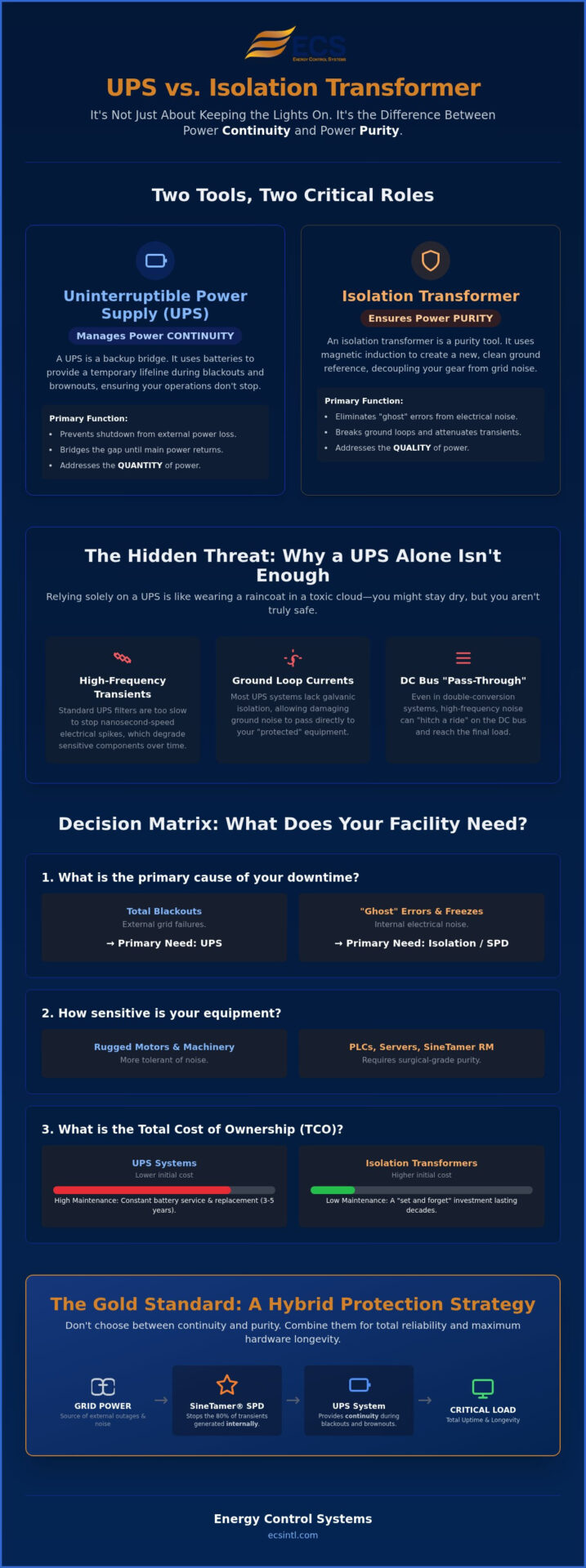
You shouldn’t have to guess why your systems crash during a storm. A UPS is fundamentally a continuity tool. It’s designed to bridge the gap during blackouts and brownouts, using chemical batteries and power electronics to provide a temporary lifeline. It keeps the clock ticking. However, an isolation transformer is a purity tool. It creates a new, electrically isolated ground reference through mechanical copper windings and magnetic induction. The isolation transformer vs ups debate starts with a simple question: do you need to stay on, or do you need to stay clean?
A common mistake is assuming a UPS provides total protection. It doesn’t. Most UPS systems lack galvanic isolation, meaning they can still pass through high-frequency transients or ground-loop currents. While the UPS manages the quantity of power, the transformer manages the quality. Understanding the nuances of isolation transformer vs ups applications is the first step toward reclaiming control over your facility’s stability. Relying solely on a UPS for sensitive equipment is like wearing a raincoat but walking through a toxic cloud; you might stay dry, but you aren’t truly safe.
When Isolation is the Priority
In high-stakes environments like CNC machine shops, electrical noise is often more dangerous than a brief power loss. Isolation transformers break ground loops and attenuate common-mode noise that causes “ghost” errors in logic controllers. This physical separation provides the mental tranquility of knowing your hardware is truly decoupled from the grid. It’s also helpful to understand how isolation transformers relate to harmonic analysis to ensure long-term stability. Purity ensures your precision tools perform exactly as they were engineered to do.
The Decision Matrix: Evaluating Your Specific Industrial Risks
Choosing between an isolation transformer vs ups requires a cold, hard look at your facility’s history. Stop guessing and start auditing. Was your last crash a total blackout or a “ghost” error where the screen just froze? If it’s the latter, your UPS didn’t fail; it simply wasn’t the right tool for the job. You deserve a solution that addresses the actual threat, not just the most obvious one.
Evaluate your equipment sensitivity next. Rugged motors might survive a bit of electrical noise, but delicate SineTamer RM Series rack components require surgical-grade purity to avoid long-term degradation. Consider your neighbors too. If a nearby factory kicks on a massive arc welder, your local grid stability vanishes instantly. Finally, calculate the Total Cost of Ownership. Transformers are a “set and forget” investment lasting decades. UPS systems demand constant battery maintenance and replacement every few years. If you’re feeling overwhelmed by these variables, a professional harmonic analysis can pinpoint exactly where your vulnerability lies.
The Hidden Limitation of Standard UPS Systems
Standard UPS filters are physically incapable of stopping high-frequency transients that move at nanosecond speeds. Even sophisticated double-conversion systems suffer from a “pass-through” effect where high-frequency noise hitches a ride on the DC bus and reaches your load. This is the missing third pillar of power quality. You need more than just a battery; you need a definitive barrier. Transient suppression isn’t an optional add-on. It’s the difference between a system that merely stays on and one that actually survives the day.
Achieving Total Uptime: Integrating SineTamer for Maximum Reliability
The debate of isolation transformer vs ups often misses a vital truth: they aren’t enemies. They’re partners. A hybrid approach is the industrial gold standard for total reliability. While your UPS handles continuity during an outage, the SineTamer LA Series acts as a definitive guard against the 80% of transients generated inside your own four walls. You don’t just need a battery; you need a shield that stops the silent erosion of your hardware. When you weigh the benefits of an isolation transformer vs ups, remember that the highest level of protection comes from a unified front.
Industrial surge protective devices complement isolation transformers by catching high-energy spikes before they reach sensitive components. This creates a “quiet” electrical environment. Imagine the relief of knowing your systems won’t fail because of a neighbor’s motor start-up or a lightning strike miles away. It’s about restoring your agency and ending the late-night calls that drain your energy. A stable facility isn’t just a goal; it’s your right as a professional.
Building a Multi-Layered Defense Strategy
Strategic placement is key to long-term success. We recommend installing SineTamer units at both the service entrance and critical points of use. This layered defense ensures that no disturbance, whether external or internal, compromises your uptime. A professional site analysis is the first step toward reclaiming your status as a leader who keeps the facility running without constant fire-fighting. At Energy Control Systems, we’ve spent decades restoring calm to chaotic industrial environments. We don’t just sell hardware; we provide the stability you need to focus on what actually matters. It’s time to stop worrying about your power and start trusting it again.
Secure Your Facility’s Future with True Power Quality
Operational chaos doesn’t have to be your status quo. You now understand that the isolation transformer vs ups choice isn’t about picking one winner; it’s about defining the specific environment your equipment needs to thrive. A UPS provides the critical time to react, while isolation and SineTamer technology provide the purity to survive. It’s the difference between merely staying online and actually protecting your hardware’s lifespan.
With over 35 years of industrial power quality expertise, we’ve seen how proprietary SineTamer technology restores agency to managers worldwide. You deserve the mental tranquility that comes from a quiet, stable electrical system. Don’t let “ghost” errors and unexplained downtime dictate your professional success any longer. It’s time to stop treating symptoms and start securing your legacy. Request a Professional Harmonic Analysis to Secure Your Facility today. Let’s restore the operational stability you’ve been working for. You’re ready to lead your facility into a more stable 2026.
Frequently Asked Questions
Do I need an isolation transformer if I already have a double-conversion UPS?
You often need both to achieve true stability. While a double-conversion UPS manages power quantity, it often lacks the physical barrier provided by an isolation transformer. High-frequency transients can still bypass electronic filters and degrade your sensitive logic. Adding a transformer ensures a clean ground reference, which is the only way to stop noise from infiltrating your most delicate system components.
Can an isolation transformer protect against lightning strikes?
An isolation transformer isn’t a substitute for dedicated surge protection. It excels at filtering low-level noise, but a massive lightning strike carries enough energy to jump across transformer windings. To truly safeguard your facility, you must pair your hardware with a SineTamer LA Series device. This combination provides the multi-layered defense necessary to handle high-energy external events and internal disturbances alike.
What is the main disadvantage of using an isolation transformer vs a UPS?
The primary drawback in the isolation transformer vs ups comparison is that a transformer offers zero power continuity. If the grid goes dark, your equipment goes dark. It lacks the chemical battery storage found in a UPS. While the transformer purifies the power quality, it cannot provide the energy reserves needed to stay operational during a total blackout or brownout event.
Why do my PLCs still have communication errors while running on a UPS?
Your PLCs are likely suffering from ground-loop noise or high-frequency transients that standard UPS filters can’t catch. These “ghost” errors often stem from the lack of a clean ground reference. A UPS keeps the power flowing, but it doesn’t always isolate the communication path. Integrating SineTamer protection can eliminate these disruptions, restoring your agency and stopping the cycle of unexplained system crashes.

Article by
Jeff Edwards
Founder of ECS International Inc. Edwards travels and speaks extensively in Latin America, Asia and Africa on the subject of power quality; transients and mitigating their impact on profitability. After graduating from Texas Tech University in Lubbock Texas, Edwards spent 9 years in the Telecommunications sector prior to founding Energy Control Systems in 1987 as a Texas based corporation selling surge suppression and UPS systems. The company has evolved into a global power quality products and energy efficiency concern with operations spanning South America, Asia, Europe and Africa.
Disclaimer
Some of the above information may be the opinion of the author.