

Did you know that 80% of the electrical transients causing your sensitive PLCs to glitch aren’t coming from the grid, but from inside your own facility? It’s incredibly frustrating to watch a high-stakes production window slip away because of an unexplained communication error. You’ve followed your maintenance schedule, yet those “ghosts in the machine” continue to trigger spoiled batches and late-night stress. Your reputation depends on meeting strict USDA and FDA windows without fail. We know the weight of that responsibility.
You deserve a plant floor where technology works for you. This article reveals how reducing electronic equipment downtime in food processing starts by neutralizing the invisible power surges that degrade your hardware. We’ll examine how standards like IEC TS 62749:2026 and SineTamer technology provide the protection you need. It’s time to restore your operational stability and gain the recognition you deserve for a truly optimized, stress-free facility.
Key Takeaways
- Understand why thin profit margins make even “micro-downtime” events a major threat to your plant’s bottom line and regulatory compliance.
- Discover how addressing internal transients is the secret to reducing electronic equipment downtime in food processing, preventing 80% of unexplained electronic failures.
- Learn how variable frequency drives impact your electrical health and why a professional harmonic analysis is the essential diagnostic first step.
- Explore how hardening your infrastructure with the SineTamer LA Series restores your personal agency and ensures total operational stability.
The High Stakes of Electronic Equipment Downtime in Food Processing
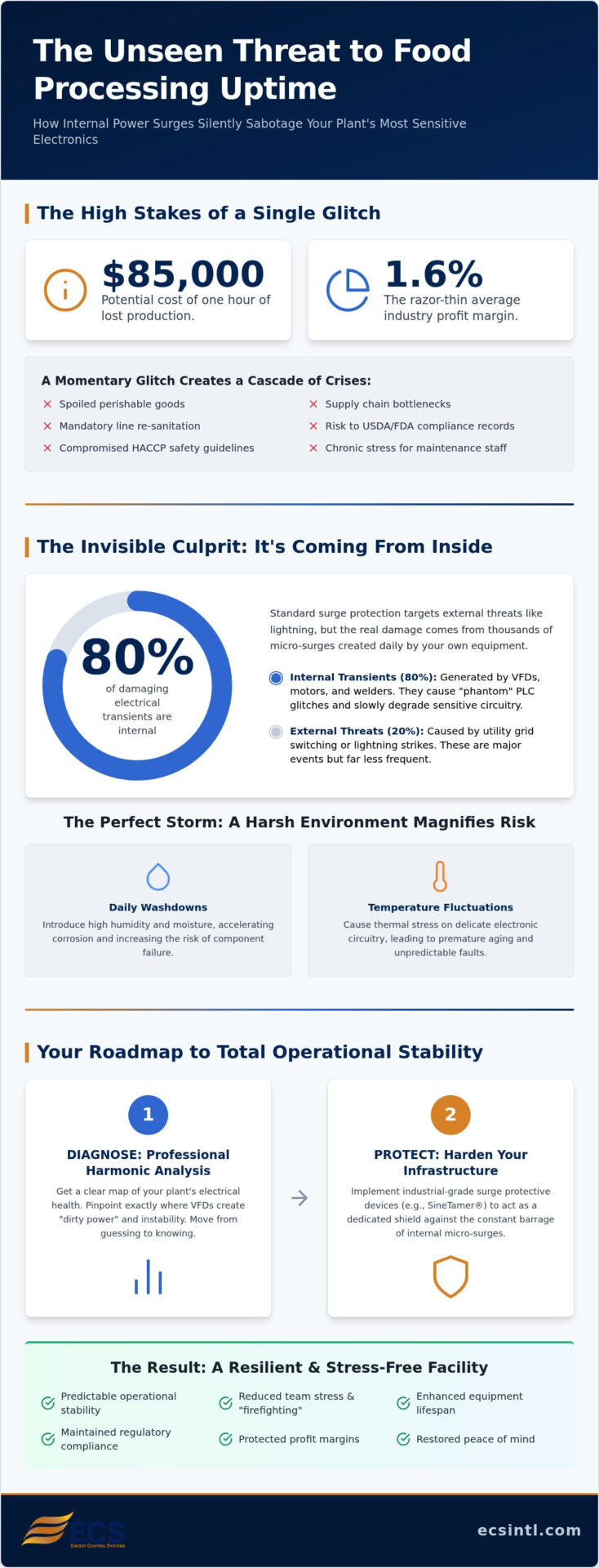
In a high-speed food manufacturing environment, downtime is more than just a paused clock. It is a full-scale operational crisis. When a PLC suddenly loses communication, you aren’t just losing minutes; you’re losing product, profit, and your team’s hard-earned momentum. Every second of unplanned stoppage eats into an industry average profit margin of just 1.6%. At that level, even “micro-downtime” events are devastating. A single hour of lost production can cost up to $85,000 when you factor in the high price of spoiled perishable goods.
The true challenge of reducing electronic equipment downtime in food processing lies in the ripple effect. A momentary glitch triggers a cascade of delays. You face line re-sanitation, supply chain bottlenecks, and the looming pressure of strict USDA or FDA production windows. Regulatory compliance depends on accurate, continuous electronic records and temperature logs. If your power quality causes a system crash, those vital records are at risk. Understanding What is Power Quality? is essential because it directly impacts the stability of the data your facility relies on for safety audits.
Beyond the Hourly Cost: Reputation and Safety
Unplanned stops don’t just hurt the bottom line; they compromise your HACCP (Hazard Analysis and Critical Control Point) guidelines. When equipment fails, the risk of biological or physical contamination increases during the restart process. Beyond the hardware, there is a heavy psychological toll on your maintenance staff. Constant “firefighting” creates a culture of chronic stress and exhaustion. You deserve a plant floor that operates with predictable stability. Reducing electronic equipment downtime in food processing isn’t just about the machines; it’s about restoring personal agency to the people who keep them running.
The Invisible Culprit: How Power Quality Sabotages Plant Electronics
Reducing electronic equipment downtime in food processing starts with identifying the invisible triggers that most maintenance schedules ignore. You might think your facility is safe because you haven’t suffered a catastrophic lightning strike. However, the real threat is quieter, more persistent, and far more frustrating. Standard surge protection often misses the high-frequency transients that wreak havoc on sensitive PLCs. These micro-events bypass traditional barriers, leading to those maddening “phantom” resets and communication errors in your SCADA systems. When your line stops for no apparent reason, it’s often this low-level electrical noise at work, stealing your time and your peace of mind.
Variable frequency drives (VFDs) are essential for modern efficiency, yet they’re also a primary source of harmonic distortion. This “dirty power” creates unnecessary heat and instability throughout your electrical distribution system. It’s a slow-motion disaster. Electronic degradation is the cumulative effect of thousands of daily micro-surges. Over time, these events weaken delicate circuitry until a total failure occurs. Following FDA guidance on food safety during power outages is essential for compliance, but preventing the outage in the first place is the only way to maintain your production schedule. Reducing electronic equipment downtime in food processing requires looking beyond mechanical wear to the very energy powering your machines.
The Perfect Storm: Washdown Environments and Electrical Stress
Food processing plants are notoriously brutal on electronics. Daily washdowns introduce high humidity and extreme temperature fluctuations. This harsh environment significantly exacerbates electrical component failure, making your hardware even more susceptible to internal transients. Industrial-grade surge protective devices are the missing link in your preventative maintenance checklist. They act as a dedicated shield, ensuring that environmental stress doesn’t turn into an unplanned production disaster. If you’re tired of chasing ghost errors, a professional harmonic analysis can provide the clarity you need to restore stability to your plant floor.
Implementing a Power Quality Shield: ECS Solutions for Total Uptime
You’ve identified the “ghosts” in your system. Now it’s time to eliminate them. The first step in reducing electronic equipment downtime in food processing is a professional harmonic analysis. This diagnostic deep-dive maps your plant’s electrical health, revealing exactly where VFDs and other loads are creating instability. It’s not just a report; it’s your roadmap to a stable facility. By identifying these hidden stressors, you can move from guessing to knowing.
Once you have your map, you must harden your infrastructure. The SineTamer LA Series provides the primary defense your plant-wide systems require. Unlike standard metal oxide varistor (MOV) devices that only react to high-voltage surges, SineTamer utilizes proprietary frequency attenuation. It tracks the sine wave and neutralizes those thousands of daily micro-surges before they can degrade your sensitive circuitry. For total continuity during grid fluctuations, adding an uninterruptible power supply ensures your temperature logs and electronic records remain uninterrupted.
Restoring Personal Agency to Plant Managers
We believe you shouldn’t have to live in a state of constant “firefighting.” By implementing these proactive protections, you shift from reactive repairs to strategic leadership. Improving your power quality does more than just stop resets; it significantly increases the lifespan of your servo motors and digital technology. This transition preserves your equipment and your reputation. You’ll gain the recognition you deserve for optimizing plant OEE while finally achieving the mental tranquility that comes with a truly reliable production environment.
Secure Your Production Future and Restore Stability
You don’t have to accept unexplained glitches as a cost of doing business. By addressing the internal transients and harmonic distortion lurking in your facility, you can finally stop the cycle of reactive repairs. These invisible triggers cause the vast majority of electronic failures. Taking a proactive stance through harmonic analysis and frequency attenuation protects your hardware, your time, and your sanity. Since 1987, we’ve helped global manufacturers reclaim their plant floor using proprietary SineTamer technology.
The path toward reducing electronic equipment downtime in food processing starts with a clear understanding of your electrical environment. You can eliminate the triggers behind 80% of unplanned failures and restore your personal agency. Request a Technical Site Analysis to Protect Your Food Processing Uptime today. You deserve the peace of mind that comes with total operational stability.
Frequently Asked Questions
What is the most common cause of electronic failure in food processing?
Internal electrical transients are the primary cause of unplanned failures. While many managers worry about external lightning, research shows that 80% of damaging surges originate from within your own facility. These micro-events occur whenever motors or pumps cycle on and off. Over time, they silently degrade delicate circuitry until a PLC fails unexpectedly, causing the high-stakes stress of a missed production window.
How does a surge protective device (SPD) help with OEE scores?
An industrial-grade SPD improves Overall Equipment Effectiveness (OEE) by stabilizing your electrical infrastructure. By reducing electronic equipment downtime in food processing, you eliminate the “micro-stops” and unexplained resets that erode your performance metrics. Protecting your hardware ensures that your availability remains high and your production quality stays consistent. It’s a reliable path to achieving professional success and operational tranquility.
Can harmonic distortion cause sensors to give false readings?
Yes, harmonic distortion is a frequent cause of “ghost” errors and inaccurate sensor data. High-frequency noise on the power line can interfere with sensitive SCADA communications and digital signals. This leads to false alarms or corrupted temperature logs, which can jeopardize your regulatory compliance. A professional harmonic analysis identifies these disturbances, allowing you to restore the accuracy and reliability of your data.
Why is SineTamer better than standard industrial surge protectors?
Standard protectors rely on metal oxide varistors (MOVs) that only react to high-voltage spikes. SineTamer is superior because it uses proprietary frequency attenuation technology. It tracks the electrical sine wave to neutralize thousands of low-level transients that standard devices ignore. This proactive shield stops electronic degradation at the source, ensuring your sensitive PLCs and motors enjoy a much longer, more stable lifespan.

Article by
Jeff Edwards
Founder of ECS International Inc. Edwards travels and speaks extensively in Latin America, Asia and Africa on the subject of power quality; transients and mitigating their impact on profitability. After graduating from Texas Tech University in Lubbock Texas, Edwards spent 9 years in the Telecommunications sector prior to founding Energy Control Systems in 1987 as a Texas based corporation selling surge suppression and UPS systems. The company has evolved into a global power quality products and energy efficiency concern with operations spanning South America, Asia, Europe and Africa.
Disclaimer
Some of the above information may be the opinion of the author.