

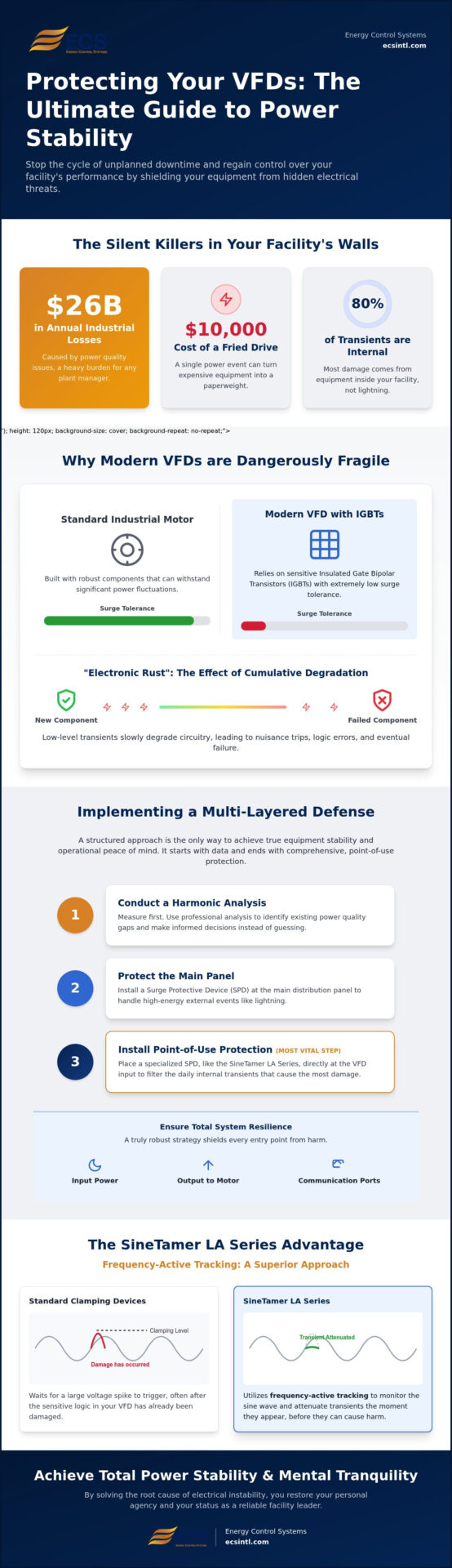
Did you know that power quality issues cause a staggering $26 billion in annual industrial losses? It’s a heavy burden for any plant manager to carry. You’ve likely stood over a fried $10,000 drive, feeling the weight of unplanned downtime while production grinds to a halt. Protecting VFDs from power surges isn’t just about preventing a rare lightning strike; it’s about shielding your micro-circuitry from the 80% of transients generated right inside your own walls. We understand the stress of constant equipment failure and the desire to regain control over your facility’s performance.
This guide will show you how to move beyond basic fuses to achieve genuine mental tranquility. You’ll discover how the SineTamer LA Series filters the hidden noise that standard devices miss. We’ll preview the 2026 NEC requirements and outline a total protection strategy that restores your operational agency and secures your equipment’s future.
Key Takeaways
- Understand why sensitive IGBT components in your drives are uniquely vulnerable to low-level electrical noise that standard fuses and filters simply cannot stop.
- Learn how a multi-layered defense, beginning with professional harmonic analysis, provides the most robust method for protecting VFDs from power surges.
- Discover the SineTamer LA Series advantage, which utilizes frequency-active tracking to eliminate the “micro-surges” that quietly degrade your equipment.
- Stop the cycle of unplanned downtime and restore your status as a reliable facility leader by achieving total power stability and mental tranquility.
Why VFDs are Vulnerable to Power Surges and Transients
Imagine the frustration of a sudden line stop. You’re looking at a $10,000 drive that’s now a paperweight because of a $50 power event. It’s a high-stakes gamble you didn’t sign up for. A modern Variable-frequency drive (VFD) is a marvel of efficiency, but its reliance on sensitive Insulated Gate Bipolar Transistors (IGBTs) creates a massive vulnerability. These solid-state components have incredibly low surge tolerance. While they provide precision control, they’re easily overwhelmed by energy levels that standard industrial motors wouldn’t even notice. Effectively protecting VFDs from power surges requires a deep understanding of these electronic vulnerabilities.
Most people worry about lightning, but that’s rarely the primary culprit. Research shows up to 80% of damaging transients are generated internally. Every time a large motor starts or a welder strikes an arc, it sends a spike through your system. These daily switching transients are the silent killers. They don’t always cause an immediate explosion. Instead, they create electrical noise that confuses the drive’s logic. This leads to those maddening nuisance trips and resets that ruin your production schedule and your peace of mind.
The Fragility of Modern Variable Frequency Drives
Low-level transient voltage surges (TVS) act like electronic rust on your VFD’s internal circuitry. They cause cumulative degradation that standard protection fails to catch. Protecting VFDs from power surges requires more than just a simple fuse. You need a solution that understands the precision power needs of solid-state electronics. Standard industrial equipment simply isn’t built to handle these micro-events. We’re here to help you stop that cycle and restore stability to your plant floor. It’s about giving you back the agency to run your facility without fear of the next power dip.
Implementing a Multi-Layered VFD Surge Protection Strategy
You don’t have to live in a state of constant anxiety over the next power dip. Real equipment stability comes from a structured, multi-layered approach. It starts with measurement. First, conduct a harmonic analysis to identify existing power quality gaps. This data gives you the agency to make informed decisions rather than guessing. Next, install a surge protective device at the main distribution panel to handle high-energy external events.
The most vital step for protecting VFDs from power surges is point-of-use protection. We recommend installing the SineTamer LA Series directly at the drive input. Many facility managers mistakenly rely on fast-acting fuses. While fuses are a critical safety feature to prevent fires, they’re simply too slow to stop the microsecond voltage transients that destroy solid-state electronics. A fuse is a seatbelt; an SPD is a protective shield. Achieving this level of security is the first step toward restoring your status as a reliable leader in the plant.
Protecting Input, Output, and Communication Ports
A truly resilient system shields every entry point. Input protection guards against utility-side spikes and the daily noise from heavy machinery switching. On the other side, output protection prevents reflected waves from damaging motor windings. Don’t overlook your communication ports. Corrupted SCADA and PLC signals can cause just as much chaos as a physical hardware failure. Protecting VFDs from power surges across all ports ensures total operational tranquility. If you’re ready to secure your facility’s future, consider starting with a professional harmonic analysis to map your path to stability.
Achieving Operational Peace of Mind with SineTamer LA Series
You shouldn’t have to spend your weekends worrying about Monday morning failures. While standard clamping devices wait for a massive voltage spike to trigger, the damage to your drive’s sensitive logic has often already begun. The SineTamer LA Series offers a fundamentally different approach. It utilizes frequency-active tracking to monitor the sine wave and attenuate transients the millisecond they appear. This precision is why it remains the gold standard for protecting VFDs from power surges. Since 1987, Energy Control Systems has served as a veteran protector in this field, bringing battle-tested expertise to facilities worldwide.
Consider the true ROI of uptime. It isn’t just about the replacement cost of the hardware; it’s about the relief of never having to justify a catastrophic production halt to your team again. When you solve the root cause of electrical instability, you restore your personal agency and your status as a reliable facility leader. By prioritizing protecting VFDs from power surges, you stop being the person who manages crises and start being the one who prevents them. It’s a powerful shift that brings immediate mental tranquility to your workday.
The Long-Term Value of Precision Surge Suppression
Moving from reactive maintenance to proactive power quality management changes your entire operational outlook. Standard industrial solutions often fail to address the high-frequency noise that quietly degrades modern electronics over time. SineTamer acts as a steady hand in a chaotic electrical landscape, filtering out the disturbances that other devices simply miss. By choosing this level of precision, you’re making a long-term investment in your plant’s stability. You have a right to a stress-free work environment, and we’re here to help you secure it.
Restore Your Operational Agency
You have the power to stop the cycle of equipment failure. By understanding that internal transients cause the majority of damage, you’ve already taken the first step toward stability. We’ve shown how the SineTamer LA Series provides a protective shield that standard clamping devices simply cannot match. Protecting VFDs from power surges is a long-term investment in your facility’s reputation and your own mental tranquility.
Since 1987, Energy Control Systems has been a veteran protector for industrial leaders worldwide. Our proprietary frequency-tracking technology is designed to eliminate the internal noise that accounts for up to 80% of damaging transients. Secure your VFDs today with the SineTamer LA Series and reclaim your status as a reliable facility expert. You deserve a stress-free work environment; it’s time to build it together.
Frequently Asked Questions
Can fast-acting fuses protect my VFD from a power surge?
No, fast-acting fuses won’t work for protecting VFDs from power surges. Fuses are critical safety components meant to prevent fires during overcurrent events. However, they’re simply too slow to stop microsecond transients. By the time a fuse reacts, the high-voltage spike has already reached your sensitive drive components. You need a dedicated shield to ensure your facility remains stable and productive.
What is the difference between a surge and a transient in VFD systems?
A surge is typically a high-energy event coming from the utility grid or lightning. Transients are faster, high-frequency spikes that usually happen inside your facility when large loads cycle. While surges are catastrophic, daily transients are the “silent killers” that confuse VFD logic and cause nuisance trips. Both threats require a proactive power quality management strategy to restore your operational peace of mind.
Where is the best place to install a surge protector for a VFD?
You should always implement a multi-layered defense. Start by installing a surge protective device at your main distribution panel to catch external spikes. Next, place point-of-use protection directly at the VFD input. This targeted approach stops internally generated noise before it can degrade your electronics. It’s a proven way to regain personal agency and protect your status as a reliable plant leader.
How does the SineTamer LA Series differ from a standard SPD?
Standard SPDs use basic clamping that only triggers at high voltage levels. The SineTamer LA Series uses proprietary frequency-active tracking to monitor the sine wave and attenuate transients as they occur. This precision is vital for protecting VFDs from power surges that standard devices miss. It effectively eliminates the electrical noise that leads to cumulative equipment damage and costly, unplanned production downtime.

Article by
Jeff Edwards
Founder of ECS International Inc. Edwards travels and speaks extensively in Latin America, Asia and Africa on the subject of power quality; transients and mitigating their impact on profitability. After graduating from Texas Tech University in Lubbock Texas, Edwards spent 9 years in the Telecommunications sector prior to founding Energy Control Systems in 1987 as a Texas based corporation selling surge suppression and UPS systems. The company has evolved into a global power quality products and energy efficiency concern with operations spanning South America, Asia, Europe and Africa.
Disclaimer
Some of the above information may be the opinion of the author.